
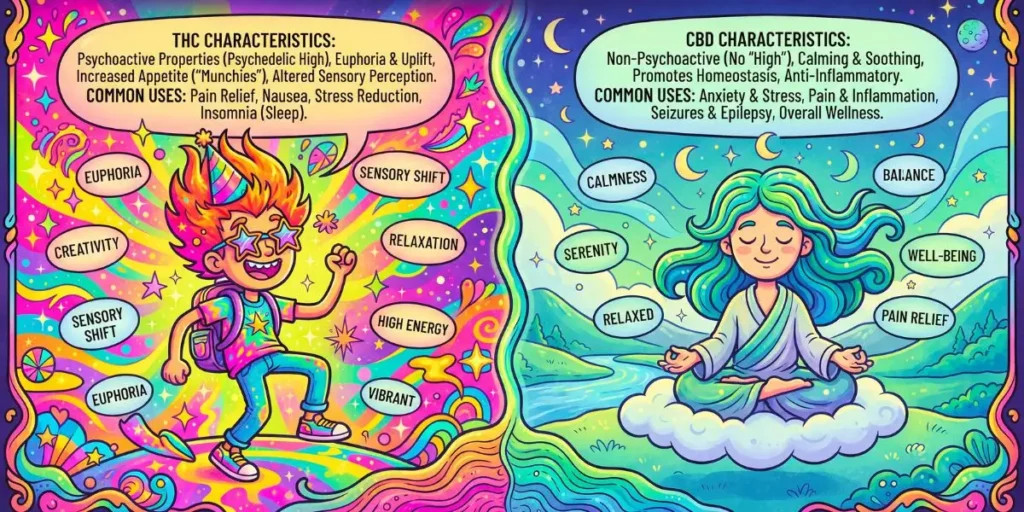
If you have ever stood in front of a dispensary shelf, scrolled through an online wellness shop, or tried to decode a cannabis label, you have probably asked the same question: What is the real difference between THC and CBD, and which one should I actually choose? The answer is not simply “one gets you high and the other does not.” THC and CBD are two naturally occurring cannabinoids with overlapping benefits, distinct risks, different legal profiles, and very different effects on the mind and body.
This guide breaks down the CBD vs THC difference in plain, human terms. You will learn how each one works, how they compare for anxiety and depression, how edibles change the experience, what a CBD vs THC chart looks like, and how other cannabinoids such as CBG and CBN fit into the picture. By the end, you should have a much clearer idea of whether CBD, THC, or a balanced combination is right for your goals.
First, What Are THC and CBD?
THC, short for delta-9-tetrahydrocannabinol, is the main psychoactive compound in cannabis. It is the molecule responsible for the classic “high” feeling: euphoria, altered perception, relaxation, increased appetite, and sometimes anxiety or paranoia at high doses.
CBD, short for cannabidiol, is the second most abundant cannabinoid in cannabis. Unlike THC, CBD is non-intoxicating. It does not make you feel stoned, but it does interact with the nervous system in ways that may influence stress, sleep, pain perception, inflammation, and mood.
Both compounds come from the same cannabis plant, and both interact with the body’s endocannabinoid system, a complex network of receptors and signaling molecules that helps regulate balance in the brain and body. However, they interact with that system differently. This is the foundation of the CBD vs THC difference.
How Do They Work in the Body?
To understand the difference, it helps to know about the endocannabinoid system (ECS). The ECS is a network of receptors and signaling molecules that helps regulate mood, pain, sleep, appetite, immune response, and memory. Your body produces its own endocannabinoids, but plant-derived cannabinoids can also influence this system.
THC has a strong affinity for CB1 receptors, which are concentrated in the brain and central nervous system. When THC binds to these receptors, it triggers a cascade of effects—dopamine release, altered sensory perception, relaxation, and increased hunger. That direct binding is why THC produces such noticeable psychoactive effects.
CBD, on the other hand, has low affinity for CB1 and CB2 receptors. Instead of binding directly, it appears to modulate how receptors respond to other cannabinoids. CBD may reduce the anxiety or paranoia some people feel from THC by influencing receptor activity and increasing levels of the body’s own endocannabinoids, such as anandamide. It also interacts with serotonin receptors, which may explain its calming and mood-related effects.
This difference in receptor activity is the core reason one compound gets you high and the other does not.
Psychoactive Effects: Why THC Gets You High and CBD Doesn’t
The most obvious distinction between the two is intoxication. THC is psychoactive; CBD is not.
When you consume THC, especially in higher doses, you may experience:
- Euphoria or a sense of well-being
- Altered perception of time and space
- Increased appetite (the “munchies”)
- Drowsiness or sedation
- Dry mouth and red eyes
- Anxiety or paranoia in some people
These effects can be enjoyable for some, but overwhelming for others. The intensity depends on dose, method of consumption, individual tolerance, and whether CBD is also present.
CBD, by contrast, does not produce a high. Most people describe its effects as subtle: a quieting of mental noise, a softening of physical tension, or improved sleep. You can take CBD during a workday and generally remain clear-headed, though high doses may cause drowsiness.
That does not mean CBD is inert. It simply works in the background, influencing mood and inflammation without dramatically altering perception.
The Core CBD vs THC Difference Explained
At the molecular level, THC and CBD share the same chemical formula: C21H30O2. But their atoms are arranged differently, which means they fit into different receptors in the body like two keys with completely different shapes.
THC binds strongly to CB1 receptors in the brain and central nervous system. That strong binding is what produces intoxication, changes in short-term memory, altered time perception, and the characteristic high.
CBD has a much lower affinity for CB1 receptors. Instead, it influences a broader range of receptor systems, including serotonin receptors, TRPV1 pain receptors, and adenosine receptors. It also appears to modulate how THC binds to CB1 receptors, which is why some people take CBD alongside THC to reduce THC-related anxiety or overstimulation.
In practical terms, the core CBD vs THC difference comes down to three things:
- Intoxication: THC is intoxicating; CBD is not.
- Effect on the mind: THC alters perception and can produce euphoria or anxiety; CBD tends to feel calming without mental impairment.
- Legal status: In many places, CBD from hemp with less than 0.3% THC is legal, while THC remains tightly controlled or limited to state-legal medical and adult-use markets.
This does not mean THC is “bad” and CBD is “good.” It simply means they serve different purposes.
CBD vs THC Chart: A Side-by-Side Snapshot
A quick comparison can help you see the difference between THC and CBD at a glance. Use this CBD vs THC chart as a starting point, not a substitute for medical advice.
| Feature | CBD | THC |
|---|---|---|
| Psychoactive? | No | Yes |
| Typical plant source | Hemp or cannabis | Cannabis/marijuana |
| Common goals | Calm, sleep, stress, inflammation, muscle recovery | Pain relief, nausea, appetite, recreation |
| Short-term mental effects | Relaxation without a high | Euphoria, altered perception, possible anxiety |
| Common side effects | Dry mouth, drowsiness, digestive upset | Dry mouth, increased heart rate, paranoia, memory changes |
| Drug test concern | Low if pure CBD isolate; full-spectrum may contain trace THC | High |
| Legal status in the U.S. | Hemp-derived CBD with <0.3% THC is federally legal, but state laws vary | Federally illegal; legal in many state programs |
This chart makes the CBD vs THC difference easy to understand, but it does not capture the nuance. The right choice depends heavily on your personal sensitivity, your reason for using cannabis, and how you consume it.
CBD vs THC for Anxiety: Which Is More Helpful?
Anxiety is one of the most common reasons people turn to cannabis, but the answer is not always straightforward.
CBD has shown promise for anxiety in several small human studies and a growing body of preclinical research. In one widely cited study, people with social anxiety disorder who took CBD before a public speaking test reported significantly less anxiety, cognitive impairment, and discomfort compared with those who took a placebo. The proposed mechanism involves CBD’s interaction with serotonin 5-HT1A receptors and its ability to calm an overactive fear response.
THC has a more complicated relationship with anxiety. At low doses, some people find THC relaxing and mood-lifting. At higher doses, however, THC can trigger or worsen anxiety, racing thoughts, and paranoia. This is sometimes called a biphasic effect: a little may help, too much can make things worse.
If you are exploring CBD vs THC for anxiety, many clinicians and experienced users suggest starting with CBD, especially if you are new to cannabis or prone to panic. If you want to try THC for anxiety, a product with a balanced CBD-to-THC ratio may reduce the likelihood of feeling overwhelmed. The key is to start low, go slow, and pay attention to how your body responds.
CBD vs THC for Depression: What the Evidence Suggests
Depression is another area where people compare CBD vs THC for depression, and the evidence is still evolving.
CBD appears to affect mood through multiple pathways. It may boost serotonin signaling, support neurogenesis in the hippocampus, and reduce inflammation that has been linked to depressive symptoms. Human trials are limited, but early results and animal models are encouraging. CBD is generally well tolerated and is being studied as a potential adjunct to conventional treatments.
THC can produce a temporary mood lift and feelings of euphoria, which may feel helpful in the moment. However, long-term or heavy THC use has been associated with an increased risk of amotivational symptoms, dependence, and worsening mood in some people. THC is not usually considered a first-line option for depression, and its use should be monitored carefully, especially in people with bipolar disorder or a family history of psychosis.
The bottom line for CBD vs THC for depression: CBD is generally viewed as the safer, more sustainable option for daily mood support, while THC may be better reserved for occasional use or for symptoms such as severe nausea and appetite loss that accompany depression.
Difference Between CBD and THC Edibles: Onset, Duration, and Effects
Edibles are one of the most misunderstood categories in cannabis. The difference between CBD and THC edibles goes far beyond whether you feel high.
When you eat a THC edible, THC is metabolized by the liver into a compound called 11-hydroxy-THC. This metabolite crosses the blood-brain barrier more easily than inhaled THC and often produces a stronger, more sedating, and longer-lasting high. THC edibles can take 30 to 90 minutes to kick in, peak after 2 to 4 hours, and leave residual effects for 6 to 12 hours or longer. That delayed onset is why people often make the mistake of eating more too soon.
CBD edibles work differently. Because CBD is non-intoxicating, the experience is subtle. The onset is similarly delayed, usually 45 to 90 minutes, and the effects may last 6 to 8 hours. People often use CBD gummies or capsules for steady, all-day calm, better sleep, or post-exercise recovery. You will not feel high from a CBD edible, even at high doses, although you may feel drowsy if you take too much.
Another key difference is dose. A standard THC edible may contain 5 to 10 milligrams of THC, while a CBD gummy often contains 25 to 50 milligrams or more. The two compounds are not interchangeable. Always read the label carefully and start with a lower dose than you think you need.
THC vs CBD Percentage: Reading Labels Without Confusion
One of the most confusing parts of buying cannabis is understanding the THC vs CBD percentage on a label.
In flower, percentages represent the concentration of a cannabinoid by weight. A strain labeled “20% THC” contains 200 milligrams of THC per gram of dried flower. A strain labeled “10% CBD” contains 100 milligrams of CBD per gram.
In oils, tinctures, and edibles, you will usually see milligrams per serving or milligrams per package. For example, a 30-milliliter tincture might say “1,000 mg CBD” on the front, which means the entire bottle contains 1,000 milligrams of CBD. If the dropper is 1 milliliter, each dropper contains about 33 milligrams of CBD.
When comparing THC vs CBD percentage, consider this:
- High THC, low CBD: Best for people with THC experience seeking strong psychoactive effects, appetite stimulation, or acute pain relief.
- Balanced THC:CBD: Often preferred for chronic pain, anxiety, and people who want therapeutic effects with less intoxication.
- High CBD, low THC or no THC: Best for beginners, daytime use, stress, sleep support, and people who cannot or do not want to feel high.
Full-spectrum CBD products may contain up to 0.3% THC by law. That tiny amount is not enough to produce a high in most people, but it can build up over time and potentially show up on sensitive drug tests. Broad-spectrum and isolate products are options if you want zero detectable THC.
THC vs CBG and THC vs CBN: Where Other Cannabinoids Fit
THC and CBD get most of the attention, but they are not the only cannabinoids worth knowing. You may have seen products advertising CBG or CBN, and it is helpful to understand THC vs CBG and THC vs CBN.
THC vs CBG: CBG, or cannabigerol, is often called the “mother cannabinoid” because other cannabinoids are synthesized from it. Unlike THC, CBG is non-intoxicating. Early research suggests CBG may support focus, gut health, and appetite, and it may have antibacterial and neuroprotective properties. The main difference between THC and CBG is clear: CBG will not make you high, and it tends to feel more energizing or neutral rather than sedating.
THC vs CBN: CBN, or cannabinol, forms when THC degrades over time, especially when exposed to heat and oxygen. CBN is only mildly psychoactive, if at all. Most people associate CBN with sleep and deep relaxation, though the scientific evidence is still limited. Compared with THC, CBN is much less likely to produce euphoria or anxiety, but it may amplify drowsiness, especially when combined with other sedating compounds.
These minor cannabinoids are increasingly used in full-spectrum products to create an “entourage effect,” where the compounds work together more effectively than any single one alone.
How to Choose: CBD, THC, or Both?
Now that you understand the CBD vs THC difference, how do you decide which one you need?
Choose CBD if you want to:
- Reduce everyday stress or occasional anxiety
- Improve sleep quality without feeling groggy
- Support post-exercise recovery and inflammation
- Avoid intoxication
- Use cannabis during work or daytime activities
- Take a consistent daily supplement
Choose THC if you want to:
- Relieve acute pain or muscle spasms
- Stimulate appetite
- Reduce nausea
- Experience euphoria or recreational effects
- Use cannabis for deep, sedating relaxation
Choose a balanced CBD:THC product if you want to:
- Get therapeutic benefits with a gentler high
- Reduce THC-related anxiety
- Manage chronic pain with fewer cognitive side effects
- Sleep deeply without waking up foggy
No matter which direction you lean, start with the lowest effective dose. If you are new to THC, try 2.5 to 5 milligrams. If you are new to CBD, 10 to 25 milligrams is a common starting range. Wait at least two hours before taking more of an edible, and longer if you are trying a new product.
Medical Benefits and Approved Uses
Both compounds have potential therapeutic properties, but the strength of scientific evidence varies.
CBD: Evidence and Approved Uses
CBD has one FDA-approved medication: Epidiolex, used to treat rare forms of epilepsy (Lennox-Gastaut syndrome and Dravet syndrome). This approval was a milestone because it confirmed CBD’s medical value in controlled clinical trials.
Beyond seizures, research and anecdotal reports suggest CBD may help with:
- Anxiety and stress: Many users report a calming effect. Some studies suggest CBD may reduce social anxiety and improve sleep.
- Inflammation and pain: CBD is widely used in topical creams and oral products for joint pain, muscle soreness, and arthritis. Evidence is promising but still developing.
- Sleep: CBD may improve sleep indirectly by reducing anxiety or pain. It is not a sedative like THC, but some people feel more relaxed and ready for bed.
- Neurological conditions: Early research is exploring CBD for Parkinson’s disease, multiple sclerosis, and other conditions, but more studies are needed.
The World Health Organization has noted that CBD is generally well tolerated and has a good safety profile, which has helped it gain widespread acceptance.
🔥 Stack your savings. Elevate your session. 10% off $100, up to 25% off $450.
🔥 Roll into the menu and start saving. CLICK HERE!
THC: Evidence and Approved Uses
THC also has FDA-approved medications, such as dronabinol (Marinol) and nabilone (Cesamet), prescribed for chemotherapy-induced nausea and vomiting, and for appetite stimulation in people with HIV/AIDS.
THC may also be helpful for:
- Chronic pain: Many patients find THC or THC-dominant products effective for nerve pain, fibromyalgia, and cancer-related pain.
- Nausea and appetite loss: THC is a powerful anti-nausea agent and appetite stimulant.
- Muscle spasticity: Some people with multiple sclerosis report relief from muscle spasms with THC-containing products.
- Insomnia: THC often causes drowsiness and can help people fall asleep, though it may reduce REM sleep.
It is important to note that cannabis research has historically been limited by legal restrictions. As laws change, more clinical trials are emerging.
Side Effects and Safety Profiles
No substance is risk-free. Understanding the side effects helps you make an informed choice.
THC Side Effects
THC’s side effects are often dose-dependent:
- Dry mouth
- Red eyes
- Increased heart rate
- Dizziness or lightheadedness
- Impaired short-term memory
- Slowed reaction time
- Anxiety or paranoia
- Nausea in rare high doses
Long-term heavy use, especially when started in adolescence, has been associated with cognitive changes and an increased risk of mental health issues in vulnerable individuals. THC can also impair driving and should never be used before operating machinery.
CBD Side Effects
CBD is generally well tolerated, but it can cause:
- Fatigue or drowsiness
- Diarrhea
- Changes in appetite
- Dry mouth
- Low blood pressure in high doses
A significant concern with CBD is drug interactions. CBD can inhibit liver enzymes (particularly CYP450) that metabolize many medications, potentially increasing their levels in the blood. If you take prescription medications, especially blood thinners, anti-seizure drugs, or antidepressants, consult a healthcare provider before using CBD.
Legal Status: Hemp vs Marijuana
Legal status is one of the most confusing parts of the THC vs CBD conversation. The key distinction often comes down to the source and the amount of THC.
In the United States, the 2018 Farm Bill legalized hemp—cannabis containing less than 0.3% THC—at the federal level. This made hemp-derived CBD legal in most states, though some states have additional restrictions on certain product types or require labeling.
THC from marijuana remains a Schedule I controlled substance under federal law, but many states have legalized it for medical or adult-use. This creates a patchwork of laws: a product legal in California may be illegal in Texas. Always check your local regulations before purchasing or traveling with any cannabis product.
Internationally, laws vary even more. Some countries allow CBD but not THC; others prohibit all cannabis-derived products. If you travel, do not assume your CBD oil is legal everywhere.
Drug Testing Considerations
This is a crucial factor for many people. Most standard drug tests do not look for CBD. They screen for THC or its metabolites.
If you use pure CBD isolate with no THC, you are unlikely to fail a drug test. However, many CBD products are full-spectrum or broad-spectrum. Full-spectrum products contain small amounts of THC (up to 0.3% legally). Over time, even trace amounts can build up in your body and potentially trigger a positive test, especially if you use high doses daily.
Broad-spectrum products have most cannabinoids but no detectable THC, making them a safer choice for people concerned about testing. Still, mislabeling and cross-contamination can occur, so choose brands that provide third-party lab results.
THC, on the other hand, is detectable in urine, blood, saliva, and hair for varying periods. Occasional users may test positive for a few days; heavy users may test positive for several weeks.
If your job or sport requires drug testing, CBD isolate or broad-spectrum CBD is usually the safer option—but verify the product’s certificate of analysis.
Which One Do You Need? A Decision Guide
There is no universal answer. The right choice depends on your goals, your body, and your circumstances.
Choose CBD if you want:
- Relief from everyday stress or mild anxiety without feeling high
- Support for inflammation, joint discomfort, or muscle soreness
- A non-intoxicating option you can use during the day
- A legal, widely available product in most regions
- A product unlikely to cause a failed drug test (choose isolate or broad-spectrum)
Choose THC if you want:
- Stronger pain relief, especially for nerve or chronic pain
- Help with nausea, vomiting, or appetite loss
- Deep relaxation or sedation for insomnia
- A euphoric or recreational experience
- You live in a place where THC is legal and you do not have drug testing concerns
Consider a combination if you want:
- The entourage effect—the theory that cannabinoids work better together than alone
- A balanced experience with less anxiety than THC alone
- Targeted relief with fewer side effects from either extreme
Many people start with CBD because it is lower risk and non-intoxicating. If that does not provide enough relief, they may explore low doses of THC or a balanced product under medical guidance.
Ways to Take THC and CBD
Both compounds come in many forms. The method affects how quickly you feel effects and how long they last.
- Oils and tinctures: Placed under the tongue for fast absorption (15–45 minutes). Easy to adjust dose.
- Edibles and capsules: Slower onset (30–90 minutes) but longer lasting (4–8 hours). Good for sustained relief.
- Vapes and flower: Fast onset (minutes) but shorter duration. Inhalation may carry respiratory risks.
- Topicals: Creams, balms, and patches applied to the skin. Good for localized pain or inflammation; no high from THC topicals because they do not reach the bloodstream in significant amounts.
- Beverages: A growing category, with effects similar to edibles but often faster.
When starting with either compound, begin with a low dose and wait before taking more. Edibles, in particular, can take a long time to kick in, leading people to overconsume.
Common Myths and Safety Notes
Myth: CBD is harmless because it is natural.
CBD is generally well tolerated, but it can cause drowsiness, dry mouth, and digestive upset. It can also interact with certain medications, especially blood thinners and drugs processed by the CYP450 liver pathway. Talk to a pharmacist or doctor if you take prescription medication.
Myth: THC is dangerous and CBD is safe.
THC has risks, especially for people with a history of psychosis, heart conditions, or anxiety disorders. But many people use THC responsibly for pain, nausea, and relaxation. Context, dose, and individual biology matter.
Myth: All CBD products are the same.
Quality varies widely. Look for products that have been tested by an independent third-party lab, clearly state THC content, and list the actual amount of CBD per serving. Avoid products with vague labeling or no certificate of analysis.
🔥 Stack your savings. Elevate your session. 10% off $100, up to 25% off $450.
🔥 Roll into the menu and start saving. CLICK HERE!
Conclusion
The CBD vs THC difference is not a simple good-versus-bad story. CBD offers a non-intoxicating option for people seeking calm, sleep support, and everyday balance. THC offers stronger psychoactive effects that can be valuable for pain, appetite, nausea, and recreation, but it carries a higher risk of anxiety and impairment. Edibles, percentages, and minor cannabinoids like CBG and CBN add even more nuance.
If your goal is to stay clear-headed while managing stress, sleep, or mild discomfort, CBD is often the better first choice. If you are comfortable with altered perception and have access to safe, legal products, THC may be worth exploring at low doses. For many people, a balanced combination provides the best of both worlds.
Whatever you choose, respect the dose, read the label, and listen to your body.
FAQs
Is CBD or THC better for anxiety?
CBD is generally considered the safer first option for anxiety because it does not cause intoxication and may reduce the body’s stress response. THC can help some people relax at low doses, but higher doses can trigger or worsen anxiety. If you try THC for anxiety, start with a very low dose or choose a balanced CBD:THC product.
What is the main CBD vs THC difference?
The main difference is that THC is psychoactive and produces a high, while CBD is non-intoxicating. THC binds strongly to CB1 receptors in the brain, causing euphoria and altered perception. CBD interacts more broadly with the nervous system without producing intoxication.
What is the difference between CBD and THC edibles?
THC edibles produce a strong, long-lasting high because the liver converts THC into a more potent metabolite. CBD edibles do not get you high and are typically used for steady, subtle effects such as calm and sleep support. Both have a delayed onset, usually 30 to 90 minutes.
Can CBD or THC help with depression?
CBD may support mood through serotonin signaling and anti-inflammatory pathways, and it is generally better tolerated for daily use. THC can lift mood temporarily, but heavy or frequent use may worsen depression in some people. Neither should replace professional mental health treatment.
What is a typical THC vs CBD percentage in products?
It varies widely. Cannabis flower may contain anywhere from less than 1% to over 25% THC, while hemp flower may have 10% to 20% CBD and less than 0.3% THC. Tinctures and edibles are usually labeled by milligrams per serving rather than percentage, so check the packaging carefully.
How do THC vs CBG and THC vs CBN compare?
THC is psychoactive, CBG is non-intoxicating and often associated with focus and gut health, and CBN is mildly sedating and linked to sleep. CBG and CBN are considered minor cannabinoids and are usually used alongside CBD or THC rather than as direct replacements.
Will CBD show up on a drug test?
Pure CBD isolate should not show up on a standard drug test, but full-spectrum CBD products contain trace amounts of THC. With regular use, that THC can accumulate and potentially trigger a positive result. If drug testing is a concern, choose broad-spectrum or isolate products.
Is it safe to mix CBD and THC?
For many people, mixing CBD and THC is safe and can reduce THC-related anxiety while enhancing therapeutic effects. This is often called the entourage effect. Start with a low dose of each and adjust slowly. If you have a medical condition or take medication, consult a healthcare provider first.
Is CBD psychoactive?
No, CBD is not psychoactive in the way THC is. It does not produce a high or euphoria. However, it can affect mood, anxiety, and sleep, which some people describe as a subtle mental shift.
Will CBD make me fail a drug test?
It depends on the product. Pure CBD isolate or broad-spectrum CBD with no THC is unlikely to cause a positive result. Full-spectrum CBD contains trace THC, which could accumulate and trigger a positive test. Always check third-party lab results.
Can I take THC and CBD together?
Yes, many people use both together. CBD may reduce THC-induced anxiety and paranoia while enhancing certain therapeutic effects. This is often called the entourage effect. Start with a higher CBD-to-THC ratio if you are sensitive.
Which is better for anxiety?
CBD is generally considered the first choice for anxiety because it is non-intoxicating and well tolerated. THC can sometimes worsen anxiety, especially at high doses or in people prone to panic. A low dose of THC combined with CBD may help some individuals, but it is more variable.
Which is better for pain?
Both can help with pain, but the type of pain matters. CBD may be enough for mild inflammatory pain or everyday soreness. THC is often more effective for severe, chronic, or nerve-related pain. A combination may provide the most relief.
Is THC legal where I live?
THC legality varies widely. In the United States, it is legal for adult use in many states, medical use in others, and still illegal in some. Check your state and local laws. Internationally, laws range from fully legal to strictly prohibited.
How long do the effects last?
Inhalation effects peak within minutes and last 1–3 hours. Edibles take 30–90 minutes to onset and can last 4–8 hours or longer. CBD oils typically last 4–6 hours. Duration depends on dose, metabolism, and method.