
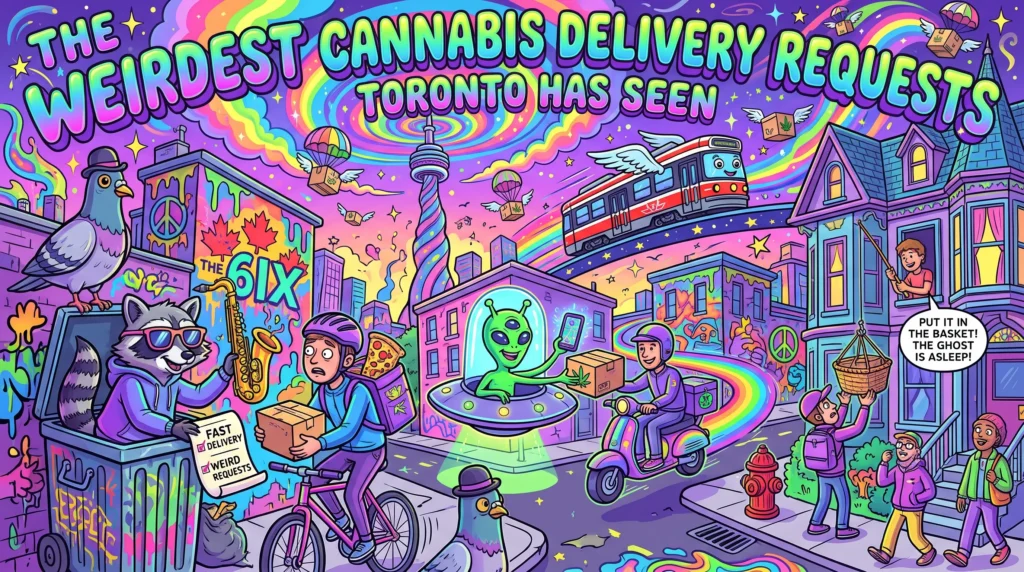
It’s 9:52 p.m. on a Tuesday in October, and a courier is standing outside a Liberty Village condo tower reading a delivery note for the third time because he’s sure he misread it.
“I’m on the balcony in the inflatable dinosaur costume. Wave twice.”
He waves twice. The T. rex waddles inside, then reappears in the lobby eleven minutes later, breathing hard, ID tucked into a taped-on plastic sleeve on the costume’s useless little arm. Nineteen-plus, verified. Order handed over. Everybody happy.
Then comes the follow-up request, the one that actually breaks something: “Next time can you just throw it up to me? The head takes forever to get off.”
No. He can’t. And that single exchange explains this entire genre.
Toronto’s strangest cannabis delivery requests are rarely criminal. They’re creative — and creativity keeps colliding with three extremely uncreative things: a federal possession cap, an Ontario hand-off rule, and a human being on an e-bike with an insulated bag and a nine-minute delivery window.
Here’s what you’ll get in this article:
- The 2013 tweet that ended a career, and how Toronto went from that to ordering cannabis on a food app.
- The weirdest request categories, sorted by legal but absurd, legal in theory but refused, and flatly illegal.
- The strange things that happen on the courier’s side of the door — including a five-figure shipment that vanished.
- Two verdict tables and the actual Ontario numbers: 19, 25, 30 grams, 10 milligrams, 11 p.m.
- A step-by-step method for placing an unusual order that still gets delivered, plus a composite case study of a 9:40 p.m. wedding rescue.
🔥REFER A FRIEND
THEY GET 10% OFF THEIR FIRST ORDER🔥
The 2013 tweet that ended a career
Long before Toronto had licensed couriers, a car repair shop employee north of the city decided a slow Tuesday called for a joint. He didn’t text a contact. He didn’t walk to a corner. He posted a public tweet asking for weed to be delivered to his Vaughan workplace.
York Regional Police saw it. They retweeted it with a reply that has aged into local folklore: “Awesome! Can we come too?” He reportedly lost his job by that afternoon.
Cannabis was still illegal then. But look closely at the request itself — bring weed to my job — and you’ll notice it was already painfully ordinary. The weirdness lived entirely in the method. That’s still true today. The method is where people get creative, and the method is where the rules bite.
How Toronto made weed delivery boring
Three milestones turned a criminal risk into a Tuesday errand:
- October 17, 2018 — the federal Cannabis Act takes effect. Ontario sets the adult age at 19.
- October 2022 — Uber Eats and Leafly switch on cannabis ordering in Toronto, billed as the first time a mainstream delivery app facilitated legal cannabis sales anywhere in the world. The app handles discovery and ordering; the licensed retailer’s staff still perform the hand-off and the ID check.
- The mid-2020s — Ontario climbs past roughly 1,800 licensed cannabis stores, a count that had already overtaken the province’s Tim Hortons locations. Canadian outlets reported that milestone with visible delight. The number keeps moving; check the AGCO registry for the current picture.
The people doing the work changed too. Ontario retail staff must hold CannSell certification before they can sell — and that includes the employee driving to your door with a tracking link and a 1–2 hour delivery window.
The guy who knew a guy now has a certification, a route, and a paper trail. That’s exactly why the strange requests stand out. When the baseline is that scripted, anything off-script becomes a story.
What makes a cannabis delivery request “weird” in Toronto?
A request crosses into “weird” territory the moment it asks a licensed retailer to bend one of three fixed constraints: the hand-off must reach a verified adult, the order must stay under the legal possession ceiling, and the delivery must happen at the address on the order, inside Ontario, within permitted hours. Everything else — costumes, canoes, chaos, emotional breakdowns in the order notes — is logistics and theatre.
That distinction matters, because readers assume the strange requests are the illegal ones. They usually aren’t. A guy asking for delivery to a paddleboard is doing something legal in a stupid way. A guy asking for a pound at midnight is doing something illegal in a confident way. Dispatchers treat those very differently.
Quotable rule of thumb: In Toronto, weird isn’t the same as illegal — weird is legal plus imagination, minus a loading dock.
The weirdest requests, sorted by how fast they get refused
“I’ll paddle out. Just drop it at the water’s edge.”
Harbourfront, a July long weekend, a customer on a rented paddleboard roughly 40 metres offshore, waving like a castaway. The note asked the courier to leave the sealed bag under a specific rock.
Verdict: refused. Unattended drops aren’t permitted. Age verification happens face-to-face, not rock-to-rock. The legal alternative is boring and effective: order to the address, meet the courier at the entrance, then go be a human buoy.
Field note: Water is the most common “creative geography” problem in this city — paddlers, sailors, and Toronto Islands visitors all try it. The islands are car-free, the ferry is a schedule, and no licensed courier is chasing you across a channel.
“Toss it over the fence, I’ll grab it after my shower.”
Variants: leave it in the mailbox, hide it behind the planter, put it in the recycling bin, “the door’s unlocked, third floor, follow the smell of pasta.”
Verdict: refused, every time — and it costs you. The hand-off requires an adult who can prove they’re 19 or older. A doorstep is not an adult. When nobody eligible is home, the order goes back to the store, and you’re looking at a redelivery attempt or a cancellation instead of an evening.
“Tell the concierge it’s aromatherapy.”
This one shows up weekly in condo-heavy neighbourhoods, and it comes in two flavours: the cover story, and the hopeful workaround of “just leave it with the front desk.”
Verdict: the lie is unnecessary, and the workaround is prohibited. A concierge, doorman, or front-desk clerk cannot legally receive a cannabis order on a resident’s behalf. Licensed cannabis already arrives in plain, unbranded, sealed packaging, so there’s nothing to disguise. Some downtown buildings have learned this the hard way and now post notices or brief staff to refuse cannabis packages outright — which means the workaround can get your driver turned away at the door before you even get a text.
“Can you bring a pound? Tonight.”
Verdict: illegal, and it’s not close. Adults in Ontario may possess up to 30 grams of dried cannabis or its equivalent in public, and licensed sellers cap a single order at that ceiling. A pound is roughly 454 grams — more than fifteen times the public limit. The cap governs what you carry in public, not what sits in your cupboard at home, but no licensed retailer will sell or deliver bulk like that in one shot.
Anyone offering it is not licensed. That’s the tell.
“I need a 500 mg gummy. The strong ones.”
Verdict: the product doesn’t exist legally in Canada. Federally, edible cannabis packages are capped at 10 mg of THC per package. Not per gummy — per package. A “500 mg” edible is an illicit-market product, full stop.
Here’s the nuance most articles skip: buying fifty legal 10 mg packages isn’t automatically illegal, because edibles convert to dried-equivalent at a generous rate. Under the Cannabis Act’s equivalency schedule, 15 grams of edible product equals 1 gram of dried cannabis — so roughly 450 grams of gummies would exhaust the 30-gram public limit.
Pro tip from the counter: The 10 mg cap exists for a reason. Edibles can take 30 minutes to two hours to kick in, and the effect outlasts smoking by a wide margin. Health Canada’s guidance is start low, go slow. Fifty packages is a shopping decision, not a dosage plan — and “it didn’t work after 20 minutes” is how the worst evenings of people’s lives begin.
“Meet me at the gate. Actually, can you drive it to Buffalo?”
Verdict: hard no, and this is the serious one. Taking cannabis across an international border is illegal even when the destination has legalized it — Washington State, Michigan, New York included. CBSA and U.S. Customs treat it as smuggling, and consequences run from seizure to lifetime entry bans.
Airport requests get a softer no. Domestic possession is legal, but couriers deliver to addresses, not security lines.
“It’s 2:40 a.m., the afterparty needs you.”
Verdict: refused on two grounds. Legal cannabis delivery in Ontario runs 9:00 a.m. to 11:00 p.m., and staff must refuse sales to anyone who appears intoxicated. The 2 a.m. call is, almost by definition, both late and slurred.
“Bring a live plant. To a funeral. In an Uber.”
Three requests wearing a trench coat. Seeds and small plants are sold through licensed channels, and Ontario households may grow up to four plants per residence — so the plant is fine. The venue may have its own rules, ride-share drivers can refuse cargo, and a seedling in a February wind is a horticultural tragedy.
Verdict: legal, logistically cursed. Deliver the plant home. Send flowers to the funeral.
“Can you put it in with my pizza order?”
The dream is one doorbell, two vices. And since 2022 it sounds plausible, because cannabis genuinely is listed on Uber Eats in Toronto.
Verdict: still not possible. Cannabis orders and restaurant orders are separate baskets with separate fulfilment: one is picked and handed over by the licensed store’s certified staff, the other by a food courier. No shared bag, no combined ETA. Order both, tip both, accept two knocks.
“Can you also grab chips? And a lighter?”
A 3.5-gram order, plus a request to swing past the convenience store for rolling papers, a lighter, and — in one memorable retelling — a bag of salt-and-vinegar chips.
Verdict: refused, and it’s a structural no, not a rudeness no. Ontario deliveries must originate from the store’s own inventory and go to the address on the order. A detour for unrelated errands blurs a regulated cannabis hand-off into an unlicensed errand service, and no retailer will risk its licence for snacks. Buy accessories from the store’s own menu or buy them yourself.
“Come up to room 1207 and knock twice.”
Hotel deliveries occupy a genuine grey zone that most coverage gets wrong. A hotel room counts as a private place under Ontario’s framework, so delivering to a hotel isn’t automatically prohibited. The obstacle is policy, not law: many couriers run a lobby-only or “red door” rule for hotels, offices, and high-security buildings, and won’t ride the elevator to your floor.
Verdict: legal, refused at the elevator. Expect a polite text asking you to come down. And remember the building’s own rules — most Toronto hotels are entirely smoke-free, balconies included.
“Deliver it to my ex. As a gift.”
Verdict: legal in principle, refused in practice. Adults can legally share cannabis within the possession limit, so gifting isn’t the crime people assume. But delivery still requires a willing, present, ID-verified adult who accepts the package — and an ambush gift rarely meets the “willing” part. Nobody wants to be the courier in that story.
Verdict table: what gets delivered, what gets refused, and why
| The request | Verdict | What decides it | The version that works |
|---|---|---|---|
| Leave it under a rock / on the porch | Refused | Hand-off requires a verified adult, 19+ | Meet the courier at the entrance |
| Toss it up to the balcony | Refused | Same hand-off rule; safety | Come down; keep the costume on |
| Leave it with the concierge | Prohibited | Front desk cannot legally accept for a resident | Meet in the lobby yourself |
| One pound, tonight | Illegal | 30 g dried-equivalent public limit | Order within the legal ceiling |
| A single 500 mg gummy | Illegal product | 10 mg THC per edible package (federal) | Multiple legal 10 mg packages, dosed carefully |
| Cross-border run to the U.S. | Illegal | Export prohibition; CBSA/CBP enforcement | Don’t. Ever. |
| 3 a.m. afterparty drop | Refused | Delivery hours 9 a.m.–11 p.m.; intoxication refusal rule | Order before the cutoff |
| Live plant to an event venue | Legal, messy | Venue policy + courier limits | Deliver plants to your residence |
| Combine with a pizza order | Not possible | Separate baskets, separate fulfilment | Two orders, two tips |
| Add chips and a lighter | Refused | Delivery must come from store inventory | Buy accessories on the same menu |
| Come up to the hotel room | Legal, refused | Courier lobby-only policies | Meet downstairs |
| Surprise gift to an ex | Legal in theory | Recipient must be present, verified, willing | Ask first, then order to their address |
When the weirdness comes from the other side of the door
Not every strange delivery story starts with a customer. Sometimes the script gets rewritten by the person holding the bag — or by a warehouse routing error.
The courier with a script of his own
One Toronto customer reported getting the same driver twice in a row. Both times, the driver opened with a house rule: every customer has to smile, or he can’t complete the transaction. Then he listed accepted payment methods — cash, card, and, casually, “organs.”
It was a joke. Obviously. But it captures something the rules-only articles miss: the hand-off is a brief, human, thirty-second interaction, and couriers who bring charm to the door get remembered long after the product is gone. The regulatory part is rigid. The human part isn’t.
The five-figure detour
Here’s the story that sober people tell. A licensed Toronto retailer reportedly had roughly $10,000 worth of cannabis delivered to the wrong store in late December — and then watched it disappear. (Reported account; treat the figure as unverified until matched to a primary source.)
The lesson scales down neatly. A misdirected pizza is an inconvenience. A misdirected cannabis shipment is a five-figure loss attached to a regulatory paper trail, which is precisely why the industry is obsessive about addresses, unit numbers, and name-matched ID. The same verification chain that protects a pallet protects your 3.5 grams. When a driver insists on the exact address and your physical ID, you’re watching that system work at retail scale.
🔥 Stack your savings. Elevate your session. 10% off $100, up to 25% off $450.
🔥 Roll into the menu and start saving. CLICK HERE!
Five requests that sound perfectly reasonable — and still fail
These are the hardest refusals to explain at the door, because nothing about them feels unreasonable to a person who orders dinner three nights a week.
| Customer request | What they’re hoping for | The Ontario reality |
|---|---|---|
| “I’ll be home in 20 minutes, just wait” | A flexible window | Couriers run scheduled routes; no eligible adult present means the order returns to the store |
| “Meet me at the corner, I’m walking” | A convenient public hand-off | Delivery goes to the address on the order — a residence or private place, not a streetcar stop |
| “My friend will grab it, they’re 19” | A proxy pickup | The receiver must be the customer or an eligible adult at that address; ID is required if they appear under 25 |
| “Split it between my place and my girlfriend’s” | One order, two drop-offs | One order, one address, one verified hand-off; a second destination is a second order |
| “Tell reception it’s product samples” | A discreet workplace drop | A workplace can qualify as a private place, but reception can’t accept for you — and plain packaging already solved the discretion problem |
That table isn’t a list of no’s. It’s a map of the gap between how people think delivery works and how it actually works.
Expert insight: The retailers that handle strange requests best over-communicate before dispatch. One confirmation text stating the ID requirement, the window, and the lobby-only policy prevents more problems than a hundred apologetic phone calls afterwards.
Why Toronto generates stranger orders than almost anywhere else
Toronto’s weirdness is structural, not cultural — the built environment manufactures requests that would never occur in a low-rise suburb.
- Vertical living. Thousands of condo towers mean concierge gatekeepers, buzzer mazes, elevator fobs, and balconies that look reachable but aren’t.
- A car-free island chain and a working waterfront. The islands, the harbour, and the marinas generate water-based delivery fantasies every summer.
- Weather with opinions. A February snowstorm turns “leave it outside” into a genuinely bad plan and turns entry instructions into a paragraph.
- Event density. Weddings, film shoots, cottage departures, Pride weekend, Halloween, playoff nights. Deadlines create desperation, and desperation creates prose.
- Imported assumptions. Visitors arrive with U.S. expectations and assume dispensary rules travel with their passport. They don’t.
Convenience, discretion, trust: the three pressure points behind every strange request
The strange requests aren’t random. They cluster around three instincts, and naming them makes the refusals feel less arbitrary.
Convenience: “I ordered delivery. Why can’t you be flexible?”
Toronto residents are trained on on-demand everything. A food courier waits five minutes, texts a photo of the bag on the step, and vanishes. A cannabis courier can do none of those things. Customers asking for a porch drop or a twenty-minute hold aren’t malicious — they’re pattern-matching from a different service category.
Legal cannabis delivery is not pizza with an age gate. It’s a regulated sale that happens to arrive by bike.
Discretion: “Can you be more… casual about it?”
Plain clothes, unmarked bag, don’t say the store’s name out loud. Licensed retailers already do all of it — discreet packaging and low-key branding are standard, not a favour. But the deeper ask, make this feel like it isn’t happening, runs straight into a legal sale that requires identification and a record. The transaction can be quiet. It cannot be anonymous.
Trust: “I don’t want to come down. Can you come up?”
The concierge request, the hotel-room request, the neighbour offer — they’re all attempts to outsource trust to someone the customer already trusts. The courier doesn’t have that option.
The ID check is the trust mechanism, and it can’t be handed to a front desk that was never trained to perform it. Once you see it that way, the weirdest requests stop looking foolish. They look like ordinary people trying to bend a regulated service into the shape of the informal world they live in — and a courier holding the line without making them feel like criminals.
Pro tip for condo dwellers: Message your concierge before the window opens. Two lines — “Expecting a delivery, I’ll come down to meet the courier myself” — stops the front desk from turning a driver away while they try to sort out who’s allowed to accept what.
The legal ceiling: the numbers that decide every strange request
Ontario’s framework is short enough to memorize, and every refusal above traces back to one line in it.
| Constraint | The actual rule | Why couriers care |
|---|---|---|
| Minimum age | 19+ in Ontario | No adult, no hand-off |
| ID threshold | Staff must verify age; standard practice is to ID anyone who appears under 25 (many retailers ID everyone) | Physical government photo ID, not a screenshot |
| Public possession | 30 g dried cannabis or equivalent | Caps any single order |
| Edible potency | 10 mg THC per package (federal) | Kills all “500 mg gummy” requests |
| Home cultivation | 4 plants per residence | Plants are legal; logistics aren’t |
| Delivery hours | 9:00 a.m. – 11:00 p.m., with retailer cutoffs often earlier | No 3 a.m. rescues |
| Typical window | 1–2 hours from a licensed store’s own staff | Routes are scheduled, not on-demand |
| Hand-off location | The address on the order, a residence or private place | Hotel rooms qualify; street corners don’t |
| Geography | Delivery stays inside Ontario | No cross-province or cross-border runs |
| Who may deliver | Licensed retailers and the OCS, via CannSell-certified staff; apps facilitate ordering only | Instagram sellers are illegal sellers |
| Consumption | Private residences generally yes; enclosed public spaces, vehicles, and many outdoor zones no (Smoke-Free Ontario Act + municipal bylaws) | “Deliver to the patio” is often a dead end |
Verify the licence before you verify the menu
Ontario’s licensed stores appear in the AGCO’s public registry (iAGCO), and the Ontario Cannabis Store (OCS) is the government-run online channel and wholesaler. If a “delivery service” isn’t a licensed retailer or the OCS, it’s operating outside the law — and the product has no verified testing behind it.
Pro tip: Check the postal-code delivery zone before you fall in love with a product. Downtown coverage is dense; outer Scarborough, Etobicoke, and rural-adjacent addresses often sit outside same-day zones.
How to place an unusual order that still gets delivered
Seven steps. This is the difference between a fun story and a cancelled order.
- Confirm the seller is licensed. Look them up in the AGCO registry, whether you found them on a map, on Leafly, or inside a food app.
- Check the zone and do the cutoff math. A 10:45 p.m. order needing a 25-minute drive isn’t late-night convenience — it’s a request to break the 11 p.m. rule. Order at 4 p.m., not 10:55 p.m.
- Do the dried-equivalent math. Stay under 30 g equivalent, and remember edibles convert at 15 g of product per 1 g dried.
- Treat the address as instructions, not a hint. Unit number, buzzer code, entrance colour, loading zone, courier door. A missing buzz code is the least glamorous and most common cause of a delayed hand-off in this city.
- Plan the hand-off spot by building type. Condo: the lobby. Hotel: downstairs. Workplace: outside the entrance. House: the door. Not a boat, not a ferry, not a park bench “near the big tree.”
- Have physical ID in your hand before the driver arrives. Not a photo, not a screenshot, not “it’s in my other jacket.” The name on the order should match the human at the door.
- Don’t ask for improvisation, and plan consumption separately. No errands, no proxy hand-offs, no “give me ten minutes.” Then confirm your lease or condo rules, keep it out of vehicles, and never drive impaired — Ontario applies zero-tolerance sanctions to young and novice drivers.
Copy-paste delivery note template:
Buzzer 1104 → “Chen.” Side entrance on the lane, blue door. I’ll meet you at the entrance within 2 minutes of your text. Physical ID ready. Phone on me. Please don’t leave it with the concierge — they can’t accept it.
That note has never made anyone’s highlight reel. It has also never failed.
Expert insight on tipping: Tipping in Canadian cannabis delivery is optional and far less standardized than in food delivery — plenty of smooth hand-offs involve no tip at all. A few dollars is a kind gesture. A complete address and a ready ID are worth more to a driver on a timed route.
Anatomy of a rescue order: 9:40 p.m., a wedding in the Beaches
A composite walkthrough — assembled from the pattern, not a single documented incident — because the failure points repeat with almost comic reliability.
The setup. A wedding party at a rented house near Queen East. Someone was assigned “bring the celebratory supplies.” That someone was also assigned the seating chart. Both were forgotten until the band started.
9:40 p.m. The group chat produces three ideas: a pound (illegal), a 500 mg gummy (nonexistent), and “just bring it to the backyard fire pit” (an address problem, not a legal one).
9:47 p.m. Reality lands. The ceiling is 30 g equivalent. Delivery closes at 11. The nearest licensed retailer serving that postal code has a cutoff earlier than anyone hoped.
9:52 p.m. What works: a modest legal order to the house’s street address, a note about the laneway entrance, and one sober, ID-holding groomsman assigned to stand at the door.
10:31 p.m. Hand-off complete. Plain bag. Two minutes. No costume involved, which is the only genuinely disappointing part.
The lesson, in one line: Every successful weird order in Toronto becomes boring on purpose — the creativity moves into the note, not the request.
🔥REFER A FRIEND
THEY GET 10% OFF THEIR FIRST ORDER🔥
What gets an order cancelled on the spot
- No adult at the address. Not a teenager, not a neighbour, not a note taped to the door.
- No physical ID, or a name that doesn’t match. Grey hair is not documentation.
- A recipient who appears intoxicated. Staff are obligated to refuse.
- A proxy who “definitely is 19” but can’t prove it.
- “Wait twenty minutes.” The route doesn’t wait; the order goes back.
- A public-place meet-up — corner, streetcar stop, parking lot of somewhere else.
- Requests to conceal, mislabel, or misdeclare contents. Unnecessary; packaging is already discreet.
- Any cross-border or out-of-province instruction.
- Bulk beyond the legal ceiling, or errands bolted onto the run.
The requests will keep coming. So will the script.
Toronto’s cannabis delivery folklore isn’t really about cannabis. It’s about a dense, vertical, waterfront, convenience-obsessed city trying to bend a deliberately rigid framework into shapes it was never designed to hold — and doing it in buildings staffed by concierges who are not allowed to help.
The dinosaur costume got its order. The paddleboard didn’t. The pound never had a chance. And the man who tweeted the police in 2013 would probably be astonished that his request is now a checkbox on a food app.
What to carry with you:
- Weird is usually legal. The refusal is almost always about the hand-off, not the product.
- The numbers don’t negotiate: 19+, ID if you appear under 25, 30 g equivalent in public, 10 mg THC per edible package, four plants per residence, 9 a.m.–11 p.m., Ontario only.
- The operating manual is one sentence: from the store’s own inventory, to a verified adult, at the address on the order, inside legal hours. Everything outside that sentence is a story.
- Boring wins. Complete address, physical ID, correct meeting spot, realistic timing.
Your next step: look up the retailer in the AGCO registry, confirm your postal code sits inside the delivery zone, save the note template above, and actually read the confirmation text before the driver arrives. Then get creative with the costume.
Rules, store counts, and app partnerships change. Verify current details with the AGCO (agco.ca), the Ontario Cannabis Store (ocs.ca), and Ontario’s cannabis pages (ontario.ca). Reported anecdotes should be matched to primary sources before republication. Informational only — not legal advice, and no endorsement of unlicensed sellers.
🔥 Stack your savings. Elevate your session. 10% off $100, up to 25% off $450.
🔥 Roll into the menu and start saving. CLICK HERE!
FAQ Section
Can a condo concierge accept a cannabis delivery on your behalf in Toronto?
No. A concierge, doorman, or front-desk clerk cannot legally receive a cannabis order for a resident. The courier must hand it to the customer or an eligible adult at the door, with ID verified. Meet the driver in the lobby yourself.
Do you need ID for cannabis delivery in Toronto if you’re obviously over 19?
Bring it anyway. The receiver must be 19 or older, and delivery staff must check government-issued photo ID from anyone who appears under 25. Many retailers ID every customer. Photos and screenshots don’t count — the physical card does.
Can you order cannabis on Uber Eats in Toronto?
Yes, ordering has been facilitated through Uber Eats and Leafly since October 2022. But fulfilment stays with the licensed retailer: its certified staff deliver and verify ID. You can’t combine cannabis and restaurant food in one basket or one hand-off.
What are the legal cannabis delivery hours in Toronto?
Delivery is permitted between 9:00 a.m. and 11:00 p.m. in Ontario, and individual retailers often stop accepting orders earlier to protect that window. Late orders are held for the next day or refused. Typical arrival windows run one to two hours.
What’s the largest cannabis order I can get delivered in Toronto?
Licensed sellers cap a single order at 30 grams of dried cannabis or its equivalent, matching Ontario’s public possession limit. Edibles convert at 15 grams of product per gram of dried cannabis, so mixed orders reach the ceiling faster than shoppers expect.
Are high-potency edibles like 500 mg gummies legal in Canada?
No. Federal rules limit edible cannabis to 10 mg of THC per package. Any single 500 mg gummy comes from the illicit market. Legal buyers purchase multiple 10 mg packages instead — and should dose cautiously, since effects can take up to two hours.