
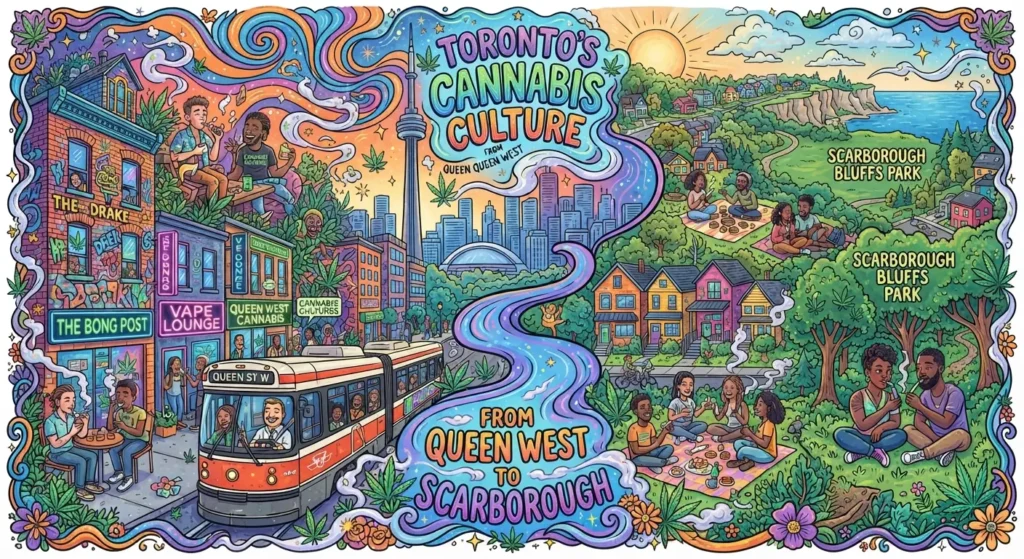
If you had stood on Queen Street West on the morning of April 1, 2019, you would have watched something absurd: a lineup, in the cold, for a single gram of legal weed. Toronto — roughly three million people, a city that had tolerated open-air dispensaries for years — had exactly one licensed cannabis store that day. Hunny Pot Cannabis Co., 202 Queen Street West. Staff handed out numbers. Camera crews filmed the first customer like he’d stepped off a spacecraft.
Seven years later, that scarcity is a punchline. What replaced it is more interesting than abundance. Toronto’s cannabis map now reads like a personality chart of the city itself. Queen West sells the story and the aesthetics. Yorkville sells the packaging. Scarborough sells the price per gram, in a plaza, beside a Hakka restaurant, with a budtender who switches languages mid-sentence.
Same product. Same law. Wildly different culture.
This guide walks that map, neighbourhood by neighbourhood, and then does the part most travel content skips: the actual rules. You’ll learn where the scene came from, how the west end differs from the east, why Scarborough’s stores sit in strip malls instead of on charming main streets, how to shop without getting talked into something too strong, and where you can — and absolutely cannot — legally consume. Written for adults 19 and older.
Quick answer: Cannabis has been legal across Canada since October 17, 2018. In Toronto, adults 19+ may buy from AGCO-licensed stores or OCS.ca, carry up to 30 grams of dried cannabis in public, and consume in private residences or outdoor areas where tobacco smoking is permitted. There are no licensed consumption lounges, and taking cannabis across an international border is a federal offence.
The rules first: what’s actually legal in Toronto?
Recreational cannabis is legal in Toronto for adults 19 and older, sold through privately owned stores licensed by the Alcohol and Gaming Commission of Ontario (AGCO) and through the government-run Ontario Cannabis Store (OCS.ca), which is the province’s only legal online retailer.
🔥REFER A FRIEND
THEY GET 10% OFF THEIR FIRST ORDER🔥
Everything else flows from that structure. Ontario chose private retail, government wholesale, and a fairly conservative public-consumption regime — a combination that explains why Toronto has hundreds of shops and nowhere legal to sit down and use what you bought.
Five numbers that govern every purchase
| Rule | Ontario / Toronto detail | Why it matters to you |
|---|---|---|
| Minimum age | 19+ (not 18, unlike some provinces) | Bring government photo ID; a passport works for visitors |
| Public possession | 30 g dried cannabis, or equivalent | Roughly an ounce; equivalents differ for edibles and extracts |
| Edible potency | Max 10 mg THC per package | A “strong” gummy bag is still 10 mg total — split it, don’t inhale it |
| Home cultivation | 4 plants per household, not per person | Roommates share the allowance |
| Store siting | Minimum 150 m from a school | The single biggest reason stores cluster on arterial roads and plazas |
Where you can actually consume
Ontario’s Smoke-Free Ontario Act generally permits cannabis smoking and vaping where tobacco smoking is allowed, with carve-outs that catch visitors constantly:
- Not in or on restaurant and bar patios, or within 9 metres of them
- Not near playgrounds, splash pads, sports fields, or school grounds
- Not in a vehicle or boat being operated — including parked-with-keys situations you’d rather not argue about
- Not in indoor common areas of condos and apartment buildings
- Not inside a cannabis store; consumption on retail premises is prohibited
- Sometimes not in your rental: leases, condo bylaws, and hotel policies can override provincial permission entirely
City park signage adds another layer. Toronto’s municipal rules restrict smoking in specific park areas, so the sign at the entrance beats the general rule you read online.
Pro Tip — Solve the “where” before the “what.” I’ve watched too many visitors buy a beautiful eighth of craft flower and then spend the evening holding it, because their hotel is smoke-free, their rental is a condo with a strict bylaw, and the park bench faces a playground. Ask your host, in writing, one question: is cannabis consumption permitted anywhere on this property? A yes or no reshapes your whole shopping list.
Queen West and Kensington Market: where the culture went public
Queen West and Kensington Market are the historic heart of Toronto’s cannabis culture — the blocks where head shops, cafés, and eventually open-air dispensaries made the scene visible decades before legalization.
From head shops to licensed storefronts
Queen West’s counterculture economy built the infrastructure first. Friendly Stranger, the Queen Street West head-shop institution dating to the mid-1990s, sold glass, grinders, and vaporizers to a clientele that had nowhere legal to buy flower. Kensington Market’s Hotbox Café became a pilgrimage site in the prohibition years — part café, part open secret. Toronto-born Tokyo Smoke launched in 2015 as a lifestyle-and-coffee concept before morphing into a retail chain, which tells you everything about how this city aestheticized the plant before it commodified it.
A distinction worth internalizing: a head shop sells accessories; a licensed retailer sells cannabis. They look similar from the sidewalk and are governed by completely different rules.
The dispensary years, and what replaced them
Between roughly 2015 and 2018, unlicensed dispensaries operated in plain view — Queen West, Kensington, the Danforth, suburban plazas. Enforcement was sporadic and theatrical: in May 2016, Toronto police raided dozens of dispensaries in a single coordinated day, an operation widely reported as Project Claudia. Charges followed. So did reopenings.
Then the province took over, and the aesthetic changed overnight. Ontario requires that cannabis not be visible from outside the store. Windows are covered. Signage is restrained. The most legally interesting retail category in the city was deliberately designed to look boring from the street.
Expert Insight — How to spot a licensed Toronto store in ten seconds: an AGCO licence displayed inside, opaque or covered windows, products in child-resistant packaging carrying the red standardized THC symbol and a provincial excise stamp, and staff who ask for ID at the door rather than at the till. If a shop sells flower through a clear display window with no licence in sight, you’re likely looking at an unlicensed operation. Toronto has spent recent years closing those storefronts; buying there means no potency testing, no recall protection, and no receipt worth anything.
Walk it properly: Queen West from Bathurst to Dufferin, north into Kensington via Spadina, then south to Trinity Bellwoods Park. The park is famously social — and that reputation is not legal permission. Smoking restrictions apply near playgrounds and sports fields, and bylaw officers do patrol.
Parkdale, Ossington, and the Junction: cannabis without the scene
Parkdale, Roncesvalles, Little Portugal, and the Junction treat cannabis as an errand, not an identity — buy, bag, go home.
These are dense, family-heavy, residential neighbourhoods where the retail experience mirrors a good independent grocer or coffee shop. Nobody performs. The Ossington strip is restaurant-first; the Junction leans craft-beer, which raises a genuine caution: combining alcohol and cannabis multiplies impairment in ways that public-health guidance consistently warns against. Pick one lane per evening. Roncesvalles and Parkdale reward the same approach — discreet purchase, private consumption, then dinner.
Downtown core and Yorkville: convenience, polish, and tourist pricing
The downtown core sells proximity, and Yorkville sells presentation — expect to pay a premium for both.
Hotels, the Eaton Centre corridor, and the entertainment district generate the highest-foot-traffic stores in the city, with the assortments to match: pre-rolls, small formats, THC beverages, grab-and-go edibles. Yorkville frames cannabis as boutique wellness, which is a merchandising choice, not a pharmacological one.
Two local traps. First, the Distillery District is private property with its own rules and zero tolerance for improvising a smoke break. Second, the unofficial 4/20 gatherings that have long clustered around the downtown square now known as Sankofa Square (formerly Yonge-Dundas) are cultural events, not sanctioned consumption zones. A crowd is not a permit.
The east end: Danforth, Leslieville, and East York
Toronto’s east end runs on neighbourhood loyalty and value pricing, with none of the west end’s mythology.
The Danforth’s Greek Town, Leslieville’s brunch strip, and East York’s residential grid produced fewer pre-legalization legends and more steady, local-serving shops. Staff tend to know repeat customers by name and by tolerance. If you want a straightforward conversation about a 3.5-gram purchase without a lifestyle pitch, this is where it happens. Riverside and the Beaches follow the same pattern: quiet storefronts, quick transactions, private consumption.
🔥 Stack your savings. Elevate your session. 10% off $100, up to 25% off $450.
🔥 Roll into the menu and start saving. CLICK HERE!
Scarborough: the part of the map most guides skip
Scarborough is Toronto’s most practical cannabis-shopping district — plaza-based, price-competitive, and multilingual — and it’s routinely ignored by downtown-written guides.
Roughly 600,000 people live here, more than half born outside Canada, in one of the most linguistically diverse urban districts in the country. That diversity shapes the retail floor: you’ll hear Tamil, Cantonese, Tagalog, Gujarati, and Caribbean English in and around these stores, and asking for help in your first language is normal rather than remarkable.
Why the stores are in plazas, not on main streets
Ontario’s 150-metre school buffer does the urban planning. Schools sit inside residential grids, so compliant sites concentrate on wide arterial roads: Eglinton Avenue East through the Golden Mile, Kingston Road, Lawrence Avenue East, Markham Road, Sheppard Avenue East, and the orbit around Scarborough Town Centre. Cheap commercial units, parking, and distance from school property lines. Function over charm — and function is exactly why the value is here.
What Scarborough does better than downtown
Larger formats, harder price competition, and staff who serve residents rather than tourists. Legal dried flower commonly lands in mid-single-digit dollars per gram across Ontario, with value formats below and small-batch craft above; the spread between a tourist-corridor shop and a Scarborough plaza shop on the same product category can be meaningful. Treat that as a pattern to verify, not a guarantee.
Then eat. Scarborough’s Hakka Chinese cooking, Tamil roti, Caribbean bakeries, and Wexford’s Lebanese kitchens are reason enough for the trip. Scarborough Bluffs, Guild Park and Gardens, and Rouge National Urban Park — Canada’s first national urban park — deliver the best walking in the city. Federal and municipal signage governs those green spaces, so read it before assuming anything.
Pro Tip — Cultural discretion varies more than legality does. In several Scarborough communities, cannabis carries real social stigma even though the law is uniform across the city. Buy, bag it, keep it sealed, and consume only where you have explicit permission. That’s etiquette, not paranoia.
North York, Etobicoke, and what changes at the city line
Crossing out of Toronto changes store density and municipal politics, not the underlying law.
North York’s Yonge corridor and Etobicoke’s Kingsway and Long Branch both carry licensed retail, generally with more parking and less foot traffic. Across the GTA, several municipalities used Ontario’s 2019 opt-out window to refuse stores before reversing course later — a history that still shows up as patchy coverage in some suburbs. Pearson Airport is federal territory: domestic flights permit legal possession within limits, but the international border is a hard wall.
Toronto cannabis neighbourhoods at a glance
| Neighbourhood | Best for | Retail pattern | Consumption reality |
|---|---|---|---|
| Queen West / West Queen West | Culture, history, aesthetics | Boutique-style licensed shops + legacy head shops | Dense condos; balconies often restricted |
| Kensington Market / Chinatown | Counterculture heritage | Small-format shops nearby on Spadina/Dundas | Market crowds ≠ legal consumption |
| Parkdale / Roncesvalles | Low-key, residential | Errand-style neighbourhood stores | Private homes, with lease limits |
| Ossington / Little Portugal | Food-first evenings | Compact, service-led shops | Restaurant patios are off-limits |
| The Junction | Craft-beer country | Plaza and main-street mix | Don’t stack alcohol and THC |
| Downtown core | Convenience | Highest-traffic, tourist assortments | Hotels mostly smoke-free |
| Yorkville / The Annex | Premium presentation | Boutique framing, higher price points | Strict condo and property rules |
| Danforth / East York | Value and straight talk | Local-serving, loyal clientele | Residential discretion |
| Leslieville / Riverside | Quiet, quick purchases | Small storefronts | Private property only |
| Scarborough (Golden Mile, STC) | Price, formats, languages | Arterial strip-mall plazas | Ample space, strong social discretion |
| North York / Etobicoke | Car-friendly shopping | Plaza retail, more parking | Same rules, fewer options nearby |
How to buy like a local: a nine-step playbook
- Verify the licence. Check the AGCO’s public cannabis retail registry or the OCS store locator before you walk in.
- Bring government photo ID. Passport for visitors. No ID, no sale — no exceptions worth testing.
- Set a budget in dollars, not grams. Decide $25 or $60 before a budtender starts describing terpenes.
- State your tolerance honestly. “I haven’t consumed in a year” gets you a better recommendation than pretending otherwise.
- Ask three questions: THC and CBD content, package or harvest date, and whether the format is inhaled or ingested.
- Start low. For edibles, 2.5 mg THC is a sensible first dose — and the legal package ceiling is 10 mg total.
- Wait. Edibles can take 30 minutes to 2 hours to show up. Redosing at minute 45 is the single most common visitor mistake.
- Confirm your consumption location before paying, then plan transit or a rideshare. Ontario applies zero tolerance to young and novice drivers.
- Keep the excise-stamped packaging and stay under 30 g in public.
| Format | Typical onset | Typical duration | Beginner note |
|---|---|---|---|
| Inhaled flower | 1–10 minutes | 2–4 hours | Easiest to titrate; one small inhalation, then wait |
| Vape cartridge | 1–10 minutes | 2–4 hours | Concentrates are far stronger than they look |
| Edible (gummy, chocolate) | 30 min – 2 hours | 4–8+ hours | Start at 2.5 mg THC; do not redose early |
| THC beverage | ~10–45 minutes | 3–6 hours | Max 10 mg THC per package in Ontario |
| Sublingual oil | 15–45 minutes | 4–8 hours | Measure the dropper; don’t eyeball it |
Ranges are general public-health guidance, not individual medical advice.
Worked example: 48 hours from Queen West to Scarborough
An illustrative planning template built from real streets and transit lines — verify current store locations, hours, and licences before you go.
Day 1 — the west end, on foot
11:00 Start at Bathurst and Queen. Walk west, reading the covered windows and the restrained signage. Note the difference between head shops and licensed retailers. 12:30 Lunch on Ossington or in Kensington Market. 14:00 Verify one licensed store in the AGCO registry, then shop with your three questions and a fixed budget. 15:30 Graffiti Alley, vintage shops, Trinity Bellwoods — observe the park signage rather than the crowd’s habits. 18:00 Confirm your consumption permission at your accommodation, or skip consumption entirely. Dinner beats a bylaw fine.
Day 2 — the east end, by transit
10:00 Take TTC Line 2 east. The Scarborough RT closed permanently in 2023, so plan on Line 2 to Kennedy or Warden plus connecting buses — not the old rapid-transit shortcut. 11:30 Shop the Eglinton East / Golden Mile plazas. Compare per-gram pricing against yesterday’s west-end quote. 13:00 Hakka lunch, then a Tamil or Caribbean bakery stop. 15:00 Scarborough Bluffs or Guild Park. Read the signs; keep everything sealed. 18:00 Dinner in Wexford or on the Danforth on the way back.
Two neighbourhoods, one law, two completely different retail cultures — and a price comparison you can repeat in any city.
Etiquette, safety, and the fine print
Legal doesn’t mean consequence-free, and the details below matter more than any strain recommendation.
- Driving: public-health guidance commonly advises waiting at least 6 hours after inhalation and 8 hours after ingestion before driving, longer if you still feel effects. Impaired driving is a Criminal Code offence.
- Medical cannabis is a separate stream in Canada: authorized through a health care practitioner and supplied by Health Canada–licensed sellers, typically by mail. Recreational stores don’t dispense it.
- Storage: edibles resemble candy. Lock them away from children and pets.
- Pregnancy, breastfeeding, and under-25 brains: health authorities advise avoidance or extra caution.
- Never cross an international border with cannabis — including to U.S. states where it’s legal. That’s federal law on both sides of the line.
- Etiquette: ask before consuming on anyone’s property, don’t vape in a queue, and don’t treat a 4/20 crowd as legal cover.
🔥REFER A FRIEND
THEY GET 10% OFF THEIR FIRST ORDER🔥
What to watch through 2026
Ontario’s market is defined by saturation, price compression, and enforcement — three forces still reshaping where Toronto shops. Ontario runs the largest licensed retail network in Canada, well over a thousand stores, with Toronto holding a few hundred; counts shift monthly, so treat any published number as a snapshot and verify in the AGCO registry. Watch for continued closures of unlicensed storefronts, growth in THC beverages within the 10 mg ceiling, and recurring policy arguments about consumption spaces. Those are trends to monitor, not predictions to bank on.
Your next three moves
Toronto’s cannabis culture isn’t one scene — it’s a west-end story, an east-end errand, and a Scarborough value proposition, all operating under identical rules. Queen West gave the city its imagery. Scarborough gives residents their price per gram. Knowing which one you’re standing in is the whole skill.
So: bookmark the rules table, check the AGCO registry before you buy, and settle your consumption permission before checkout. Do those three things and you’ll navigate this city better than most people who live here.
Travelling with a specific neighbourhood in mind? Build your route around food and walking first, shopping second — that ordering has never once disappointed anyone.
This guide is informational, for adults 19+, and is not legal or medical advice. Verify current rules with the AGCO (agco.ca), Ontario Cannabis Store (ocs.ca), Health Canada (canada.ca), and the City of Toronto (toronto.ca). Store locations, hours, and licensing status change frequently.
🔥 Stack your savings. Elevate your session. 10% off $100, up to 25% off $450.
🔥 Roll into the menu and start saving. CLICK HERE!
FAQ Section
Can tourists legally buy cannabis in Toronto?
Yes. Visitors aged 19+ can buy from AGCO-licensed stores or OCS.ca with valid government photo ID, such as a passport. Possession in public is capped at 30 grams of dried cannabis. Taking cannabis across Canada’s international border remains a federal offence.
Where can you legally smoke or vape cannabis in Toronto?
Private residences and many outdoor spaces where tobacco smoking is allowed — not sidewalks near schools, playgrounds, sports fields, hospital grounds, restaurant patios, or vehicles. Condos, leases, and hotels can ban it outright. City park signage overrides general rules, so read the sign.
Are there legal cannabis consumption lounges in Toronto?
No. Ontario does not license cannabis consumption lounges, and consumption inside licensed retail stores is prohibited. Any Toronto “lounge” operating publicly sits outside the legal framework and risks closure. Private spaces, used with the owner’s explicit permission, remain the practical option for visitors.
Can I take cannabis home from Toronto on a plane?
Within Canada, adults may fly with up to 30 grams of dried cannabis in carry-on baggage, subject to airline and security rules. Crossing an international border with cannabis is illegal — including flights to U.S. states where cannabis is legal. Diverted flights create real risk.
Is cannabis cheaper in Scarborough than downtown Toronto?
Often, yes — but it’s a pattern, not a rule. Scarborough’s plaza-based stores compete on price and larger formats, while tourist-heavy downtown shops lean on convenience. Compare per-gram pricing and package dates rather than assuming any district is uniformly cheaper. Verify licences too.
Copiar
Preguntar a Qwen
Explicar
Traducir(es-ES)