
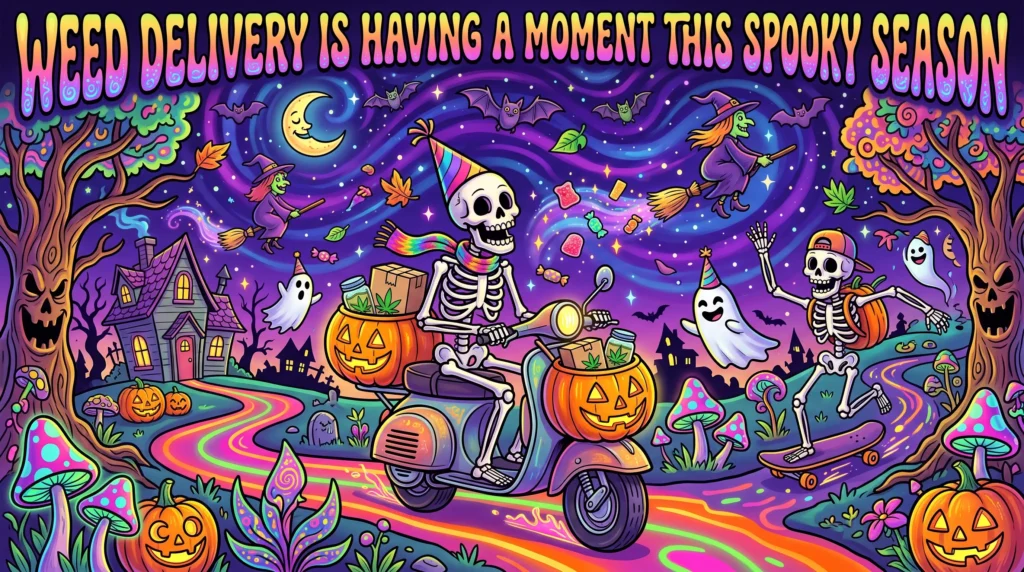
The porch light is on. The horror marathon is queued. The group chat is deciding who brings snacks. For some adults in legal markets, the autumn routine now includes another notification: your cannabis order is outside.
That shift is not just a social media vibe. Weed delivery is becoming a visible part of seasonal consumer behavior, especially in regions where licensed cannabis retailers can legally fulfill home deliveries. The combination of cooler weather, holiday gatherings, streaming culture, and growing comfort with online cannabis purchasing has created a spooky-season spike that dispensary operators, marketers, and compliance teams are noticing.
Before going further, one boundary matters: this article is about legal, age-restricted cannabis commerce. It is not guidance for bypassing local laws, buying from unlicensed sellers, or driving after using cannabis. Rules vary by state, province, and municipality. In the United States, cannabis remains subject to federal restrictions, while many states operate medical or adult-use programs. Always confirm local law before ordering, advertising, or fulfilling delivery.
Direct answer: Weed delivery is having a spooky-season moment because legal consumers are combining autumn stay-at-home habits with the privacy, speed, and convenience of licensed home delivery. The trend is strongest where regulations allow delivery, retailers offer lab-tested products, and marketing avoids youth appeal and impaired-driving messages.
🔥REFER A FRIEND
THEY GET 10% OFF THEIR FIRST ORDER🔥
This guide breaks down why the trend is rising, how licensed brands can participate responsibly, what buyers should check, and where weed delivery may go next.
Why is weed delivery trending during spooky season?
Weed delivery is trending during spooky season because autumn routines push adults toward at-home comfort, private purchasing, and convenient access to legal cannabis products. The season also aligns with longer weekends, holiday entertaining, and seasonal marketing cycles that make delivery feel timely rather than transactional.
The at-home ritual effect
Spooky season has a particular rhythm. People stay in later. They watch horror films, host costume parties, bake seasonal treats, and look for low-friction ways to extend the evening. Delivery fits that pattern neatly. Instead of driving to a dispensary, browsing in person, and transporting products home, consumers can order from a couch, verify age digitally, and receive items at the door.
That convenience is not unique to cannabis. Food delivery, grocery delivery, and streaming have trained consumers to expect immediacy. Cannabis e-commerce is borrowing from the same behavioral playbook. The difference is regulatory complexity. A legal weed delivery order must include age verification, product tracing, compliant packaging, and often real-time inventory syncing with a licensed storefront.
Privacy still sells
Not every cannabis buyer wants to walk into a store. Some live in communities where stigma persists. Others work in professions with drug-testing policies. Some simply prefer not to explain their purchases to neighbors. Home delivery reduces that friction.
Privacy is not about concealment for its own sake. It is about control. A shopper can review menus, compare THC and CBD levels, read lab-testing information, and place an order without feeling observed. For newer consumers, that lower-pressure environment can make legal cannabis feel less intimidating. For experienced users, it can simply be faster.
Legal infrastructure is catching up
The spooky-season delivery trend is also a sign of market maturity. In early legal markets, cannabis retail was mostly storefront-based. Over time, regulators added delivery licenses, courier rules, geofencing requirements, and track-and-trace obligations. Those systems are imperfect, but they create a framework where compliant delivery can scale.
Industry trackers and retail reports have shown legal cannabis sales expanding through the early 2020s, with online discovery and delivery gaining share in mature markets. Exact numbers vary by state and measurement method, but the direction is clear: consumers increasingly expect cannabis to behave like other regulated consumer goods. Search, compare, order, track, receive.
Expert Insight: Delivery demand rarely appears in isolation. It grows when three things align: legal permission, reliable courier operations, and consumer trust in product labeling. Remove one leg, and the trend weakens fast.
What does “spooky season” mean for cannabis brands?
Spooky season refers to the autumn marketing window centered on Halloween, fall festivities, and cozy indoor entertainment, and for cannabis brands it means a chance to connect seasonal lifestyle moments with compliant adult-use products. The opportunity is real, but the execution must avoid youth appeal, unverified health claims, and any message that normalizes impaired driving.
Cannabis branding during spooky season works best when it feels adult, transparent, and operationally sound. A pumpkin-scented pre-roll bundle is very different from a candy-shaped edible. One can be positioned as seasonal novelty for verified adults. The other can create regulatory and reputational risk.
The table below summarizes how spooky-season angles can be translated into compliant cannabis commerce.
| Spooky-season angle | What shoppers may want | Compliant brand execution | Guardrail |
|---|---|---|---|
| At-home movie night | Easy, low-effort entertainment | Feature pre-rolls, measured vape products, or flower bundles with clear THC/CBD info | Never suggest driving, boating, or operating machinery after use |
| Autumn flavors | Seasonal novelty and familiarity | Use flavor language such as spice, orchard fruit, or roasted notes without medical claims | Avoid packaging that mimics candy or children’s snacks |
| Costume-party adjacency | Shared adult experiences | Offer adult-only sample kits or curated bundles with child-resistant packaging | Do not market to minors or use cartoonish youth-oriented imagery |
| Last-mile convenience | Speed, privacy, and simplicity | Display delivery radius, ETA ranges, ID requirements, and fee breakdowns | Ensure couriers do not advertise at doors where minors may be present |
| Limited drops | Exclusivity and discovery | Release small-batch seasonal flower or compliant preroll packs | Maintain lab testing, accurate weights, and traceability |
A useful rule for cannabis marketers: seasonal relevance works when it feels like a treat for adults, not a lure for minors.
That distinction matters because regulators are watching. Halloween-themed campaigns can quickly cross from clever to noncompliant if they use bright cartoons, candy-like formats, or language that suggests safety for children. The safer path is mature design, precise dosing information, and clear age gating.
How can dispensaries capture spooky-season demand without breaking rules?
Dispensaries can capture spooky-season demand without breaking rules by aligning inventory, delivery logistics, product education, and marketing creative with local cannabis regulations. The goal is not just to sell more. It is to sell better: compliantly, transparently, and in a way that builds repeat trust.
Step 1: Confirm delivery authority before promoting it
The first move is boring but necessary. Verify that the business holds the correct license for delivery in each jurisdiction served. Some markets allow storefront delivery only. Others permit independent delivery licensees. Some ban delivery entirely. A campaign that assumes uniform rules across cities can create compliance failures quickly.
Pro Tip: Create a delivery matrix by jurisdiction. List license type, allowed product categories, distance limits, courier requirements, age-verification method, and packaging rules. Review it before every seasonal campaign.
Step 2: Age-gate the entire funnel
Age verification cannot stop at checkout. It should appear at the top of the website, in app onboarding, in promotional emails, and at the delivery doorstep. If a platform allows underage sign-ups or does not block minors from viewing menus, the compliance risk expands beyond the transaction.
A strong funnel includes:
- Birth-date verification before product browsing
- Government ID validation at order confirmation
- In-person ID scan or visual check at delivery
- Refusal protocols for fake, expired, or mismatched IDs
- Records retention aligned with local regulator requirements
Step 3: Train couriers like brand ambassadors
Delivery drivers are often the only human touchpoint in an online cannabis purchase. They need more than route training. They should understand product categories, age-verification steps, no-consumption rules, and how to handle awkward doorstep situations.
A courier should never:
- Leave cannabis with anyone under the legal age
- Allow consumption on-site
- Post photos of deliveries to personal social media
- Offer unrequested product recommendations that sound medical
- Accept cash outside approved compliance systems
Step 4: Curate seasonal bundles that reduce confusion
Spooky-season bundles can work, but only if they are clear. A bundle labeled “Halloween Fun Pack” means little unless it lists THC per serving, total package weight, product type, lab-testing status, and usage warnings.
Better bundle naming examples:
- “Autoom Evening Pre-Roll Trio”
- “Spice-Inspired Flower Bundle, 3.5g Total”
- “Adult-Only Halloween Tasting Kit, Lab-Tested”
Avoid names that imply euphoria, invincibility, or medical benefit. “Calming,” “pain relief,” “anxiety help,” and “sleep aid” can trigger regulatory scrutiny unless the product has approved medical claims in that market.
Step 5: Make dosing information impossible to miss
For edibles, this is where trust is won or lost. Consumers need to know:
- Milligrams of THC per serving
- Number of servings per package
- Onset time variability
- Storage instructions
- Child-resistant packaging status
- Whether the product contains allergens or other ingredients
A simple menu description can prevent costly misuse. “Start with one serving. Wait at least two hours before considering more. Do not drive.” That sentence is not flashy, but it is responsible.
Step 6: Use seasonal creative without youth coding
Gothic fonts, muted orange, black, deep purple, and vintage horror posters can signal adult spooky season. Bright cartoon pumpkins, candy graphics, and toy-like characters can send the wrong message.
The creative test is straightforward: would this ad be appropriate on a platform where minors may see it? If not, revise it.
Step 7: Plan courier capacity before demand spikes
Spooky-season demand can cluster around weekends, Halloween night, and long holidays. If delivery windows are vague or couriers are overloaded, customer satisfaction drops fast. A late cannabis delivery is not just an inconvenience. It can erode trust in the entire brand.
Operators should forecast order volume, stagger delivery slots, and communicate realistic ETAs. Overpromising speed creates avoidable complaints.
🔥 Stack your savings. Elevate your session. 10% off $100, up to 25% off $450.
🔥 Roll into the menu and start saving. CLICK HERE!
Step 8: Measure the right signals
Do not judge a seasonal campaign only by gross revenue. Track:
- Delivery completion rate
- Age-verification failure rate
- Average order value
- Repeat order rate
- Support tickets related to dosing or delivery
- Compliance exceptions by courier
- Cart abandonment due to fee transparency
These metrics show whether spooky-season growth is healthy or merely noisy.
What should customers check before ordering weed delivery?
Customers should check legal availability, retailer licensing, product testing, dosing clarity, total cost, and delivery policies before ordering weed delivery. A compliant order protects the buyer, the courier, and the broader reputation of legal cannabis markets.
Here is a practical checklist:
- Is delivery legal in my city or county?
Some jurisdictions allow adult-use sales but restrict delivery. Do not assume neighboring-state rules apply. - Is the retailer licensed?
Look for a license number, physical storefront, or clear regulatory disclosure. If the site hides its licensing status, treat that as a warning sign. - Are products lab-tested?
Licensed cannabis products should have current certificates of analysis, often called COAs. These reports can show potency and screening for contaminants. - Does the menu show THC and CBD clearly?
“Strong” or “super potent” is marketing language. Milligrams per serving and total package potency are actionable information. - Is the edible packaging child-resistant?
This matters even for responsible adults. Homes with children, guests, or pets require extra caution. - Are fees disclosed before checkout?
Delivery fees, taxes, tips, and minimum-order requirements should be visible early. Surprise fees at checkout damage trust. - Will someone verify ID at delivery?
A legitimate delivery should require a valid government ID matching the order. If a service says no ID is needed, that is a major red flag. - Do they prohibit impaired driving?
Responsible retailers remind customers not to drive after consuming cannabis. That message should appear on product pages, checkout screens, and delivery confirmations.
Pro Tip: If a dispensary website does not show lab results, dosage information, or licensing details within a few clicks, choose another retailer. Transparency is not a bonus feature in legal cannabis. It is the baseline.
Mini-case: A compliant spooky-season delivery campaign
A licensed dispensary can turn spooky-season demand into repeat orders by pairing themed merch with strict age gates, courier training, and clear product education. The following composite example reflects common practices reported by legal retailers; it is not a named client case.
Imagine a mid-sized dispensary in a mature adult-use market. The owner notices that October orders skew toward pre-rolls, flower, and low-dose edibles. Customers are not just buying products. They are buying an evening plan: movie, snacks, comfortable setup, minimal errands.
Instead of launching a generic “Happy Halloween” sale, the team builds a campaign called Adults Only, October Nights. The concept is simple: curated seasonal bundles, transparent delivery windows, and educational product pages.
What the team did
- Mapped legal delivery zones
The compliance lead confirmed which ZIP codes were eligible under state and local rules. The website blocked ineligible addresses before checkout. - Created three bundle tiers
- Flower-and-pre-roll bundle for seasoned users
- Low-dose edible-and-tea bundle for newer adults
- Non-smokable botanical accessory bundle for home-setup shoppers
- Rewrote product descriptions
The marketing team removed vague wellness language. They replaced it with factual copy: strain name, terpene profile where available, THC percentage, weight, and suggested responsible use limits. - Trained couriers on doorstep boundaries
Drivers practiced scripts for ID checks, package handoff, and refusing delivery to anyone who appeared underage. They were instructed not to linger, photograph orders, or discuss effects beyond label information. - Added a delivery ETA slider
Customers could choose evening windows instead of receiving a vague “tonight” promise. This reduced missed deliveries and support calls. - Used adult-oriented creative
The campaign visuals leaned into vintage horror posters, dark botanical illustrations, and muted autumn colors. No cartoon candy. No child-like mascots.
What the campaign demonstrated
The composite model shows why compliance and conversion are not opposites. Clear delivery zones reduce failed orders. Transparent dosing reduces misuse complaints. Adult-oriented creative protects brand reputation. Courier training turns last-mile delivery into a trust-building moment rather than a liability.
Operators measuring this kind of campaign would watch for fewer abandoned carts, lower delivery exception rates, stronger repeat purchase behavior, and fewer customer-service escalations around product strength. Those signals matter more than a single viral Halloween post.
What mistakes make cannabis delivery campaigns risky?
Cannabis delivery campaigns become risky when brands prioritize seasonal hype over regulatory clarity, consumer safety, and operational discipline. The most common mistakes are predictable, and most are avoidable with a compliance-first review process.
Mistake 1: Treating edibles like candy
Packaging that resembles confectionery can trigger enforcement action and public backlash. Legal cannabis edibles should not look like something a child would grab from a Halloween bowl.
Mistake 2: Making medical claims without approval
Words like “treats insomnia,” “reduces anxiety,” or “heals pain” can move a product from consumer wellness into regulated drug territory. Unless the market and product authorization allow those claims, avoid them.
Mistake 3: Ignoring municipal delivery bans
State legality does not always mean local legality. A city may prohibit cannabis storefronts, delivery, or both. Marketing a service that cannot legally operate in a target ZIP code wastes spend and creates compliance exposure.
Mistake 4: Weak ID verification
If a delivery can be completed without checking ID, the business is gambling with its license. Age gates online are not enough. Doorstep verification matters.
Mistake 5: Overpromising speed
“30-minute cannabis delivery” sounds appealing until traffic, ID issues, or inventory substitutions delay the order. Better to promise a realistic window and hit it consistently.
Mistake 6: Failing to separate brand voice from user-generated content
A dispensary may run a clean campaign, but customer reviews or social comments can introduce noncompliant claims. Monitoring is part of responsible marketing.
Mistake 7: Forgetting impaired-driving messaging
Any seasonal campaign tied to nighttime entertaining should include a clear reminder: do not drive after using cannabis. This is not optional branding. It is public-safety communication.
🔥REFER A FRIEND
THEY GET 10% OFF THEIR FIRST ORDER🔥
Will weed delivery stay seasonal or become a default buying habit?
Weed delivery is likely to become a default buying habit in mature legal markets, with spooky season acting as a visible demand spike rather than a one-off gimmick. The seasonal moment matters because it introduces new users to convenience, but long-term growth depends on trust, regulation, and product consistency.
Several forces point toward permanence.
First, consumers now expect digital commerce in nearly every category. Cannabis is no longer exceptionless. If a shopper can order prescription refills, groceries, and alcohol in some markets, legal cannabis delivery fits the same expectation curve.
Second, retailers need differentiation. In crowded legal markets, product selection alone is not enough. Service quality, education, delivery reliability, and privacy become competitive advantages.
Third, regulators are gradually building clearer frameworks. That does not make compliance easy, but it gives operators a map. Delivery rules, packaging standards, and advertising restrictions are becoming more defined across many jurisdictions.
Still, obstacles remain. Banking limitations, insurance costs, local bans, tax complexity, and public-health concerns can slow expansion. Cannabis delivery is not simply food delivery with a different product. It carries age restrictions, potency variability, impairment risk, and heavier regulatory oversight.
The brands that endure will treat delivery as infrastructure, not promotion. Spooky season can create a burst of attention. Operational excellence creates repeat customers.
Conclusion & Next Steps
The practical takeaway is that weed delivery is having a spooky-season moment because convenience, privacy, and seasonal storytelling converge in legal markets, but lasting success depends on compliance, clear product information, and responsible fulfillment. Consumers benefit when retailers make licensing, testing, dosing, and delivery rules easy to understand. Businesses benefit when they avoid youth-coded creative and build trust through consistent operations.
If you operate a licensed cannabis business, start with a compliance audit before launching seasonal delivery promotions. Verify local rules, tighten age verification, train couriers, and rewrite product pages so dosing information is impossible to miss.
If you are a consumer, order only from licensed retailers, check lab-testing details, respect local laws, and never drive after using cannabis. A good spooky-season setup should feel relaxing, not risky.
The trend is real. The responsibility is equally real. Legal weed delivery grows when the experience is convenient, transparent, and safe.
🔥 Stack your savings. Elevate your session. 10% off $100, up to 25% off $450.
🔥 Roll into the menu and start saving. CLICK HERE!
FAQ Section
Is weed delivery legal everywhere?
No. Weed delivery is legal only where state or provincial law authorizes licensed cannabis retailers to deliver. Adult-use purchases usually require buyers to be 21 or older, while medical rules vary. Always confirm local regulations before ordering or advertising delivery services.
Why is cannabis delivery popular around Halloween?
Halloween encourages at-home gatherings, movie nights, and private relaxation. Delivery adds convenience and reduces the stigma some shoppers feel when visiting a storefront. Licensed markets also use seasonal promotions, making legal weed delivery easier to discover during autumn.
Are spooky-themed cannabis edibles safe?
They can be safer when sold by licensed retailers with child-resistant packaging, accurate THC labels, and single-serving dosing. Avoid products that resemble candy. Keep edibles away from children and pets, start low, wait longer than expected, and never share doses with underage people.
Can I drive after receiving weed delivery?
No. Do not drive after using cannabis, even if the product was legally delivered. Impaired-driving laws apply to THC, and reaction time can be affected for hours. Plan a sober ride, use rideshare, walk, or wait until you feel fully unimpaired.
What should I look for on a weed delivery menu?
Check the retailer’s license, lab-testing status, certificate of analysis, THC and CBD amounts per serving, total package weight, price, delivery fees, and service area. Clear dosing info and age-gated checkout are strong signs of a professional, compliant operation.