
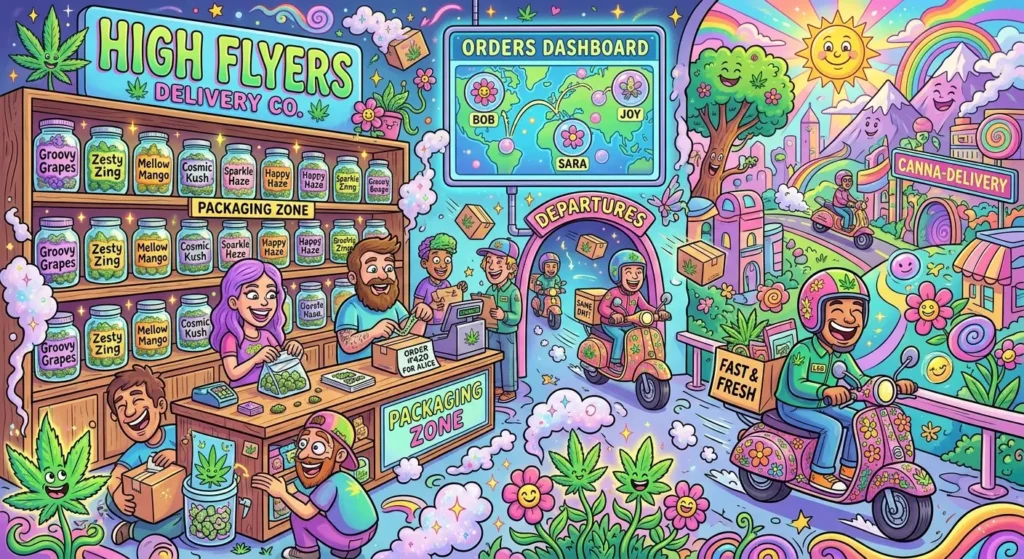
A customer taps “order,” chooses a few products, and expects a driver at the door within the hour. But a same-day weed delivery is not simply a cannabis purchase placed in a car. It is a tightly sequenced operation involving age verification, inventory control, dispatch software, route planning, legal transport rules, and a documented handoff.
This article explains exactly what happens behind the scenes of a same-day cannabis delivery: how an order is accepted, how drivers are dispatched, what compliance checks occur, how inventory stays accountable, and what happens if something goes wrong. Whether you are a consumer, dispensary operator, or entrepreneur researching the market, you will see why the fastest deliveries are usually the ones with the strongest systems.
What Is Same-Day Weed Delivery?
Same-day weed delivery is a licensed cannabis fulfillment service that delivers products to an eligible customer on the same day the order is placed. It differs from standard e-commerce because cannabis is a regulated product: the order, payment, transport, and handoff may all be subject to state or local rules.
The experience looks simple from the customer’s side:
- Browse a dispensary menu.
- Add products to the cart.
- Verify age and identity.
- Pay or reserve payment for the driver.
- Receive live status updates.
- Meet the driver and complete the delivery.
Behind that sequence, however, the dispensary must confirm product availability, assign the order to a compliant driver, track every package, and document the transaction. In regulated markets, a delivery is often not considered complete until the customer’s ID has been checked at the door and the sale is recorded in the dispensary’s system.
🔥REFER A FRIEND
THEY GET 10% OFF THEIR FIRST ORDER🔥
Step 1: The Order Enters the System
The process begins the moment a customer submits an order through a dispensary website, app, phone line, or in-store kiosk. The platform immediately checks whether the delivery address falls inside an approved service zone.
A well-built cannabis delivery system performs several checks at once:
- Delivery-zone validation: Confirms the address is eligible for service.
- Inventory availability: Reserves products before another customer can buy them.
- Purchase-limit enforcement: Flags orders that exceed local possession or sales limits.
- Age attestation: Requires the customer to confirm they meet the legal purchasing age.
- Fraud and duplicate-order screening: Looks for suspicious ordering behavior.
- Payment authorization: Processes payment where permitted or prepares it for collection at delivery.
This is where many “same-day” promises fail. If inventory is not synchronized in real time, a customer may order a product that is already sold out. Strong operators connect their menu, point-of-sale system, and inventory platform so that a product disappears from the online menu as soon as its last sellable unit is reserved.
Expert insight: The best delivery operations treat inventory as a live promise, not a marketing display. If the website says an item is available, the system should already have reserved that exact package for that order.
Step 2: Compliance Screening Begins
Cannabis delivery is legal only within the boundaries set by the jurisdiction. Rules vary significantly by state, city, and license type, but several requirements appear repeatedly across regulated markets.
For example, New York requires adult-use cannabis customers to be 21 or older, permits adults to purchase up to three ounces of cannabis flower and 24 grams of concentrated cannabis in a single day for delivery, and requires an additional ID check when the delivery is made. Nevada similarly requires valid government-issued photo identification for cannabis sales, including deliveries, and requires approved ID scanners for those transactions.
A typical compliance screen includes:
| Checkpoint | What Happens | Why It Matters |
|---|---|---|
| Legal age | Customer attests to eligibility online; driver verifies ID at handoff | Prevents sales to minors |
| Identity match | Driver compares the ID photo, name, and date of birth to the recipient | Stops order pickup by another person |
| Purchase limits | System checks product type, quantity, and daily limits | Keeps the sale within legal thresholds |
| Delivery zone | Address is matched to approved service boundaries | Ensures the delivery is permitted |
| Product eligibility | Menu filters out restricted products or quantities | Prevents noncompliant fulfillment |
| Transaction record | Sale, products, driver, time, and location are logged | Creates an audit trail |
Age verification is not a one-time formality. In many markets, the customer must affirm eligibility during checkout and then present valid government-issued photo identification at the door. Some delivery platforms enforce this in the driver app, requiring an ID photo, age confirmation, and timestamp before the driver can mark the delivery complete.
Step 3: Inventory Is Picked and Staged
Once the order passes initial checks, a fulfillment associate picks the products from the dispensary’s inventory. This stage is more demanding than ordinary retail picking because cannabis inventory is commonly tracked at the package level.
The associate verifies:
- The correct product strain, brand, and variant.
- Package ID or batch number.
- Weight, count, or volume.
- Expiration or packaging requirements.
- Tamper-evident packaging.
- Required labels and warnings.
- Purchase-limit calculations.
Many dispensaries integrate their point-of-sale and inventory software with state track-and-trace systems such as Metrc or BioTrack. These integrations help account for each gram from cultivation through final sale and report data in real time.
For same-day delivery, speed matters—but accuracy matters more. A picker who grabs the wrong edible, miscounts a pre-roll pack, or selects an expired package creates problems that surface later at the customer’s door or during an audit.
Pro tip: High-performing fulfillment teams use a “scan, pick, scan” workflow. The associate scans the order, scans each product package, and scans the completed order before sealing it. That reduces substitution errors and creates a digital chain of custody.
Step 4: Dispatch Assigns the Right Driver
After the order is packed, dispatch assigns it to a driver. This decision is not random. Dispatch software weighs driver location, current route load, vehicle capacity, delivery deadline, traffic conditions, and the products on board.
There are two common fulfillment models:
| Model | How It Works | Best For |
|---|---|---|
| Hub-and-spoke | Orders are packed at a dispensary or fulfillment hub, then assigned to drivers | Dense urban areas and predictable order volume |
| Mobile inventory | Drivers carry a pre-approved inventory kit and can fulfill new orders while on route | Fast on-demand delivery across wider areas |
| Scheduled windows | Customers choose a delivery window in advance | Lower-cost operations and batch routing |
| On-demand | Orders are dispatched immediately after packing | Customers who prioritize speed |
On-demand models can use drivers already on the road with pre-loaded inventory. The software tracks each driver’s location and onboard inventory, then assigns nearby orders and optimizes the route. This can shorten delivery times, but it requires exceptionally tight inventory control because the products are moving rather than sitting on a shelf.
Dispatchers also consider route density. Three deliveries in the same neighborhood may be grouped into one route, while a single far-away order may need its own driver. The goal is to balance speed, fuel cost, driver safety, and compliance.
Step 5: The Driver Receives a Manifest
Before leaving, the driver receives a digital or printed manifest. Think of it as the delivery route’s official record: it identifies what is being transported, where it is going, and which orders belong to which stop.
Depending on the jurisdiction, a manifest may include:
- Order numbers.
- Customer names or anonymized identifiers.
- Delivery addresses.
- Product packages and quantities.
- Driver and vehicle details.
- Departure time.
- Expected delivery sequence.
- Return-to-inventory instructions for undelivered orders.
The driver performs a final count before departure. If the manifest says six orders, the driver should have six sealed orders—not five plus a vague bag of products. This count protects the business, the driver, and the customer.
In some markets, deliveries must use ground transportation. New York, for instance, specifies that cannabis deliveries be made by ground transport such as a car, van, bicycle, scooter, or on foot.
🔥 Stack your savings. Elevate your session. 10% off $100, up to 25% off $450.
🔥 Roll into the menu and start saving. CLICK HERE!
Step 6: Route Optimization and Live Tracking
Once the driver is moving, the operation shifts into logistics mode. Route-optimization software calculates the most efficient sequence of stops while accounting for traffic, road closures, delivery windows, and priority orders.
Customers usually see simplified updates:
- “Order confirmed.”
- “Preparing your order.”
- “Out for delivery.”
- “Driver nearby.”
- “Delivered.”
Behind those messages, the operations team may be watching:
- Driver GPS location.
- Estimated arrival times.
- Route deviations.
- Failed-delivery risk.
- Customer communication threads.
- Driver safety alerts.
- Inventory remaining on the vehicle.
Real-time tracking is not only a customer convenience. It helps dispatchers intervene when a driver is stuck in traffic, when a customer is unreachable, or when an order needs to be reassigned.
Expert insight: A reliable ETA is more valuable than an aggressive one. Customers forgive a 55-minute delivery promised at 60 minutes far more readily than a 35-minute delivery that arrives after 75 minutes.
Step 7: The Doorstep Verification and Handoff
The most important moment of the delivery happens at the door. The driver confirms that the person receiving the cannabis is the person who placed the order—or is otherwise legally allowed to accept it under local rules.
A standard handoff includes:
- Arrive at the approved address.
- Confirm the customer is present.
- Request valid government-issued photo ID.
- Compare the photo, name, and birth date to the person.
- Scan or record the ID where required.
- Confirm the order contents with the customer.
- Collect payment if payment was not completed online.
- Provide a receipt or digital confirmation.
- Mark the delivery complete in the driver app.
This step cannot be treated casually. Licensed operators commonly require employees to be at least 21, wear identifiable badges, and verify age both at point of sale and at delivery. Los Angeles delivery guidance, for example, states that employees must be 21, must wear an ID badge with licensee and employee details, and must complete age verification at both the point of sale and delivery.
If the customer cannot produce valid identification, the driver should not leave the products. The order is typically returned to inventory, documented as undelivered, and handled according to company policy and local regulation.
Step 8: Payment, Receipt, and Order Closure
After the handoff, the system closes the loop. The delivery is marked complete, payment is reconciled, inventory is decremented, and the transaction record is finalized.
A complete delivery record may include:
- Customer order ID.
- Products and package IDs.
- Driver ID.
- Vehicle or route ID.
- Delivery timestamp.
- GPS confirmation.
- ID-verification evidence, where permitted and required.
- Payment status.
- Customer signature or digital confirmation.
- Any exceptions, such as a substituted product or returned item.
This record matters for customer service, accounting, theft prevention, and regulatory audits. If a customer later says an item was missing, the business can compare the picked order, driver manifest, and delivery confirmation.
What Happens When a Delivery Fails?
Not every same-day delivery ends with a successful handoff. A customer may be unavailable, may lack valid ID, may have entered the wrong address, or may no longer want the order.
A professional operation follows a clear exception process:
- No answer at the door: The driver attempts contact, waits according to policy, and documents the attempt.
- Invalid or missing ID: The driver does not release the cannabis and returns the order.
- Wrong address: Dispatch contacts the customer; if the address cannot be corrected safely, the order returns to the hub.
- Damaged package: The driver photographs the issue, returns the product, and flags it for inventory review.
- Customer refusal: The order is canceled or returned according to refund and inventory policies.
- Safety concern: The driver leaves the area if the environment feels unsafe and reports the incident.
Returned cannabis is not simply put back on the shelf. It must be inspected, documented, and reconciled in the inventory system. Package-level tracking, adjustment reason codes, waste records, and audit-ready documentation are common requirements in licensed cannabis operations.
How Dispensaries Keep Cannabis Inventory Accountable
Inventory accountability is the invisible backbone of same-day delivery. Every product must be traceable from the moment it enters the dispensary to the moment it reaches a customer—or returns to stock.
Modern cannabis software commonly supports:
- Real-time inventory updates.
- Package-level tracking.
- Purchase-order and receiving workflows.
- Reorder alerts.
- Compliance documentation.
- Integration with state track-and-trace platforms.dutchie
Delivery inventory needs an additional layer: the products loaded onto a vehicle must be distinguishable from products on the dispensary shelf. Some systems use “inventory kits” assigned to a specific vehicle or route, keeping onboard stock separate while still tracking it within the same system.
That distinction prevents a common operational error: selling the same package twice. If a package is loaded onto Driver A’s vehicle, it should not simultaneously appear available for an in-store customer or another delivery route.
A Real-World Same-Day Delivery Workflow
Consider a customer who orders at 4:12 p.m. on a Friday.
- 4:12 p.m. — Order submitted. The platform validates the address, age attestation, product availability, and purchase limits.
- 4:13 p.m. — Inventory reserved. The system reserves a specific package of flower, a vape, and a pack of edibles.
- 4:16 p.m. — Fulfillment begins. A picker scans each product, confirms package IDs, and seals the order.
- 4:24 p.m. — Quality check. A second team member verifies the order against the digital manifest.
- 4:31 p.m. — Driver assigned. Dispatch assigns the order to a driver already two stops away in the same neighborhood.
- 4:38 p.m. — Driver departs. The driver confirms the manifest count and begins the optimized route.
- 5:02 p.m. — Arrival. The driver arrives, contacts the customer, and requests ID.
- 5:06 p.m. — Handoff complete. The driver verifies the ID, confirms the order, collects payment if needed, and marks the delivery complete.
- 5:07 p.m. — System reconciliation. Inventory, payment, delivery status, and compliance records update automatically.
The customer experiences a 54-minute delivery. The operator sees a controlled sequence of reservations, scans, route decisions, identity checks, and audit records.
Why Same-Day Cannabis Delivery Is Harder Than Food Delivery
Food delivery and cannabis delivery share routing challenges, but cannabis adds regulatory weight. A restaurant can often leave an order with a neighbor, front desk, or doorstep. A cannabis delivery usually cannot.
Key differences include:
| Factor | Food Delivery | Same-Day Weed Delivery |
|---|---|---|
| Age verification | Usually not required | Often required online and at handoff |
| Recipient identity | Flexible | Often must match the ordering customer |
| Inventory tracking | Order-level | Often package- and batch-level |
| Transport rules | Generally broad | May require licensed workers, approved vehicles, or ground transport |
| Purchase limits | Rare | Common |
| Return process | Often simple | Requires documentation and inventory reconciliation |
| Audit exposure | Lower | High |
Minnesota law, for example, says only a cannabis worker employed by or contracted with the delivery service—and at least 21 years old—may transport cannabis flower, cannabis products, and certain hemp-derived consumer products. That makes driver eligibility a core compliance control, not just an HR preference.
What Customers Can Do to Get Faster Delivery
Customers can influence delivery speed more than they may realize. The fastest orders are usually the easiest orders to verify and fulfill.
- Order from a dispensary that delivers to your exact address.
- Upload or enter accurate address details, including apartment or unit number.
- Keep your phone nearby after ordering.
- Have a valid government-issued photo ID ready.
- Meet the driver personally when required.
- Avoid last-minute address changes.
- Review the order before checkout.
- Choose a delivery window if the service offers one.
- Be available during the estimated arrival period.
A driver may have the order ready in minutes, but a missing apartment number, unreachable phone, or unavailable ID can turn a 30-minute delivery into a failed one.
🔥REFER A FRIEND
THEY GET 10% OFF THEIR FIRST ORDER🔥
How Operators Build a Reliable Same-Day Service
For cannabis retailers, same-day delivery is an operational discipline. The businesses that succeed usually invest in five areas:
- Accurate menus: Inventory must update in real time across online and in-store channels.
- Compliant fulfillment: Staff must verify age, identity, quantities, packaging, and documentation.
- Smart dispatch: Routing should balance speed, safety, cost, and delivery density.
- Driver enablement: Drivers need clear manifests, navigation, customer communication tools, and exception workflows.
- Audit-ready records: Every order should produce a clean trail from checkout to handoff.
Delivery software can automate order assignments, driver dispatch, real-time status updates, and route optimization, while POS systems can support seed-to-sale tracking through integrations with systems such as Metrc or BioTrack. But software alone does not create trust. Consistent training, clear SOPs, and accountable managers do.blaze
Conclusion & Next Steps
A same-day weed delivery feels instantaneous to the customer, but it is actually a chain of precise decisions: reserve inventory, verify eligibility, pick and scan products, build a manifest, dispatch a driver, optimize the route, verify ID at the door, and reconcile the transaction.
For customers, the practical takeaway is simple: order accurately, stay reachable, and have valid ID ready. For operators, the takeaway is broader: speed is a result of operational clarity, not a substitute for it. The most dependable same-day cannabis delivery services are the ones that make compliance, inventory accuracy, and driver safety as important as arrival time.
If you operate a dispensary or delivery service, audit one recent day of orders and ask: Where did delays begin? Were IDs verified consistently? Did inventory match the manifest? Those answers will reveal more about your delivery performance than any marketing promise.
🔥 Stack your savings. Elevate your session. 10% off $100, up to 25% off $450.
🔥 Roll into the menu and start saving. CLICK HERE!
FAQ Section
Do weed delivery drivers check ID?
Yes. In most licensed cannabis markets, drivers check a valid government-issued photo ID at delivery to confirm the recipient’s age and identity. New York, for example, requires an additional identification check when the delivery is completed.
How long does same-day weed delivery take?
Many services aim for 30 to 90 minutes, but actual timing depends on order volume, distance, traffic, driver availability, and verification requirements. Orders with accurate addresses and prepared customers usually arrive fastest.
Can someone else accept my weed delivery?
It depends on local law and the dispensary’s policy. Many licensed services require the person who placed the order to be present with valid photo ID, though some jurisdictions permit an authorized recipient under specific conditions.
What happens if I miss my weed delivery?
The driver will usually attempt to contact you, wait for a defined period, and document the attempt. If delivery fails, the cannabis is typically returned to the dispensary, reconciled in inventory, and handled under the company’s refund or re-delivery policy.
Is same-day weed delivery legal everywhere?
No. Cannabis delivery legality depends on state and local law, license type, product category, and delivery boundaries. Even where adult-use cannabis is legal, delivery may be restricted or prohibited in certain cities or municipalities.