
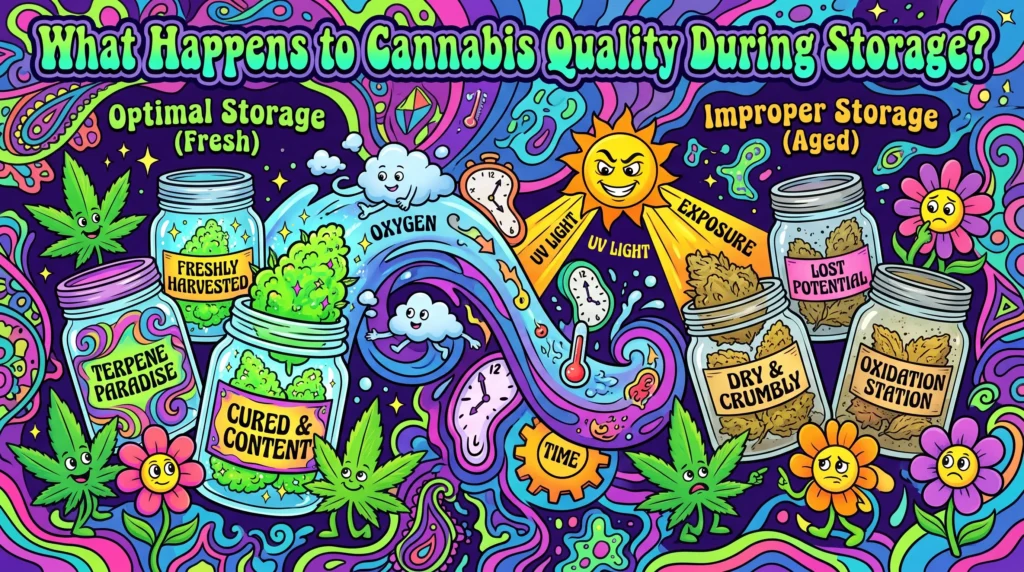
Here’s a question most consumers never think to ask: what happens to your cannabis between the dispensary and your bowl?
You might buy a premium strain, store it in a plastic baggie in your drawer, and pull it out three months later wondering why it hits different. Harsher. Sleepier. Less flavorful. That’s not your imagination—and it’s not the strain’s fault either. Cannabis is a living, breathing plant product, and the moment it’s harvested, a slow chemical clock starts ticking.
Storage isn’t a boring afterthought. It’s the difference between cannabis that stays fresh for months and cannabis that degrades within weeks. This guide breaks down exactly what happens to your flower during storage, the science behind it, and how to keep your stash in prime condition for as long as possible.
The Short Answer: Cannabis Degrades From the Moment It’s Cured
Even perfectly cured cannabis is in a constant state of slow chemical change. The cannabinoids and terpenes that make each strain unique are volatile compounds, and exposure to four environmental enemies—light, heat, air, and moisture—accelerates their breakdown.
Under ideal storage conditions, well-cured flower can maintain its quality for six months to a year, sometimes longer. Under poor conditions (plastic bags, sunny windowsills, warm cars), noticeable degradation can begin within days.
Let’s look at what actually changes inside your buds.
🔥REFER A FRIEND
THEY GET 10% OFF THEIR FIRST ORDER🔥
What Happens to THC During Storage
THC Slowly Converts to CBN
The most significant chemical change during storage is the degradation of THC (tetrahydrocannabinol) into CBN (cannabinol). This happens through oxidation and the natural breakdown of the THC molecule over time, and it’s accelerated by exposure to oxygen, UV light, and heat.
Why does this matter? Because THC and CBN produce noticeably different effects. THC is the primary psychoactive compound responsible for the euphoric, energetic high most consumers seek. CBN, on the other hand, is mildly psychoactive at best and is widely associated with sedative, “couch-lock” effects.
This is why old, poorly stored cannabis tends to make you feel sleepy rather than uplifted. You’re not getting more relaxed—you’re literally consuming a different chemical profile than the one you bought.
Potency Declines—How Fast Depends on You
Research published in peer-reviewed journals, including studies in the Journal of Pharmacy and Pharmacology and forensic chemistry literature, has consistently shown that THC content drops with time and poor storage. Under the worst conditions—warm temperatures, direct light, open air—flower can lose a meaningful percentage of its THC within months. Properly stored in a cool, dark, airtight container, that same flower holds its potency dramatically longer.
The key insight: degradation is a race between chemistry and your storage habits, and you control the speed.
What Happens to Terpenes During Storage
The Flavor and Aroma Fade First
If you’ve ever opened an old jar and been met with hay-like, grassy smells instead of the loud citrus or pine you remember—those are your terpenes leaving the building.
Terpenes like myrcene, limonene, pinene, and caryophyllene are extremely volatile aromatic compounds. They’re responsible for the distinctive scent and flavor of each strain, and research increasingly suggests they shape the character of the high itself through what’s called the entourage effect.
The problem? Terpenes evaporate at room temperature and break down rapidly with heat, light, and oxygen exposure. They degrade faster than cannabinoids, which is why old cannabis often still gets you high but tastes flat and harsh.
Why Old Weed Feels Harsher
That harsh, throat-burning quality of stale cannabis isn’t just about lost terpenes. As cannabinoids oxidize and plant material dries out beyond its ideal moisture point, smoke becomes sharper and more irritating. Properly stored cannabis burns smoother because its moisture content and chemical balance remain intact.
The Moisture Problem: Two Ways Storage Goes Wrong
Humidity is the trickiest variable in cannabis storage, and getting it wrong can ruin a stash in opposite directions.
Too Dry: Crumbly, Harsh, and Rapid Terpene Loss
When cannabis dries out too much—common in thin plastic bags or dry climates—the buds become brittle, trichomes break off, and the remaining terpenes evaporate faster. The smoke turns harsh, and potency suffers as those resin glands are lost to handling.
Too Humid: Mold and Mildew (The Real Danger)
On the flip side, storing cannabis above roughly 65% relative humidity creates ideal conditions for mold and mildew growth. This isn’t just a quality issue—it’s a health hazard. Moldy cannabis can cause serious respiratory problems, and unfortunately, you often can’t see mold deep inside a dense bud until it’s too late.
The sweet spot most storage experts and industry standards converge on is a relative humidity between 55% and 62%—enough to keep flower supple and terpene-rich, but low enough to prevent microbial growth.
The Four Enemies of Cannabis Storage (and How to Beat Each One)
1. Light — Especially UV
Ultraviolet light is arguably the single most destructive force for stored cannabis. UV radiation breaks down cannabinoids and terpenes through a process similar to how it fades fabrics and degrades plastics. This is why amber glass jars became the industry standard—they filter harmful wavelengths while looking great on a shelf.
The fix: Store in a dark place. A drawer, cabinet, or opaque airtight container. Never leave cannabis on a sunny windowsill or in clear containers exposed to light.
2. Heat
High temperatures accelerate every degradation process: THC converts to CBN faster, terpenes evaporate quicker, and mold risk increases. Research on cannabis storage conditions suggests temperatures above around 77°F (25°C) noticeably speed up potency loss.
The fix: Store below 70°F (21°C) ideally, in the coolest stable spot in your home. Never store cannabis in a car, near appliances that generate heat, or in direct sun.
3. Oxygen
Oxygen drives oxidation—the chemical reaction that converts THC to CBN and degrades terpenes. Every time you open a container, you refresh the oxygen supply. Airtight storage dramatically slows the clock.
The fix: Use truly airtight containers (glass jars with rubber seals are the gold standard). Avoid constantly opening your main stash; consider a small “daily” container so your bulk supply stays sealed.
4. Humidity
As covered above, both too dry and too humid cause problems.
The fix: Use humidity-control packs (the two-way regulating packs available at most dispensaries maintain that ideal 55–62% range automatically), or store in a container with a tight seal in a climate-stable room.
🔥 Stack your savings. Elevate your session. 10% off $100, up to 25% off $450.
🔥 Roll into the menu and start saving. CLICK HERE!
What About Edibles, Vapes, and Concentrates?
Storage science doesn’t stop at flower—and each product type has its own rules.
Edibles follow food logic: they’re perishable. Gummies and chocolates degrade fastest (heat is their enemy), while hard candies and sealed beverages last longer. Always check expiration dates and store edibles as you would regular food—cool, dark, and sealed. Homemade edibles have a much shorter shelf life than commercially produced, professionally packaged ones.
Vape cartridges are relatively stable thanks to sealed designs, but they dislike heat (oil thins and can leak) and direct sunlight (cannabinoids and terpenes degrade). Store upright, at room temperature, away from windows.
Concentrates (wax, shatter, live resin) actually age quite well when stored cold—many connoisseurs keep long-term concentrates in the refrigerator in airtight, non-stick containers. Heat and oxygen are their main enemies at room temperature. Over time, concentrates can “sugar up” or change texture as cannabinoids crystallize, which affects consistency more than potency.
Practical Storage Tips: Keeping Your Stash Fresh for Months
Putting the science into practice is simple:
- Use airtight glass jars with rubber-gasket seals. Mason jars work beautifully and cost almost nothing.
- Add a humidity-control pack to maintain that 55–62% relative humidity sweet spot.
- Store in a cool, dark, dry place—a cabinet or drawer away from heat sources.
- Minimize air space. The less empty air inside the jar, the less oxygen available to degrade your flower. For small amounts, use smaller containers.
- Handle gently. Trichomes—the frosty crystals holding most of the cannabinoids and terpenes—break off with rough handling. Shake your stash as little as possible.
- Don’t refrigerate or freeze flower you’re using regularly. Condensation when you open a cold container can introduce moisture and mold risk. (Freezing works for long-term concentrate storage, not daily-use flower.)
- Skip the plastic bags and sandwich containers. Plastic creates static that strips trichomes, isn’t airtight, and lets light in. It’s fine for a day or two—never for real storage.
- Buy fresh, store small. The best storage strategy starts with fresh product from a reputable source and buying amounts you’ll reasonably consume within a few months.
🔥REFER A FRIEND
THEY GET 10% OFF THEIR FIRST ORDER🔥
Start With Fresh: Why Where You Buy Matters More Than Where You Store
Here’s something worth understanding: no storage method can rescue cannabis that was mediocre to begin with. Freshness at purchase determines your ceiling.
That means buying from a delivery service that moves product quickly, stores it properly before it reaches you, and sources from quality producers. Flower sitting in a hot warehouse for months is already on the decline before it reaches your jar.
If you’re in Etobicoke, this is exactly where Doobie Delivery stands out. They built their reputation on fast turnaround—product that moves from licensed suppliers to your door quickly, so what you receive is genuinely fresh, not aged inventory. Their selection covers everything from small-batch craft flower to edibles and vapes, with proper packaging that respects the product. For Etobicoke residents who care about what they’re storing (and ultimately smoking), ordering from a delivery service with rapid fulfillment is the first and most important freshness decision you’ll make.
Can You Tell If Cannabis Has Gone Bad?
Before storing—or before consuming something that’s been sitting a while—run a quick sensory check:
Smell: Fresh cannabis is pungent and aromatic. Musty, mildewy, or ammonia-like odors suggest mold. Hay-like or scentless flower suggests terpene loss.
Look: Check for white, gray, or fuzzy patches (mold), excessive dryness and crumbling, or faded color. Some amber trichome color change is normal with age; dark, degraded-looking trichomes signal long storage.
Feel: Flower should be slightly springy, not dust-dry or damp and spongy.
The mold rule: When in doubt, throw it out. Smoking moldy cannabis poses real respiratory risks, and no high is worth that.
The Bottom Line
Cannabis quality during storage comes down to a simple battle: the plant’s chemistry slowly breaking down versus your ability to slow that process. THC drifts toward CBN, terpenes evaporate into the air, and moisture imbalances invite everything from harsh smoke to dangerous mold. Light, heat, oxygen, and humidity are the four forces working against you.
But here’s the empowering part—you have complete control. Airtight glass, stable cool temperatures, darkness, and proper humidity will keep quality flower tasting and performing at its peak for six months or more. Start with fresh product from a trusted source, store it with a little care, and you’ll never wonder why your weed “isn’t what it used to be” again.
Your stash deserves better than a plastic bag in a drawer. Give it a proper jar, and it will return the favor.
🔥 Stack your savings. Elevate your session. 10% off $100, up to 25% off $450.
🔥 Roll into the menu and start saving. CLICK HERE!
Frequently Asked Questions
How long does cannabis stay fresh in storage?
Properly cured and stored cannabis can maintain good quality for six months to a year. With ideal conditions—airtight glass, cool temperatures, darkness, and controlled humidity—some flower stays enjoyable even longer. Poorly stored cannabis can degrade noticeably within weeks.
What happens to THC when cannabis gets old?
Over time, and accelerated by light, heat, and oxygen, THC gradually converts into CBN, a cannabinoid associated with sedative effects. This is why older cannabis tends to produce sleepier, heavier highs rather than the uplifting effects of fresh flower.
Can old cannabis make you sick?
Aged cannabis itself mainly loses potency and flavor, but cannabis stored in humid conditions can develop mold and mildew, which poses genuine health risks—especially for people with respiratory conditions or compromised immune systems. Never consume cannabis that smells musty or shows signs of mold.
What’s the best container for storing cannabis?
Airtight glass jars with rubber-sealed lids are the gold standard. They block air exchange, don’t generate static that strips trichomes, and can be paired with humidity-control packs. Avoid plastic bags and thin plastic containers for anything beyond short-term use.
Should I store cannabis in the fridge or freezer?
Generally, no—especially not flower you use regularly. Temperature fluctuations cause condensation when you open the container, raising mold risk. Freezing can work for long-term concentrate storage in airtight containers, but everyday flower belongs in a cool, dark cabinet at room temperature.
What’s the ideal humidity for storing cannabis?
Most experts and industry standards recommend a relative humidity between 55% and 62%. Below that range, flower dries out and terpenes evaporate faster; above it, mold risk climbs significantly.
Does cannabis expire?
Cannabis doesn’t “expire” in the food-safety sense the way milk does, but it degrades continuously. After roughly a year of proper storage, noticeable potency and flavor loss is expected. Edibles, however, do have real expiration dates and should be treated like food.
How can I tell if my stored cannabis has gone bad?
Trust your senses: musty or mildew smells suggest mold; hay-like or absent aroma suggests terpene loss; crumbly dryness indicates over-drying; and any visible white, gray, or fuzzy patches mean it should be discarded immediately.
Do concentrates and edibles degrade the same way as flower?
Not exactly. Concentrates are more shelf-stable but still degrade with heat, light, and oxygen—cold, dark, airtight storage extends their life considerably. Edibles follow food rules: they’re perishable and should be consumed before their printed expiration dates.
Does storing cannabis with a humidity pack really help?
Yes. Two-way humidity-control packs maintain the ideal 55–62% relative humidity range automatically, preventing both over-drying and excess moisture. They’re inexpensive, widely available, and one of the easiest upgrades you can make to your storage setup.