
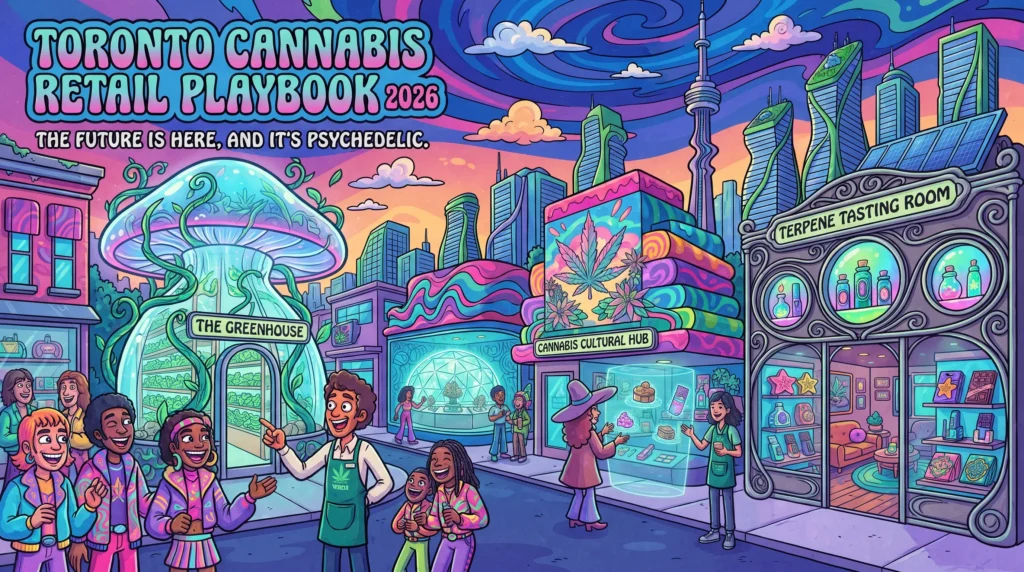
Walk down Queen Street West, stroll through Yorkville, or explore the strip near Kensington Market in 2026, and you’ll notice something has shifted. Toronto’s cannabis retail landscape no longer looks like the wild frontier of 2019 or the pandemic-scarred scramble of 2021. The city now hosts over 1,500 licensed cannabis retailers, and the question consumers are asking has evolved from “Where can I buy legal weed?” to “Which store actually deserves my loyalty?”
In a market where product selection is largely standardized by the Ontario Cannabis Store (OCS) supply chain, differentiation no longer comes from having the “best” flower. It comes from experience. The stores winning in 2026 are those that treat cannabis retail less like a transactional counter-service and more like a curated hospitality journey.
This playbook breaks down exactly what makes a cannabis store different in Toronto today — and why the customer experience is the only sustainable competitive advantage left.
The Toronto Cannabis Landscape in 2026: Beyond the Green Rush
To understand what makes a store different, you first need to understand the market context. Toronto’s cannabis sector has matured rapidly. According to industry data, the Canadian peak sales day has shifted from 4/20 to holidays like Canada Day and Christmas, signaling that cannabis purchasing has become routine rather than event-driven.
This normalization means consumers are no longer impulse buyers. They’re repeat shoppers with preferences, budgets, and expectations. Women now represent an estimated 42% of cannabis consumers, up from 35% in 2020, and they tend to purchase more items per visit than male counterparts. Meanwhile, Gen Z drives frequency but spends less per trip, while Boomers visit less often but generate larger cart sizes.
The bottom line for Toronto retailers: cookie-cutter store models are losing ground. The ones succeeding are those building a distinct point of view — through curation, community, in-store experience, or product discovery.
What Separates an Exceptional Cannabis Store from the Average?
Not all dispensaries are created equal. In 2026, these five pillars define the stores that stand out in Toronto’s saturated market.
1. Hyper-Personalized Customer Journeys
The best Toronto cannabis stores in 2026 don’t greet every customer the same way. They recognize that a first-time visitor exploring low-dose edibles needs a radically different experience than a seasoned consumer hunting for a limited craft flower drop.
Top-tier retailers use data intelligently. Loyalty programs aren’t just points machines — they’re behavioral engines. Approximately 45% of cannabis shoppers would return more often if offers felt personalized, and one in three shoppers have churned from a dispensary they liked due to irrelevant outreach.
Leading stores segment their customers by:
- Experience level: First-timer, casual, connoisseur
- Product preference: Inhalation vs. ingestion vs. topicals
- Visit pattern: Weekly regular vs. monthly stock-up shopper
- Effect goals: Sleep, creativity, social lubrication, pain relief
This segmentation allows staff to tailor recommendations instantly rather than defaulting to “What’s your THC percentage?”
2. The Rise of the “Cannabis Sommelier” — Educated Budtenders
In 2026, budtender expertise has re-emerged as a genuine competitive differentiator. After years of over-reliance on technology, retailers have rediscovered that human connection drives loyalty. According to consumer insights, 88% of shoppers say budtenders shape their purchase decisions, and 85% would return specifically for knowledgeable staff.
But “knowledgeable” in 2026 means more than knowing indica vs. sativa. Elite Toronto budtenders understand:
- Minor cannabinoids: CBN for sleep, CBG for focus, THCV for appetite suppression
- Terpene profiles: How myrcene, limonene, and caryophyllene influence effects beyond THC percentages
- Nano-emulsion technology: Explaining why fast-acting edibles onset in 15-30 minutes instead of 90
- Ontario craft producers: Distinguishing between mass-market LPs and small-batch artisans like Carmel Cannabis or 1964 Supply Co.
Stores investing in continuous staff education — not just product training, but sensory evaluation and consumer psychology — are building brands that cannot be replicated by competitors.
3. Seamless Digital-Physical Integration
The modern Toronto cannabis consumer expects the same frictionless experience they get from Amazon or Starbucks. In 2026, approximately 25% of all dispensary sales happen online, and digital orders consistently generate higher revenue per transaction than walk-in purchases.
Specifically:
- Online AOV: $68.01 vs. $50.56 for walk-in (35% higher)
- Online cart size: 3.9 items vs. 2.7 for walk-in (44% larger)
But here’s what separates good stores from great ones: they don’t treat online and in-store as separate channels. They integrate them.
Exceptional retailers offer:
- Real-time inventory syncing: If it’s on the website, it’s on the shelf
- Reserve online, customize in-store: Pre-order for convenience, then consult with a budtender for substitutions or additions
- Digital payment options: Reducing cash dependency, since integrated digital payments boast an AOV of $93.50 compared to $49.25 for cash
- Express pickup lanes: Dedicated counters for online orders that respect the customer’s time
4. Product Curation Over Product Volume
In 2026, the smartest Toronto cannabis stores have stopped trying to carry everything. Instead, they curate intentionally.
The data supports this. While flower still accounts for roughly 45% of revenue, consumers are increasingly overwhelmed by choice — 49% of shoppers report feeling overwhelmed by too many options.
Leading stores differentiate through:
- Thematic bundles: “Date Night Kits,” “Sleep Support Sets,” or “Creative Flow Packs”
- Rotating seasonal showcases: Summer beverage features, winter wellness collections
- Low-dose leadership: Prioritizing 2.5-10mg products for the wellness segment, which is the fastest-growing demographic
- Local Ontario spotlight: Dedicating shelf space to craft producers from the province, telling their cultivation stories
This curation signals expertise. It tells customers, “We have taste, and we respect your time.”
5. Community-First Retail Philosophy
The final differentiator is intangible but powerful: community. The Toronto cannabis stores thriving in 2026 function as neighborhood anchors, not anonymous transaction points.
This manifests through:
- Event programming: Terpene tasting workshops, cannabis and yoga sessions, or educational seminars on harm reduction
- Local partnerships: Collaborating with nearby coffee shops, art galleries, or wellness studios
- Inclusive environments: Stores that explicitly welcome women, seniors, and cannabis-curious newcomers rather than catering exclusively to the “stoner” stereotype
- Transparency: Clear sourcing information, lab results accessible via QR codes, and honest conversations about consumption limits
In a city as diverse as Toronto, stores that reflect their neighborhood’s culture — whether that’s the upscale professionalism of Bay Street or the artistic energy of Parkdale — build authentic connections that no marketing budget can buy.
🔥 Stack your savings. Elevate your session. 10% off $100, up to 25% off $450.
🔥 Roll into the menu and start saving. CLICK HERE!
Technology as a Silent Differentiator
While human connection remains central, technology in 2026 acts as an invisible infrastructure that elevates the entire experience.
AI Budtenders and Smart Recommendations
AI-powered recommendation systems are now standard in leading Toronto stores. These aren’t chatbots that replace humans — they’re digital assistants that extend the budtender’s reach. When a customer browses an online menu at 11 PM with 300 products in front of them, an AI budtender can ask targeted questions, filter the catalog, and recommend two or three relevant options.
In-store, AI functions as a staff-facing tool, surfacing real-time product insights during customer conversations. This hybrid model — human empathy augmented by data intelligence — defines the 2026 standard.
Self-Service Kiosks and Digital Signage
For the 60% of shoppers who prefer to browse independently, self-service kiosks with touchscreen menus, contactless payment, and personalized recommendations reduce friction without eliminating human support.
Dynamic digital signage also replaces static paper menus, ensuring customers always see live inventory rather than disappointed “sorry, we’re out” conversations at the counter.
The Toronto-Specific Edge: Local Regulations and Cultural Nuance
Toronto cannabis stores operate under Ontario’s unique regulatory framework, and the best retailers turn these constraints into advantages.
In 2025, Ontario amended rules to allow cannabis stores to operate with transparent windows and more visible branding — a shift that enabled retailers to design inviting, street-facing experiences rather than bunker-like spaces.
Progressive stores leveraged this by:
- Designing for the sidewalk: Using window displays to destigmatize cannabis and invite curiosity
- Navigating municipal zoning: Selecting locations that balance foot traffic with neighborhood sensitivity
- Adapting to OCS supply rhythms: Understanding that Ontario’s centralized distribution means product drops are predictable, allowing for strategic launch events
Culturally, Toronto’s diversity demands multilingual support, culturally sensitive product education, and an understanding that cannabis intersects with wellness, spirituality, creativity, and social justice for different communities. The stores that acknowledge this complexity earn trust that transcends transactions.
How to Evaluate a Cannabis Store in Toronto: A Shopper’s Checklist
If you’re a consumer trying to identify a standout dispensary in Toronto’s crowded market, look for these signals:
Table
| Criteria | Average Store | Exceptional Store |
|---|---|---|
| Staff Knowledge | Can read THC percentages | Explains terpenes, minor cannabinoids, and onset times |
| Product Mix | Maximizes SKUs | Curates intentionally with seasonal rotations |
| Digital Experience | Basic website | Real-time menu, online ordering, loyalty integration |
| Payment Options | Cash-only or cash-preferred | Multiple digital payment methods |
| Atmosphere | Clinical or intimidating | Welcoming, inclusive, neighborhood-appropriate |
| Education | None | Workshops, printed guides, or QR-linked resources |
| Community Presence | Transactional | Hosts events, partners with local businesses |
Use this framework to separate the dispensaries that are merely convenient from those that are genuinely exceptional.
Conclusion: Experience Is the Product
In 2026, Toronto’s cannabis market has reached a maturity where product alone cannot differentiate a store. Every licensed retailer accesses the same OCS catalog. Every shop can stock pre-rolls, vapes, and edibles. The variable is experience.
The cannabis stores that will thrive — and the ones that deserve your loyalty — are those that treat every visit as an opportunity to educate, personalize, and connect. They invest in their people as much as their technology. They curate rather than accumulate. They build community rather than just a customer base.
For operators, the message is clear: survival in 2025 required discipline. Growth in 2026 requires intention. The retailers succeeding are unlikely to be the loudest or the cheapest, but the most deliberate — those with clear points of view, well-trained staff, and a deep understanding of how cannabis fits into consumers’ lives.
For consumers, the power has shifted to you. You no longer have to settle for the closest option. The Toronto cannabis store that gets your business in 2026 should earn it — through expertise, through experience, and through a genuine commitment to your journey.
🔥 Stack your savings. Elevate your session. 10% off $100, up to 25% off $450.
🔥 Roll into the menu and start saving. CLICK HERE!
Frequently Asked Questions (FAQs)
What makes a cannabis store different from a dispensary?
In Toronto’s 2026 market, the terms are often used interchangeably, but “cannabis store” typically refers to the full retail experience — including ambiance, education, and community — while “dispensary” can imply a more clinical, transactional model. The difference lies in whether the business prioritizes customer experience or mere product distribution.
How do I choose the best cannabis store in Toronto?
Look for four key indicators: (1) staff who ask about your goals, not just your THC tolerance; (2) a curated product selection rather than overwhelming volume; (3) integrated digital tools like real-time menus and online ordering; and (4) a welcoming atmosphere that matches your comfort level.
Are Toronto cannabis stores required to check ID?
Yes. All licensed cannabis retailers in Ontario must verify that customers are 19 years of age or older. Reputable stores will scan ID at entry and may require it again at checkout. This is non-negotiable and a sign of regulatory compliance.
Can I order cannabis online for pickup in Toronto?
Absolutely. In 2026, approximately 25% of Toronto dispensary sales occur online, and stores with e-commerce integration typically see 35% higher average order values than walk-in customers. Most leading retailers offer reserve-online, pickup-in-store options.
What payment methods do Toronto cannabis stores accept?
While cash remains common, the trend is shifting rapidly. Leading stores now accept debit cards, ACH transfers, and integrated digital payment solutions. Stores offering digital payments report significantly higher average transaction values than cash-only locations.
What is an AI budtender, and does it replace human staff?
An AI budtender is an AI-powered recommendation system — often integrated into online menus or in-store kiosks — that helps customers navigate product catalogs through guided questions. It does not replace human budtenders; rather, it extends their expertise to digital channels and off-hours browsing.
What are low-dose cannabis products, and why are they trending?
Low-dose products typically contain 2.5–10mg of THC per serving. They are trending in 2026 because 42% of edible consumers prefer doses of 10mg or less, prioritizing functional, predictable effects over maximum potency. This appeals particularly to wellness-focused consumers and first-time users.
What is craft cannabis, and is it available in Toronto?
Craft cannabis refers to smaller-batch, hand-finished products — often hang-dried, hand-trimmed, and produced by smaller licensed producers. Yes, Toronto stores increasingly feature Ontario craft brands like Simply Bare, Carmel Cannabis, and 1964 Supply Co., offering unique terpene profiles and cultivation narratives.
How important is budtender education in 2026?
Critical. Eighty-eight percent of shoppers say budtenders directly influence their purchases, and 85% would return specifically for knowledgeable staff. In 2026, education extends beyond strain names to include minor cannabinoids, terpene science, and consumption technology like nano-emulsion.
Are cannabis stores in Toronto allowed to have visible storefronts?
Yes. Following 2025 regulatory amendments, Ontario cannabis stores may now operate with transparent windows and more visible branding, allowing retailers to create inviting, street-facing experiences rather than concealed entrances.
What product categories are growing fastest in Toronto cannabis stores?
Pre-rolls (especially infused and multi-packs), cannabis beverages, and low-dose edibles are the fastest-growing categories in 2026. Infused pre-rolls alone hold 43% market share within the pre-roll category, while beverages benefit from new multipack regulations and flavor innovation.
How can I tell if a Toronto cannabis store is legitimate?
Verify that the store displays its Retail Operator License issued by the Alcohol and Gaming Commission of Ontario (AGCO). All legal stores must scan ID, provide excise-stamped products, and operate within hours mandated by provincial law. If a store lacks these protocols, it may be unlicensed.