
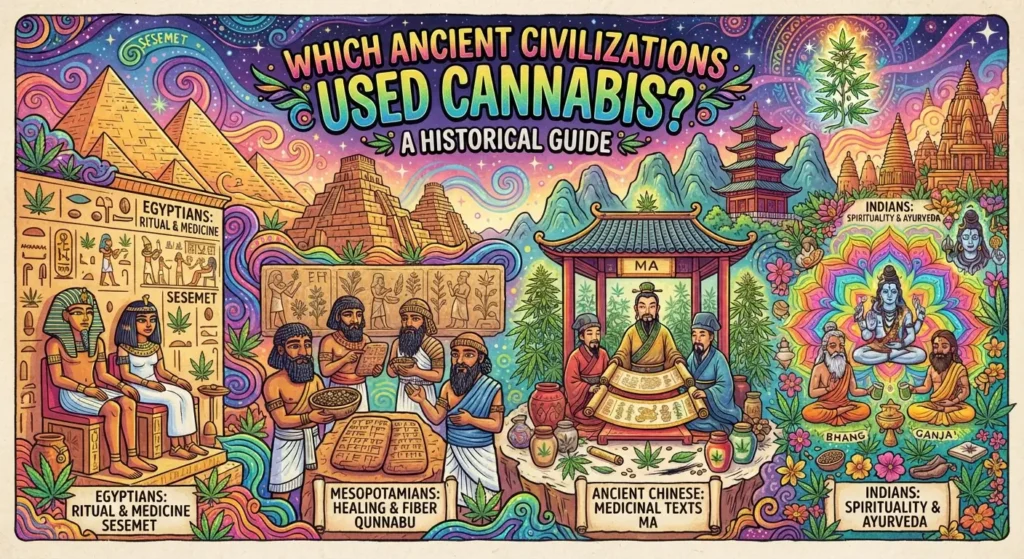
The short answer is that several ancient societies in Asia used cannabis, but no single civilization can be confidently named as the one “first” to use weed in every sense.
Archaeological and scientific evidence points to long-term relationships between humans and cannabis in Central Asia and China. People used the plant for fiber, seeds, food, medicine, trade and possibly ritual purposes. Chemical evidence from a 2,500-year-old cemetery in the eastern Pamirs shows that cannabis was burned in funerary contexts during the first millennium BCE.
Other findings from the Yanghai Tombs in Xinjiang, China, reveal cannabis preserved in a 2,700-year-old burial associated with a possible shaman. Researchers have suggested medicinal, ritual or psychoactive uses, although the exact purpose remains open to interpretation.academic.
This article examines the strongest evidence, explains which ancient communities used cannabis and separates established facts from claims that remain uncertain.
What Is the Earliest Evidence of Cannabis Use?
The earliest evidence of cannabis involves cultivation, plant remains and material use, but the date of the first psychoactive use is harder to establish.
Researchers have identified ancient cannabis-related evidence in parts of:
- Central Asia.
- China.
- The eastern Pamirs.
- South Asia.
- The Middle East.
- Africa.
- Europe.
A key distinction is necessary:
The presence of cannabis in an archaeological site does not automatically prove that people used it for intoxication.
Cannabis seeds may have been used as food. Fibers may have been used for rope or textiles. Pollen may indicate nearby plants rather than deliberate cultivation.
Stronger evidence of psychoactive use may include:
- Chemical residues containing cannabinoids.
- Burned plant material.
- Specialized braziers or smoking vessels.
- Ritual or funerary context.
- Written descriptions that identify the plant and its effects.
- High-THC cannabis remains.
- Multiple forms of evidence from the same site.
🔥REFER A FRIEND
THEY GET 10% OFF THEIR FIRST ORDER🔥
Cannabis may have been present before documented use
A scientific review places cannabis evidence near the Altai Mountains and suggests human interaction with the plant may extend back approximately 12,000 years. The researchers also describe how cannabis seeds may have accompanied the migration of nomadic peoples.tandfonline
However, the date of early plant presence is not the same as the date of the first deliberate use for intoxication. Archaeology can identify traces, but it cannot always reconstruct intention.
Ancient China and the Yanghai Tombs
Ancient China provides some of the most discussed archaeological evidence of cannabis use.
At the Yanghai Tombs near Turpan in Xinjiang, researchers found cannabis remains in a grave dating back approximately 2,700 years. The burial was associated with a male individual described in research as a possible Caucasian shaman, along with objects that may have had ritual significance.
The cannabis was unusually well preserved, allowing researchers to examine its physical and chemical characteristics.
Possible interpretations include:
- Medicinal use.
- Ritual use.
- Burial symbolism.
- Fiber production.
- Psychoactive use.
- A combination of these roles.
The evidence is valuable because it shows cannabis was important enough to be placed in a burial context. But it does not provide a complete explanation of how the person used the plant.
Was the Yanghai cannabis psychoactive?
Researchers have discussed the possibility that the cannabis had psychoactive properties. The plant material appeared to contain characteristics associated with higher cannabinoid production, but archaeological interpretation must avoid turning possibility into certainty.
A burial containing cannabis can support the argument that the plant held cultural or practical value. It does not automatically prove that the individual consumed it for recreational intoxication.
Expert Insight: The best historical writing uses calibrated language. “Evidence suggests” is more accurate than “archaeologists proved” when the original purpose of an artifact remains uncertain.
Cannabis Smoking in the Ancient Pamirs
The strongest evidence for early cannabis smoking comes from the Jirzankal Cemetery in the eastern Pamirs.
Researchers analyzed wooden braziers recovered from funerary contexts and identified chemical residues associated with cannabis. Some residues indicated the presence of cannabinoids linked to psychoactive cannabis. The site dates to approximately 2,500 years ago.
The findings suggest that cannabis was burned during ritual or mortuary ceremonies.
This discovery matters for three reasons:
- It provides chemical evidence rather than only plant fragments.
- It connects cannabis with burned material in specialized vessels.
- It places cannabis use within a funerary and ceremonial context.
The study does not prove that every person at the site smoked cannabis or that the practice resembled modern smoking. It supports a more specific conclusion: some people in the ancient Pamir region burned cannabis in ritual settings.
Why chemical residue matters
Archaeological objects can be difficult to interpret visually. A wooden bowl may look like an ordinary household item, while chemical analysis reveals what it contained or burned.
Residue analysis can identify:
- Cannabinoid compounds.
- Plant oils.
- Charred substances.
- Fermented materials.
- Aromatic compounds.
- Other chemical markers.
This scientific approach helps researchers distinguish between a vessel used for food, incense or psychoactive plant material.
Central Asian Peoples and Cannabis
Central Asia appears repeatedly in cannabis history because it was a major zone of plant diversity, migration and cultural exchange.
The region included routes connecting:
- China.
- The Eurasian steppe.
- South Asia.
- Iran.
- The Middle East.
- Europe.
Cannabis could move through these networks as:
- Seeds.
- Fiber.
- Textiles.
- Medicinal preparations.
- Ritual knowledge.
- Agricultural practices.
- Trade goods.
Nomadic groups may have played an important role in spreading cannabis seeds and knowledge across broad territories. But historians should avoid treating “Central Asians” as one unified civilization. The region contained many communities with different languages, economies, religions and social practices.
Cannabis and the Silk Road
The Silk Road was not one road but a network of routes. Cannabis-related products and knowledge may have traveled through these routes along with spices, textiles, metals, medicines and religious ideas.
Cannabis may have been especially useful because it could serve several purposes at once:
- Durable fiber.
- Portable seeds.
- Medicinal material.
- Ritual substance.
- Agricultural crop.
Its value was not limited to its psychoactive effects.
Cannabis in Ancient South Asian Traditions
Cannabis also appears in the cultural and medical history of South Asia.
Historical sources and later traditions associate cannabis preparations with certain ritual, social and medicinal practices. Bhang, for example, has been linked to regional customs and religious observances.
However, ancient texts can be difficult to interpret because:
- Plant names change across languages.
- Translations may be disputed.
- Later commentators may reinterpret older passages.
- A reference to an intoxicating plant may not identify cannabis with certainty.
- Modern categories may not match ancient categories.
Some popular articles claim that cannabis was central to every major South Asian religious tradition. That is too broad. The historical record is more varied, with practices differing by region, period and community.
Medicine and traditional preparations
Traditional cannabis preparations could differ in:
- Plant material.
- Potency.
- Preparation method.
- Dosage.
- Additives.
- Cultural purpose.
Modern cannabis products are not interchangeable with historical preparations. A contemporary edible, vape or concentrated extract may have much higher or more predictable cannabinoid content than products available centuries ago.
Historical use can provide cultural context, but it should not be presented as medical proof.
Cannabis as Fiber, Food and Industrial Material
Many ancient societies used cannabis for non-intoxicating purposes.
Hemp fiber could be used for:
- Rope.
- Nets.
- Clothing.
- Bags.
- Household textiles.
- Sailcloth.
- Cordage.
- Paper-like materials.
Cannabis seeds could be used for:
- Food.
- Oil.
- Animal feed.
- Trade.
- Agricultural propagation.
🔥 Stack your savings. Elevate your session. 10% off $100, up to 25% off $450.
🔥 Roll into the menu and start saving. CLICK HERE!
This practical history is often overshadowed by modern discussions of marijuana. Yet fiber and seed use may represent some of humanity’s earliest relationships with cannabis.
Why non-psychoactive use matters
A seed found in an ancient settlement does not necessarily indicate a drug culture. It may reflect ordinary farming or food preparation.
For this reason, historians classify evidence by strength:
| Evidence type | What it may indicate | What it cannot prove alone |
|---|---|---|
| Cannabis seeds | Food, farming or trade | Psychoactive use |
| Hemp fibers | Textiles, rope or nets | Ritual intoxication |
| Pollen | Nearby plants or cultivation | Deliberate human use |
| Burned plant remains | Heating, cooking or ritual burning | Cannabis smoking |
| Cannabinoid residues | Cannabis exposure or burning | Exact social purpose |
| Written references | Cultural or medicinal knowledge | Accurate botanical identification |
| Burial placement | Symbolic or practical importance | How the deceased consumed it |
This distinction makes historical cannabis writing more accurate and more trustworthy.
Cannabis in the Middle East, Africa and Europe
Cannabis history extends beyond China and Central Asia, although evidence varies by region and period.
The Middle East
Cannabis appears in historical discussions of medicine, fiber, trade and intoxicating preparations in parts of the Middle East. Written evidence must be interpreted carefully because translations and plant identification are not always straightforward.
Africa
Research has examined evidence of cannabis use in parts of Africa, including archaeological traces and historical accounts. The plant may have arrived through trade routes and later developed different social roles across regions.academic.oup
Europe
European societies valued hemp for rope, textiles and maritime purposes. Hemp production became especially important for naval powers that needed strong cordage and sail materials.
This industrial history often existed separately from the psychoactive cannabis traditions documented in Central and South Asia.
Which Ancient Civilization Used Cannabis First?
No single civilization can be identified with complete certainty as the first to use cannabis for every purpose.
A more accurate answer is:
- Early cannabis cultivation and material use are strongly associated with parts of Asia.
- Ancient Chinese sites provide important evidence of cannabis in burial and agricultural contexts.
- Central Asian sites provide some of the strongest evidence of ritual cannabis burning.
- South Asian traditions preserve historical and cultural references to cannabis preparations.
- Later trade networks helped spread cannabis, hemp and related knowledge.
The answer depends on what “used” means.
| Meaning of “used cannabis” | Likely evidence |
|---|---|
| Grew the plant | Early agricultural remains in Asia |
| Used cannabis fiber | Ancient textiles, rope and cordage |
| Ate cannabis seeds | Food remains and historical records |
| Used cannabis medicinally | Medical texts and traditional preparations |
| Burned cannabis | Chemical residue from ritual vessels |
| Used cannabis for intoxication | Cannabinoid evidence plus ritual or smoking context |
This is why a responsible article should not declare one civilization the winner of an ancient “first.”
A Practical Historical Research Method
If you want to evaluate a claim about ancient cannabis use, follow these steps.
Step 1: Identify the source type
Is the claim based on:
- A peer-reviewed study?
- An archaeological report?
- A museum article?
- A historical text?
- A popular blog?
- A social media post?
The source type affects how much confidence you should place in the claim.
Step 2: Ask what was actually found
Was it:
- A seed?
- Fiber?
- Pollen?
- A burned residue?
- A written reference?
- A specialized vessel?
- A burial offering?
Different findings support different conclusions.
🔥REFER A FRIEND
THEY GET 10% OFF THEIR FIRST ORDER🔥
Step 3: Separate date from interpretation
A site may be thousands of years old, but the researchers may still be uncertain about how cannabis was used.
Step 4: Compare independent sources
Check whether academic papers, museums and institutional sources describe the evidence consistently.
Step 5: Avoid modern assumptions
Ancient people did not necessarily use cannabis in the same ways as modern consumers. A ritual brazier is not the same as a vape cartridge, and a hemp textile is not evidence of recreational marijuana use.
A Real-World Example: Interpreting Jirzankal Cemetery
Consider the 2,500-year-old braziers from Jirzankal Cemetery.
A weak article might say:
Ancient Chinese people smoked marijuana at funerals exactly as people do today.
That sentence goes too far.
A stronger interpretation says:
Chemical analysis identified cannabinoid residues in wooden braziers from a 2,500-year-old funerary site in the eastern Pamirs, suggesting that cannabis was burned during ritual ceremonies.
The second sentence is better because it identifies:
- The location.
- The date.
- The evidence.
- The likely context.
- The remaining uncertainty.
This is the kind of precision that improves E-E-A-T and gives AI search systems a clean, quotable answer.
Ancient Cannabis Use and Modern Cannabis Culture
Modern cannabis culture inherits some themes from history, including:
- Ritual use.
- Herbal medicine.
- Trade.
- Agricultural cultivation.
- Social identity.
- Prohibition and resistance.
- Community traditions.
But modern cannabis culture is not a direct continuation of one ancient civilization.
Today’s market includes:
- Standardized products.
- Laboratory testing.
- Branded packaging.
- Licensed dispensaries.
- Online ordering.
- Cannabis delivery.
- THC and CBD labels.
- Digital marketing.
- Product reviews.
The historical relationship is real, but the commercial system is new.
History should not become a marketing shortcut
Cannabis brands sometimes use ancient imagery to suggest authenticity, wellness or timeless safety. Consumers should evaluate these claims carefully.
A reference to ancient use does not establish:
- Modern product safety.
- Medical effectiveness.
- Appropriate dosage.
- Legal status.
- Quality control.
- Suitability for a particular person.
History adds context. It does not replace scientific evidence or professional advice.
🔥 Stack your savings. Elevate your session. 10% off $100, up to 25% off $450.
🔥 Roll into the menu and start saving. CLICK HERE!
Frequently Asked Questions
Which ancient civilization used cannabis first?
No single civilization can be proven to be the first cannabis user in every sense. Evidence points to ancient communities in Central Asia and China, with cannabis used for fiber, seeds, medicine and possibly ritual purposes. Different types of archaeological evidence support different dates and interpretations.
Did ancient Chinese people use cannabis?
Yes, archaeological findings in ancient China show cannabis remains associated with burials and settlements. The Yanghai Tombs contained approximately 2,700-year-old cannabis material, but researchers continue to debate whether it served medicinal, ritual, fiber-related or psychoactive purposes.academic.
Where is the earliest evidence of cannabis smoking?
Some of the earliest direct evidence comes from the Jirzankal Cemetery in the eastern Pamirs. Researchers found cannabinoid residues in wooden braziers dating to approximately 2,500 years ago, suggesting cannabis was burned during funerary ceremonies.
Did ancient civilizations use cannabis as medicine?
Historical evidence suggests that some societies used cannabis preparations medicinally, but ancient remedies varied widely in strength, preparation and dosage. Historical use does not prove that a modern cannabis product is safe or effective for every medical condition.
Was cannabis used mainly for getting high?
No. Cannabis was also used for fiber, rope, textiles, food, oil, agriculture and trade. Archaeological evidence of cannabis does not automatically indicate psychoactive use, which requires stronger contextual or chemical evidence.
Final Takeaway
Ancient cannabis history is shared across multiple regions rather than owned by one civilization.
China and Central Asia provide some of the strongest archaeological evidence. The Yanghai Tombs show that cannabis held significance in an ancient burial context, while the Jirzankal Cemetery provides chemical evidence of cannabis being burned during funerary rituals.
Other societies used hemp for fiber and seeds, while South Asian traditions preserved medicinal and cultural relationships with cannabis.
The most accurate answer to “Which ancient civilization used weed?” is therefore not a single name. It is a broader historical conclusion: people across Asia and other regions interacted with cannabis in different ways over thousands of years, and the evidence must be interpreted according to the specific use being studied.