
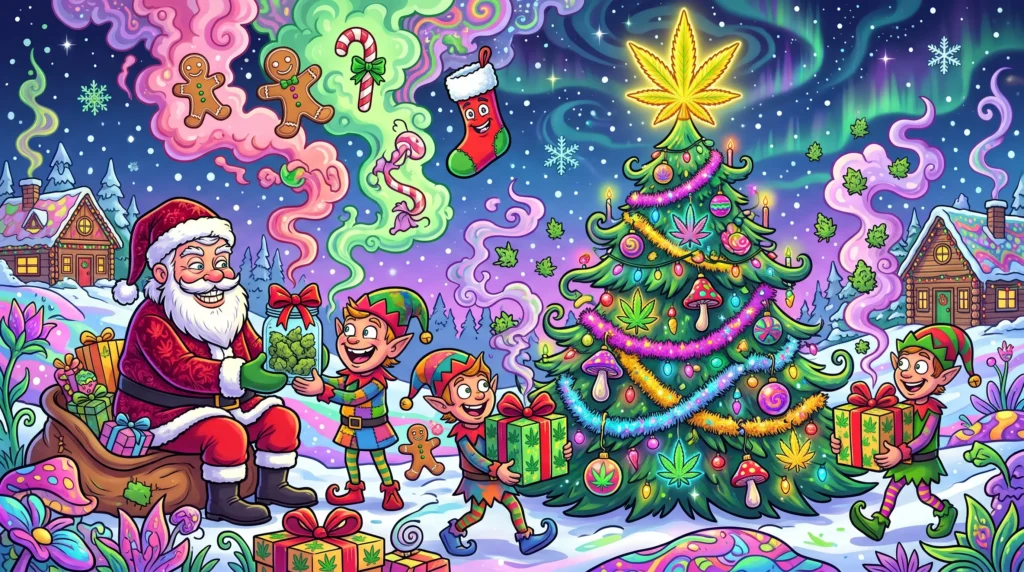
A Christmas tree fills a room with the sharp, clean scent of pine. A jar of cannabis flower may smell earthy, citrusy, or herbal. At first, they seem unrelated.
Then you notice something: both scents can change the mood of a room. Both are tied to plants, ritual, memory, and the human need to make winter feel less dark.
Cannabis and Christmas are not the same thing. One is a cultural and religious holiday; the other is a regulated plant with legal and health considerations. But their shared connections—evergreens, terpenes, winter solstice traditions, scent, gift-giving, and celebration—are more meaningful than most people realize.
This article explains the botanical, historical, sensory, and modern links between cannabis and Christmas. It also separates credible history from popular myth and offers practical guidance for adults who choose to include cannabis in a legal holiday celebration.
The Short Answer
Cannabis and Christmas share cultural, botanical, and seasonal connections—not a direct origin story. Both are associated with winter plants, aromatic compounds, ritual, gathering, relaxation, and gift-giving.
Cannabis has documented links to ancient Eurasian purification and funeral rituals. It may also have appeared in some European Yule-related customs. However, it was not a universal or central Christmas tradition, and modern claims should be treated carefully.
🔥REFER A FRIEND
THEY GET 10% OFF THEIR FIRST ORDER🔥
The Botanical Connection
Cannabis and Christmas trees share more than a seasonal association. They are both plants that produce aromatic compounds called terpenes.
Christmas trees are usually conifers: firs, spruces, or pines. These evergreens have long symbolized endurance because they remain green through winter.
Cannabis is an annual flowering plant. It produces a sticky, aromatic resin that can help protect it from environmental stress, pests, and ultraviolet radiation. Terpenes are part of that protective system.
Terpenes Explain the Scent Overlap
The familiar pine scent comes largely from compounds such as alpha-pinene and limonene. Cannabis can also contain pinene and limonene, along with terpenes such as myrcene, caryophyllene, and linalool.
That is why a Christmas tree lot and a cannabis dispensary can trigger a similar sensory response. Your nose recognizes familiar plant chemistry, even if the plants belong to different botanical families.
| Plant feature | Christmas trees | Cannabis |
|---|---|---|
| Plant type | Usually coniferous evergreens | Annual flowering plant |
| Signature aroma | Pine, citrus, woody, fresh | Earthy, citrus, herbal, floral, skunky |
| Key terpenes | Often pinene and limonene | May include pinene, limonene, myrcene, and others |
| Biological role | Defense, communication, environmental response | Defense, communication, environmental response |
| Cultural use | Winter decoration and seasonal ritual | Ritual, medicine, fiber, food, and adult recreation |
Terpenes are not unique to cannabis. They are widespread in plants and can serve as natural defenses against insects and other threats.
Expert insight: The overlap is chemical, not mystical. Two unrelated plant lineages can evolve similar aromatic strategies because both face pests, weather, and environmental stress.
Winter Solstice and Ancient Ritual
Long before Christmas became a widely recognized holiday, communities across the Northern Hemisphere marked the winter solstice.
The solstice is the shortest day and longest night of the year in the Northern Hemisphere. For many early societies, it represented a turning point: darkness had reached its peak, but daylight would slowly return.
Evergreens, fire, candles, feasting, and gift-giving became ways to express hope during a difficult season. Many of those customs later became part of Christmas traditions.
Cannabis in Ancient Eurasia
Cannabis has a documented relationship with ritual in parts of ancient Eurasia. The Greek historian Herodotus described Scythian mourners placing hemp seeds on heated stones inside an enclosed tent after a funeral. The resulting vapor was part of a purification practice.
Archaeological evidence adds support to that account. Researchers recovered half-burned cannabis seeds from a bronze burner in a burial mound at Pazyryk, dating to the second or third century BCE.
These rituals were not Christmas celebrations. They were funeral and purification rites. Still, they show that cannabis has long been connected to human rituals involving death, memory, transformation, and community.
From Yule to Christmas
Christmas did not appear in a cultural vacuum. As Christianity spread through Europe, it often absorbed or reshaped existing winter customs.
Evergreen branches, candles, feasting, and gift exchange carried meanings from earlier seasonal traditions. The evergreen tree became the Christmas tree. Winter celebrations became part of a Christian holiday calendar.
Cannabis followed a different path. It remained part of some regional folk practices, but it did not become a mainstream Christmas symbol.
What We Can Say With Confidence
- Cannabis was used in some ancient Eurasian ritual contexts.academic.
- Winter solstice customs influenced later Christmas traditions.
- Cannabis may have appeared in certain European Yule-related smudging or smoking customs.
- There is no strong evidence that cannabis created Christmas or directly shaped its central traditions.
- The modern cannabis-Christmas overlap is largely cultural, commercial, and legal—not ancient continuity.
Pro tip: Be skeptical of sweeping claims such as “cannabis invented Christmas.” The stronger, more accurate story is that both belong to a broader human history of using plants, light, food, and ritual to face winter.
The Sensory Parallels
Christmas and cannabis both engage the senses. That is one reason the comparison feels natural.
Smell is especially powerful. The brain processes scent through regions involved in memory and emotion. This is why pine, cinnamon, gingerbread, or a familiar strain aroma can instantly bring back a memory.
Scent, Light, and Anticipation
Christmas is built around sensory cues:
- Pine needles and wreaths.
- Cinnamon, cloves, orange, and baked goods.
- Candles, firelight, and string lights.
- Wrapped gifts and countdown calendars.
Cannabis culture has its own sensory rituals:
- The aroma of fresh flower.
- The glow of a lighter or vape device.
- The careful selection of a strain.
- The slow onset of an edible.
- The shared experience of a legal social setting.
Both traditions create anticipation. Christmas builds toward a morning of gifts. Cannabis use can build toward a chosen experience, especially when someone prepares a low-dose edible or selects a product carefully.
The important difference is consent and safety. A holiday scent is optional for everyone in the room. Cannabis smoke, vapor, or edibles can affect other people, so it should never be assumed welcome.
Cannabis Became a Holiday Gift
Cannabis has become a growing holiday gift category in legal markets. The reason is familiar: people give gifts that offer comfort, pleasure, relaxation, or a personal touch.
A cannabis gift can be a flower strain, a pre-roll, a low-dose edible, a topical, a beverage, or an accessory such as a grinder or storage container.
But cannabis gifting is not like gifting a candle or a sweater. Laws vary by state, city, and product type. Cannabis remains federally regulated, even as many states permit adult use.
🔥 Stack your savings. Elevate your session. 10% off $100, up to 25% off $450.
🔥 Roll into the menu and start saving. CLICK HERE!
How to Choose a Cannabis Gift
Match the gift to the person—not to a stereotype.
| Recipient style | Better gift fit | Avoid |
|---|---|---|
| Beginner | Low-dose, clearly labeled edible or beverage | High-THC products or vague dosing |
| Flower consumer | Quality grinder, storage jar, rolling accessories | Cheap, unlabeled accessories |
| Edible lover | Individually dosed infused chocolate or gummies | Homemade edibles with unknown potency |
| Wellness-focused adult | Topical, CBD-dominant product, herbal tea | Products with unverified health claims |
| Design-minded friend | Decorative storage, glassware, or a curated gift set | Products that look like children’s candy |
Expert insight: The best cannabis gift is not necessarily the strongest product. It is the one that fits the recipient’s experience level, preferences, local laws, and comfort with consumption.
Modern Holiday Products
Cannabis-themed holiday products have moved beyond novelty items. In legal markets, consumers may find infused chocolates, peppermint-flavored edibles, THC beverages, gift sets, and seasonal accessories.
These products can feel familiar because they borrow the language of holiday indulgence: chocolate, peppermint, eggnog, warm drinks, and shared desserts.
That familiarity can also create risk. A cannabis-infused brownie can look like an ordinary dessert. A gummy can resemble candy. Clear labeling and secure storage matter.
Christmas Traditions and Cannabis Culture
| Christmas tradition | Cannabis-culture counterpart | Shared function |
|---|---|---|
| Decorating an evergreen tree | Cannabis-themed ornaments or decor | Marking the season with greenery |
| Exchanging gifts | Cannabis gift sets or accessories | Expressing care through a chosen item |
| Sharing festive food | Sharing clearly labeled edibles, where legal | Creating a communal experience |
| Lighting candles | Lighting a vape or using another legal product | Setting a mood |
| Advent countdown | Product selection and preparation | Building anticipation |
| Post-dinner dessert | Low-dose infused treat, where legal | A shared moment of indulgence |
The table describes cultural parallels. It does not imply that cannabis belongs in every home, every celebration, or every guest’s holiday experience.
Why the Connection Matters
Understanding the overlap between cannabis and Christmas can reframe the conversation. Instead of treating cannabis only as a taboo or punchline, it can be discussed as part of a longer human relationship with plants, ritual, and seasonal celebration.
That does not erase real concerns. Cannabis can impair judgment and coordination. It can interact with alcohol and medications. It is not appropriate for minors, people who are pregnant, people with certain health conditions, or anyone who does not want to use it.
But recognizing history can reduce stigma without ignoring responsibility.
A Step-by-Step Holiday Guide
If cannabis is legal where you live and you plan to include it in a holiday gathering, use a thoughtful approach.
Step 1: Learn the Local Rules
Check state, local, venue, and landlord rules before buying or gifting cannabis. Recreational cannabis is legal in 24 states, Washington, D.C., Guam, and the Northern Mariana Islands, but federal law still classifies marijuana as a Schedule I controlled substance.
Do not assume that a product can be shipped, gifted, consumed in public, or brought across state lines simply because it was purchased legally.
Step 2: Know the Recipient
Ask what the person already uses and enjoys. A daily consumer, an occasional edible user, and a curious beginner need very different gifts.
Avoid giving cannabis to someone who has never used it, has a substance-use concern, is pregnant, takes medications that may interact with it, or simply does not want it.
Step 3: Pair a Product With an Accessory
A thoughtful gift often combines a consumable item with something practical.
Examples include:
- A low-dose edible with a labeled storage tin.
- A pre-roll with a quality lighter.
- A THC beverage with a festive glass.
- A topical product with a small gift box.
- A grinder with a decorative storage container.
This approach mirrors a classic holiday gift: something useful paired with something enjoyable.
Step 4: Label and Store Everything Clearly
Keep cannabis products away from children and pets. Store them in their original packaging, out of sight, and separate from regular food.
Never place an unlabeled edible in a shared dessert tray. If a child or pet may have consumed cannabis, contact poison control or a veterinarian promptly.
Step 5: Plan Transportation Before Celebrating
Cannabis can impair reaction time, coordination, and judgment. Alcohol can intensify impairment.
Arrange a designated driver, rideshare, public transit, or overnight stay before the celebration begins. No holiday tradition is worth a preventable crash.
🔥REFER A FRIEND
THEY GET 10% OFF THEIR FIRST ORDER🔥
A Mini Case Study: A Safer Holiday Gathering
Imagine an adult-only holiday dinner in a state where recreational cannabis is legal. The host wants to offer options without pressuring anyone.
The host sends a message before the event: “We’ll have alcoholic and non-alcoholic drinks, plus a clearly labeled low-dose cannabis option for interested adults. No pressure either way.”
At the gathering, cannabis products remain sealed and stored away from the dessert table. Each portion is individually labeled. The host offers food, water, and non-cannabis desserts.
No one drives after using cannabis or alcohol. Guests who decline are offered sparkling water, pie, and a seat near the fire.
The result is simple: the celebration remains festive, inclusive, and safe.
The Shared Language of Celebration
Cannabis and Christmas are connected through botany, history, scent, ritual, and the evolving culture of gift-giving.
Evergreens have symbolized resilience for millennia. Winter solstice traditions used light, food, and community to push back against darkness. Cannabis has appeared in ritual contexts across ancient Eurasia and may have been part of some regional winter customs.
The modern connection is different. It reflects changing laws, adult consumer culture, and a growing willingness to treat cannabis as part of some people’s everyday lives.
The strongest takeaway is not that cannabis belongs at every Christmas table. It is that both cannabis and Christmas tap into something old and human: the desire to find warmth, meaning, and connection during the darkest time of year.
Key Takeaways
- Cannabis and Christmas share themes, not a direct historical origin.
- Terpenes explain part of the sensory overlap between pine, citrus, herbs, and cannabis.
- Ancient cannabis rituals were real, especially in Eurasian funeral and purification practices.
- Christmas traditions evolved from older winter customs, including evergreens, feasting, and gift-giving.
- Cannabis gifts should be legal, labeled, age-appropriate, and matched to the recipient.
- Safety is non-negotiable: no impaired driving, no unmarked edibles, and no pressure to participate.
🔥 Stack your savings. Elevate your session. 10% off $100, up to 25% off $450.
🔥 Roll into the menu and start saving. CLICK HERE!
FAQs
What do cannabis and Christmas trees have in common?
Both produce aromatic terpenes, the plant compounds responsible for many distinctive scents. Pine and cannabis can share terpenes such as pinene and limonene, which plants use for defense, communication, and environmental response.
Did ancient winter solstice celebrations involve cannabis?
Some ancient Eurasian rituals involved cannabis, including Scythian purification practices after funerals. That does not prove cannabis was a widespread Christmas tradition, but it shows a long historical connection between cannabis and ritual.
Why has cannabis become a popular Christmas gift?
Cannabis gifting follows the broader holiday desire to give comfort, relaxation, and a personal experience. In legal markets, consumers may choose flower, low-dose edibles, beverages, topicals, or accessories—but local laws and product safety must come first.
How do I choose a cannabis gift for someone?
Match the gift to their experience and preferences. Beginners do best with clearly labeled low-dose products; flower consumers may appreciate accessories; edible lovers may prefer individually dosed treats. Always verify local law and avoid pressuring anyone.
Can cannabis be shipped as a Christmas gift?
Usually no. Cannabis products generally cannot be mailed or shipped across jurisdictions, and rules differ by state and product type. In most cases, legal gifting requires in-person delivery to an eligible adult under local law.
Next Steps
If you are shopping for a cannabis lover this holiday season, start with their habits—not a generic “stoner gift” list.
Choose something legal, clearly labeled, useful, and appropriate for their experience level. Then pair it with a thoughtful note, a safe consumption plan, and respect for anyone who prefers to skip it.
The evergreen on the doorstep and the flower in a jar may come from different worlds. But both remind us why people have always gathered in winter: to share warmth, memory, and a little light.