
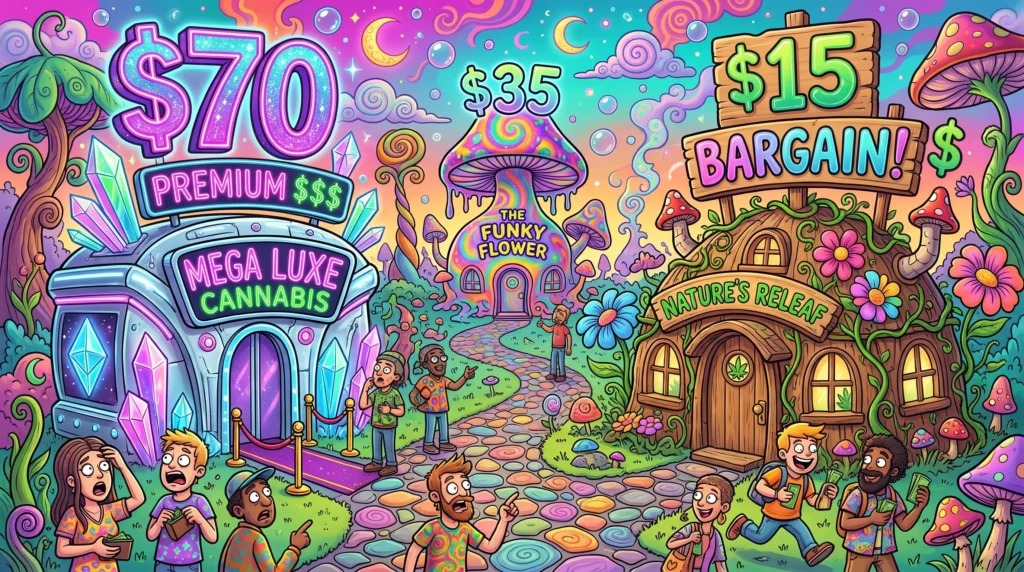
Picture this: You’re standing in a licensed retail store in Vancouver, British Columbia. You pick up a jar of “Blue Dream,” a classic sativa-dominant hybrid. The label reads $42.00 CAD for 3.5 grams. It feels steep, but you accept it as the cost of doing business in a major metropolitan hub. A week later, you fly home to Edmonton, Alberta. You walk into a competing retailer near your neighborhood. Same strain name, similar packaging aesthetic, same genetic lineage claimed on the website. But here, the price tag is $28.00 CAD.
Your immediate reaction isn’t joy; it’s suspicion. Is the Alberta product fake? Did the Vancouver store make a mistake? Or is there a hidden economic engine running beneath the surface of the Canadian cannabis market that most consumers ignore?
This scenario plays out daily across Canada. Since federal legalization in October 2018, the country has struggled with extreme price volatility between provinces, cities, and even individual storefronts within the same postal code. Unlike the United States, where state laws create fragmented markets, Canada operates under a single federal framework (the Cannabis Act), yet local execution creates wildly different realities.
Understanding why these disparities exist is no longer optional for savvy Canadian buyers. With the recent implementation of excise duty reductions and ongoing debates about illegal market competition, knowing the levers of pricing empowers you to vote with your wallet effectively. This guide dissects the seven critical factors driving cannabis price variance in Canada, moving beyond simple speculation to hard data and structural analysis.
Provincial Taxation Structures: The Hidden Markup
The primary driver of price differences across Canada is not the cost of the weed, but the cost of the government. While the federal excise duty applies nationally, provinces add their own sales taxes (GST/HST/PST/QST) and, crucially, specific provincial levies or regulatory fees.
For instance, British Columbia imposes a distinct tax structure compared to Quebec. In some provinces, the retail margin is capped by regulation, forcing stores to compete on volume rather than markup. In others, margins are free-floating, allowing retailers to adjust prices based on overhead. When you see a higher price in one province, it is often because the local government takes a larger cut per transaction.
However, a significant shift occurred recently. The federal government reduced the excise duty rate to align more closely with international standards and combat the illicit market. Yet, provinces react differently. Some pass these savings directly to consumers, dropping shelf prices overnight. Others absorb the reduction to bolster public health funding or stabilize retailer margins during periods of oversupply. This inconsistency means that two jars of identical flower can have vastly different final bills depending solely on which provincial treasury they belong to.
Expert Insight: Always check if the displayed price includes GST/HST. In many Canadian jurisdictions, advertised prices exclude tax, meaning a “$30” jar could actually cost $33–$39 at checkout depending on your province’s combined tax rate. Never compare sticker prices without calculating the “landed cost.”
Supply Chain Maturity: Legacy vs. New Licensed Producers
Canada’s cannabis market is bifurcated between established giants and agile boutique LPs (Licensed Producers). The legacy brands—those that survived pre-legalization or scaled rapidly post-2018—benefit from massive economies of scale. Companies like Aurora Cannabis or Canopy Growth operate industrial-scale facilities that drive down the cost-per-gram through automation and bulk nutrient purchasing. They can afford to sell premium-looking flower at mid-tier prices because their production efficiency offsets the retail markup.
Conversely, smaller, craft-focused LPs cannot compete on volume. They rely on manual harvesting, organic soil methods, and small-batch curing. These processes increase labor costs significantly. Consequently, a boutique producer in Prince Edward Island might charge $60 for an eighth, while a mass-market producer in Saskatchewan sells comparable potency for $35. The price difference reflects philosophy: one pays for artisanal care, the other for industrial consistency.
Retailers act as the filter here. Large chains prioritize high-turnover, low-cost SKUs to maximize cash flow. Independent boutiques curate exclusive drops from micro-growers, accepting lower inventory velocity for higher perceived value. If you shop exclusively at big-box dispensaries, you will see lower average prices but less variety. If you frequent indie shops, you pay a premium for exclusivity and curation.
🔥REFER A FRIEND
THEY GET 10% OFF THEIR FIRST ORDER🔥
| Factor | Mass-Market Retailer | Boutique/Indie Retailer | Impact on Consumer Price |
|---|---|---|---|
| Sourcing | Bulk contracts with large LPs | Direct relationships with micro-LPs | Indie is 20–40% higher due to scarcity |
| Inventory Turnover | High speed, low margin | Slow speed, high margin | Big box offers deeper discounts on old stock |
| Product Range | Standardized strains | Limited edition/craft batches | Boutique charges premium for unique genetics |
| Overhead Costs | Shared corporate infrastructure | Individual lease/staffing | Corporate scales reduce per-unit overhead |
Geographic Density and Competition Levels
Location within Canada dictates competitive pressure. In dense urban centers like Toronto or Montreal, dozens of licensed retailers may operate within a few square kilometers. This saturation triggers aggressive price wars. To survive, stores slash margins, offer loyalty rebates, and discount slow-moving inventory heavily. You will find frequent “flash sales” and bundle deals (e.g., “Buy 2 Get 1 Free”) in these hotspots.
In contrast, rural areas or smaller towns in Northern Ontario or the Prairies may have only one or two authorized retailers. Without direct competition, these stores maintain higher baseline prices. There is no incentive to discount when customers have nowhere else to go. Furthermore, shipping logistics to remote locations add freight costs that are passed down to the consumer. A gram of flower sold in downtown Calgary might cost $25, while the exact same SKU in a remote community in Northwest Territories could hit $45 due to cold-chain transportation expenses and lack of local competition.
Pro Tip: If you live in a saturated market, wait until the end of the month. Many retailers aim to meet monthly sales quotas set by head office. During the last 3–5 days of the month, expect increased promotional activity and steeper discounts as managers push to clear inventory targets.
The Federal Excise Floor: The Cost That Follows Every Gram
Every gram of legal cannabis in Canada carries a federal excise duty of the greater of $1 per gram or 10% of the producer’s list price, and that duty is already embedded in the wholesale cost before any province touches it. Health Canada collects this at the cultivator or processor level. It is not a line item at the register. It is baked into the shelf price you see.
The structure matters more than the headline rate. For cheap flower, the $1-per-gram flat rate dominates. For premium flower, the 10% ad valorem component can exceed the flat rate once the producer’s wholesale price passes roughly $10 per gram. That creates a pricing floor that disproportionately affects budget products: a $4-per-gram wholesale flower carries a 25% excise burden, while a $12-per-gram craft flower carries a proportionally lighter 10% burden. The federal tax is regressive with respect to quality.
On top of the excise duty, licensed producers pay a Health Canada annual regulatory fee of 2.3% of revenues. That fee, like the excise, is a cost of doing business that flows into the wholesale price and eventually the retail menu.
Expert Insight: The excise duty is the one cost that no province can undercut. A dispensary in Alberta and a dispensary in Quebec are both paying the same federal floor on the same gram of flower. The divergence begins after that gram leaves the producer’s loading dock.
Provincial Sales Tax: The Register Shock That Varies by Province
The sales tax you pay at the register ranges from 5% to 15% depending on the province, and that alone can create a double-digit percentage gap in out-the-door price between two stores selling identical wholesale product. Canada’s provincial tax architecture is a patchwork of harmonized and separate taxes, and cannabis sits inside all of it.
Alberta, Yukon, the Northwest Territories, and Nunavut charge only the 5% federal GST. No provincial sales tax applies. British Columbia, Saskatchewan, and Manitoba layer a 5% GST on top of a 6% to 7% provincial sales tax. Ontario and the Atlantic provinces use a harmonized sales tax of 13% or 15%. Quebec applies 5% GST plus a 9.975% Quebec Sales Tax.
The combined effective cannabis tax at retail—counting the embedded federal excise plus the register tax—ranges from roughly 15% in Alberta and the territories to roughly 25% in Quebec and the Atlantic provinces. Ontario sits near 23%.
| Province / Region | Register Tax | Combined Effective Cannabis Tax (incl. federal excise) |
|---|---|---|
| Alberta, Yukon, NWT, Nunavut | 5% GST only | ~15% |
| British Columbia | 5% GST + 7% PST | ~22% |
| Saskatchewan | 5% GST + 6% PST | ~21% |
| Manitoba | 5% GST + 7% PST | ~22% |
| Ontario | 13% HST | ~23% |
| Quebec | 5% GST + 9.975% QST | ~25% |
| New Brunswick, PEI, Newfoundland | 15% HST | ~25% |
| Nova Scotia | 14% HST | ~24% |
A gram of flower that wholesales at $4 costs roughly $4.60 out the door in Alberta before retail margin and roughly $5.00 in Quebec before retail margin. That four-cent gap may look trivial. It compounds across every product category, every package size, and every month of a consumer’s purchasing history. And it is only one layer.
The Illicit Market Shadow Effect
Despite legalization, the illegal market still influences legal pricing strategies. Data from Statistics Canada indicates that a significant portion of cannabis consumption remains sourced from unregulated channels, particularly among younger demographics and price-sensitive buyers. Legal retailers know this. To capture market share from the black market, legitimate stores must keep prices competitive.
If the illegal market offers “street grade” weed for $15/eighth, legal retailers cannot price their entry-level products at $40/eighth without losing customers entirely. Therefore, you will see a tiered pricing strategy:
- Budget Tier: Priced aggressively ($15–$25) to mimic illegal market rates, often using lower-grade biomass or shake.
- Mid-Tier: Standard quality ($25–$40), targeting casual users who want safety and consistency.
- Premium Tier: Craft quality ($40+), targeting connoisseurs willing to pay for terpenes and aesthetics.
Stores vary widely in how much emphasis they place on each tier. A discount-heavy chain will dominate the budget sector, keeping overall average prices low. A luxury-focused dispenser will ignore the bottom tier, resulting in a higher average basket size. Understanding which segment a store targets helps explain its general price level.
Regulatory Compliance and Testing Costs
Every gram sold legally in Canada undergoes rigorous third-party testing. Health Canada mandates strict limits on pesticides, heavy metals, mold, and microbial contaminants. Each batch requires a Certificate of Analysis (CoA). For small producers, these testing fees represent a fixed cost that doesn’t scale well. A micro-grower spending $500 on lab tests for a 1kg harvest bears a higher per-gram burden than a mega-producer spreading that cost over 10 tonnes.
Retailers also bear compliance costs. Staff training, secure storage systems, video surveillance requirements, and POS software integration with government tracking systems (like BCOIA in BC or AGCO in Ontario) add operational overhead. Stores in provinces with stricter enforcement protocols or higher licensing renewal fees must recoup these costs through product markup. Thus, a dispensary in a highly regulated jurisdiction may appear more expensive simply because its administrative burden is heavier, not because the flower is superior.
How to Navigate Canadian Cannabis Pricing Wisely
Armed with this knowledge, you can stop reacting emotionally to price tags and start strategically optimizing your purchases. Here is a practical framework for Canadian consumers.
🔥 Stack your savings. Elevate your session. 10% off $100, up to 25% off $450.
🔥 Roll into the menu and start saving. CLICK HERE!
Step 1: Master the “Cost Per Gram” Calculation
Don’t look at the jar price alone. Divide the total cost by the weight.
- Example: Jar A is $40 for 7g ($5.71/g). Jar B is $25 for 3.5g ($7.14/g).
- Even though Jar A looks more expensive upfront, it is cheaper per unit of weight. However, adjust for potency. If Jar A is 15% THC and Jar B is 25% THC, calculate cost per milligram of THC. Often, the “cheaper” option is actually poor value if it lacks psychoactive efficacy.
Step 2: Leverage Provincial Online Platforms
Most provinces now have centralized online ordering systems (e.g., OCS in Ontario, SQDC in Quebec, BC Cannabis Store). These platforms allow you to compare prices across all licensed retailers in your region instantly. Use filters to sort by “Price: Low to High” for specific strains. Note that online-only retailers sometimes undercut physical stores because they save on rent and staffing, passing those savings to you via delivery-inclusive pricing.
Step 3: Monitor Harvest Dates and Batch Codes
Freshness equals potency. Older stock loses terpenes and THC. Ask budtenders for the harvest date. If a store is selling “premium” flower harvested six months ago at full price, negotiate or walk away. Look for stores that actively discount aging inventory. This is where you find the best deals on high-quality goods that are simply nearing the end of their peak window.
Step 4: Join Loyalty Programs Immediately
Canadian retailers rely heavily on retention. Sign up for every available rewards program. Points accumulate quickly, and many stores offer birthday bonuses or double-point weekends. Additionally, follow local dispensaries on social media. Flash sales are often announced exclusively via Instagram Stories or Twitter/X posts to drive foot traffic during slow hours.
Retail Model: Private Competition, Government Monopoly, and the Hybrid Middle
The structure of the retail system—purely private, government-run, or hybrid—determines how aggressively prices are competed down, even though the average price itself may not differ as much as consumers assume. Alberta and Saskatchewan operate purely private retail systems. Ontario, British Columbia, Manitoba, and Newfoundland run hybrid models: a government wholesaler supplies private storefronts. Quebec, Nova Scotia, New Brunswick, and Prince Edward Island operate full government retail monopolies through the SQDC, NSLC, Cannabis NB, and PEI Cannabis.
The intuitive assumption is that private competition produces lower prices. The evidence is more nuanced. A 2026 peer-reviewed comparison of Canadian retail systems found no significant difference in average price between private competitive and government-dominated retail models. What private systems do deliver, and deliver robustly, is variety and convenience: more SKUs, more locations, longer hours, and a wider range of product formats.
Price competition in private systems does not eliminate price gaps. It reshapes them. Two private Alberta shops may both carry the same wholesale product at different retail margins, one running a loss-leader promotion and the other holding firm on margin. A government monopoly sets a single price across its entire network, which means the “shopping around” function is outsourced to the wholesaler rather than the consumer. The price you see at the SQDC is the price everyone in Quebec sees at every SQDC. In Alberta, the price is a negotiation between the wholesaler’s landed cost and the individual retailer’s margin strategy.
The Distributor Markup: Where the Provincial Hand Enters the Price
Provincial distributors add their own markup between the producer’s wholesale price and the retailer’s shelf price, and the size of that markup varies significantly by province and product category. In Ontario, the Ontario Cannabis Store applies a fixed wholesale markup by product category—23% for dried flower, 29% for pre-rolls and infused pre-rolls, 25% for vapes and capsules—before the product reaches a private retailer. The OCS’s own e-commerce retail operation then applies a 39% markup above the wholesale price to determine its online shelf price.
British Columbia’s wholesale markup has historically been around 15%. Manitoba applies a $0.75-per-gram markup at the distributor level plus an additional percentage on top, a structure that has been adjusted upward in recent years and drawn criticism from independent retailers. The Ontario Cannabis Store’s markup on the final sale price has been estimated at 20% to 30% depending on the product category.
These markups are not hidden, but they are invisible on the menu. A consumer comparing an Alberta private shop to an Ontario private shop is comparing two products that have passed through different provincial hands with different revenue targets. The Alberta product may have passed through a leaner distributor layer. The Ontario product carries the OCS’s wholesale margin plus whatever margin the private retailer adds on top. Neither shop is necessarily more efficient. They are operating inside different provincial cost structures.
Pro Tip: When comparing prices across provinces, ignore the pre-tax menu price entirely. Calculate the out-the-door price per gram by adding the applicable sales tax to the shelf price and dividing by the net weight. A $25 pre-tax eighth in Alberta costs roughly $26.25 at the register. A $25 pre-tax eighth in Ontario costs roughly $28.25. Over an ounce, that gap exceeds $16.
Why Alberta Is Cheap and Newfoundland Is Expensive: The Geography of Competition
Alberta has the lowest cannabis prices in Canada, and the northern territories and Atlantic provinces have the highest, and the difference is driven by a combination of tax structure, retail density, and transportation cost. Budget flower in Canada starts at C$4 per gram, with premium craft running C$10 to C$16. But those national ranges mask enormous provincial variation.
Alberta’s advantage is structural. It has no provincial sales tax, a purely private retail system, and one of the densest retail footprints in the country. Alberta saw exponential expansion in the number of retail stores, and that expansion coincided with steady sales growth and aggressive price competition. Industry earnings calls have acknowledged “an element of saturation in retail doors” in Alberta, with operators describing “pretty healthy growth rates based on more aggressive price competition” through 2024 and 2025.
Ontario has the largest market by sales volume, but its hybrid model and 13% HST keep prices above Alberta’s. Ontario’s average item price was $21.64 in May 2026, with flower averaging $9.81 per gram. British Columbia sits in the middle: average item prices edged up to $23.39 in September 2026, with flower at $8.77 per gram, reflecting both premiumization and a competitive private retail market. Quebec’s SQDC offers consistently low prices through government buying power—average sale prices around $5.84 per gram in the three months ending June 2024—but the monopoly model limits variety and store density.
The northern territories face a different cost stack entirely. Transportation costs and limited competition push prices higher. A gram of flower that costs $4 to produce and ship to Calgary may cost $6 or more to land in Yellowknife, and the absence of competing shops removes the downward pressure that a dense urban market provides.
🔥REFER A FRIEND
THEY GET 10% OFF THEIR FIRST ORDER🔥
| Province | Approx. Avg. Flower Price/Gram (2025–2026) | Retail Model | Key Price Driver |
|---|---|---|---|
| Alberta | $4–$8 | Purely private | No PST; dense competition; aggressive price wars |
| Quebec | $5–$9 | Government monopoly (SQDC) | Centralized buying power; low variety; fewer stores |
| British Columbia | $5–$9 | Hybrid (BCLDB wholesale, private retail) | Competitive private retail; 12% combined PST/GST |
| Ontario | $6–$10 | Hybrid (OCS wholesale, private retail) | 13% HST; OCS markup; large but uneven retail footprint |
| Nova Scotia | $6–$11 | Government monopoly (NSLC) | 14% HST; fewer discount options |
| Newfoundland | Higher end of national range | Hybrid (government wholesale, private retail) | 15% HST; transportation costs; smaller market |
Licensing, Rent, and the Cost of Opening a Door
Retail licensing costs and commercial rent vary enough between provinces that two shops with identical wholesale costs can have completely different break-even prices. Manitoba’s retail permit structure illustrates the range: a $1,000 submission fee, a $2,000 permit application fee, and an annual permit fee of $3,000 for Winnipeg locations or $1,500 elsewhere. Producer registration runs $500. British Columbia has charged a $7,500 application fee for private retail licences. These fees are not the dominant cost of opening a dispensary, but they are real, and they differ by an order of magnitude depending on the province.
Rent is the larger variable. A dispensary on a high-traffic urban corridor in Toronto or Vancouver pays commercial rent that a shop in a smaller Alberta market does not. Cannabis businesses have historically faced landlord reluctance and zoning constraints that compress available locations and push rents above market rate. That premium flows into the shelf price.
Market Maturity and the Great Canadian Price Compression
Canadian cannabis prices have fallen dramatically since legalization, and the stage of a local market’s maturity is one of the most underappreciated reasons two stores in the same province can charge different prices. The average retail price has stabilized near C$5 per gram**, down sharply from roughly **C$10 per gram at legalization. Wholesale flower prices fell nearly 50% between January 2021 and December 2025. Licensed producers destroyed more than 425 million grams of excess inventory in a single year.
The retail footprint exploded alongside that price decline. Canada went from roughly 210 stores in April 2019 to 3,500 in April 2023, and that expansion pushed prices down 28% during the period. There are now more than 3,800 licensed stores across the provinces. The competition is real, but it is unevenly distributed. A province with a dense retail cluster experiences price competition that a province with fewer stores per capita does not. Quebec still has ten times fewer stores per capita than Ontario, a policy choice that limits the competitive pressure that drives prices down.
The market is also structurally oversupplied. Licensed production capacity exceeds domestic demand, and wholesale prices near C$3.20 per gram closely track the production costs of smaller growers, limiting profitability and driving company exits. For consumers, oversupply is a tailwind: it pushes wholesale prices down, and retail prices follow with a lag. For retailers, it is a margin squeeze. The gap between the cheapest and most expensive store in a given province is partly a function of which retailers have accepted that squeeze and which are holding onto margins in the hope that competitors blink first.
Expert Insight: The legal market has achieved near-parity with the illicit market on price. The average price gap between legal and illicit dried flower shrank to just **C$1.49 per gram by 2023**, down from over C$3 at legalization. When a legal eighth costs $5 more than a black-market eighth, the legal premium is buying testing, consistency, and the absence of legal risk. When it costs $25 more, the premium is harder to justify. That calculus changes the competitive dynamics between stores as much as the tax code does.
A Practical Framework for Comparing Canadian Dispensary Prices
The provincial variables above can feel abstract when you are scrolling a menu. Here is a step-by-step method for cutting through the noise.
Step 1: Calculate the out-the-door price per gram. Take the shelf price, add the applicable sales tax for the province, and divide by the net weight in grams. This is the only number that allows a fair comparison between an Alberta private shop and an Ontario hybrid shop. A $22 eighth in Calgary and a $28 eighth in Toronto may be closer in real terms than the menu suggests once tax and weight are normalized.
Step 2: Identify the retail model you are shopping inside. A government monopoly sets one price across its network. A private shop sets its own margin. In a private system, a low price may reflect a genuine cost advantage or a loss-leader promotion that will disappear next week. In a monopoly system, the price is stable but the variety is constrained. Neither model is inherently cheaper; they distribute the trade-off differently.
Step 3: Check the package size and the batch date. Larger formats carry lower per-gram prices across every province. Wholesale data from Ontario’s regulated market showed that a 28-gram format carried a far lower per-gram cost than a 3.5-gram one. Older flower may be discounted because terpenes have degraded, not because the dispensary is passing on a cost saving.
Step 4: Separate the brand premium from the product. National brands and craft labels command markups that reflect marketing, packaging, and perceived prestige as much as measurable quality. A house brand or value-tier flower from a vertically integrated producer may deliver a comparable experience at a significantly lower price point. Test the premium with a single purchase before treating it as a habit.
Step 5: Compare like with like across three or four stores, not two. Cannabis menus fluctuate weekly. A store that is expensive for flower may be competitive on edibles or vapes. A shop running a Tuesday promotion may be the cheapest option on Tuesday and the most expensive option on Friday. Build a small basket of products you buy regularly and check prices across a month. The pattern that emerges is more reliable than any single snapshot.
Case Study: The $22 Eighth and the $38 Eighth. A consumer compared two stores in different provinces. Store A, a private Alberta retailer, sold a 3.5-gram eighth of mid-tier flower for $22 pre-tax. With 5% GST, the out-the-door price was $23.10. Store B, a hybrid-model retailer in Newfoundland, sold a comparable eighth for $38 pre-tax. With 15% HST, the out-the-door price was $43.70. The flower in both packages tested in a similar THC range. The gap was not a quality gap. It was a tax gap, a distributor-markup gap, a transportation-cost gap, and a retail-density gap, stacked on top of one another. The Alberta consumer was not buying better weed. They were buying the same weed inside a cheaper provincial cost structure.
🔥 Stack your savings. Elevate your session. 10% off $100, up to 25% off $450.
🔥 Roll into the menu and start saving. CLICK HERE!
Conclusion: Value Is Contextual in Canada
The variation in cannabis prices across Canada is not a bug; it is a feature of a maturing, decentralized market. It reflects the tension between federal standardization and provincial autonomy, between industrial scaling and artisanal craft, and between legal compliance and illicit competition.
As a consumer, your power lies in awareness. By understanding the tax structures, supply chain realities, and geographic pressures shaping your local market, you transform from a passive buyer into an informed participant. You learn to distinguish between inflated branding and genuine quality. You recognize when a price drop signals a clearance event versus a decline in product integrity.
Next time you stand between two jars—one in Vancouver, one in Edmonton—don’t just guess. Calculate the cost per milligram, check the CoA, and consider the local tax implications. Make your choice based on data, not decoration.
Ready to optimize your next purchase? Open your preferred provincial online catalog right now. Filter by your favorite strain, sort by price, and identify three retailers offering the best value per milligram of THC. Bookmark them. That list is your new roadmap to smarter cannabis spending in Canada.
FAQ Section
Q: Why is cannabis more expensive in some Canadian provinces than others? A: Price variance is primarily driven by differing provincial tax structures (PST/HST/GST combinations) and regulatory fees. Additionally, supply chain logistics, such as shipping costs to remote regions in the North or Atlantic Canada, inflate retail prices. Provinces with fewer licensed retailers face less competition, allowing for higher margins.
Q: Does a higher price guarantee better quality in Canadian dispensaries? A: Not necessarily. Higher prices often reflect brand positioning, packaging costs, or sourcing from boutique micro-producers rather than superior potency. Always verify quality by checking the Certificate of Analysis (CoA) for THC percentage and contaminant screening. A mid-priced strain with verified high potency often offers better value than a premium-branded, low-effect product.
Q: How do I compare cannabis prices accurately across Canadian stores? A: Use the “cost per milligram of THC” formula: Divide the total price by the total milligrams of active THC in the package. This normalizes differences in weight and potency. Also, utilize provincial online catalogs (like OCS or SQDC) to filter by price and read user reviews regarding freshness and customer service reliability.
Q: Are legal Canadian cannabis prices affected by the illegal market? A: Yes. Legal retailers strategically price their budget tiers to remain competitive with the illicit market, which often offers lower prices for lower-quality product. This forces legal stores to maintain aggressive discounting on entry-level SKUs to prevent customer churn to unregulated sources, impacting overall average shelf prices.