
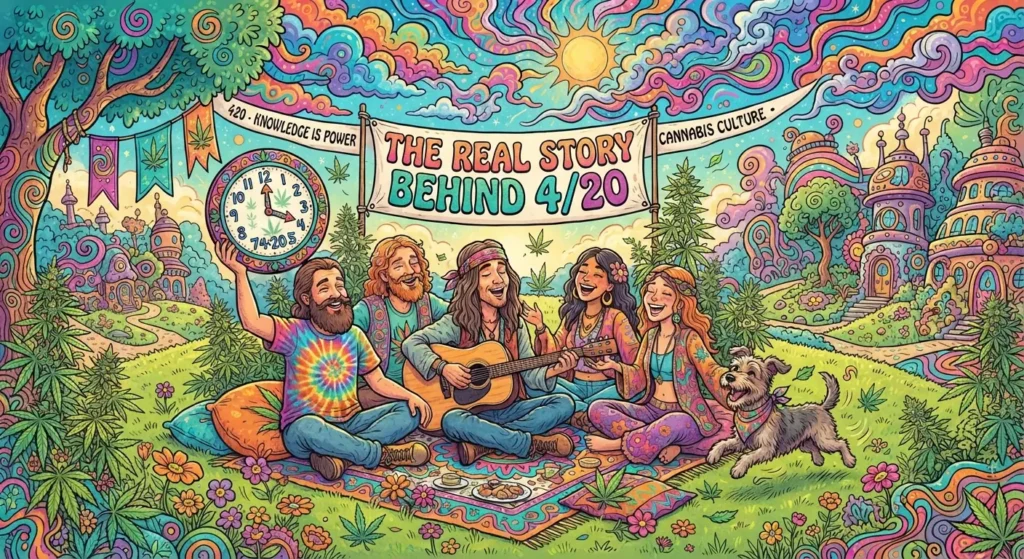
Every April 20, cannabis users, retailers, media outlets and activists reference the same number: 420. It appears on dispensary promotions, T-shirts, social posts and cannabis events around the world.
But why 420?
The most credible explanation traces the term to a group of California high school students who used “4:20” as a secret meeting time in 1971. The students, later known as the Waldos, reportedly met after school to search for an abandoned cannabis crop near San Rafael. The crop was never found, but the code survived and gradually became part of cannabis culture.
Over time, 4:20 p.m. became associated with consuming cannabis, while April 20—written as 4/20 in the United States—became an unofficial cannabis date.
This article explains where 420 came from, who the Waldos were, how the phrase spread, which popular origin stories are unsupported and why April 20 became so important to modern weed culture.
What Does 420 Mean in Cannabis Culture?
420 is a cannabis-related code and cultural reference that originated as a time—4:20 p.m.—before becoming associated with April 20 and weed culture.
The term can refer to:
- 4:20 p.m. as a time to consume cannabis.
- April 20 as an unofficial cannabis celebration.
- Cannabis culture more broadly.
- Social events, promotions and activism related to marijuana.
- A symbol of shared identity among cannabis consumers.
The number is not an official cannabis holiday, medical standard or legal designation. Its meaning is cultural rather than regulatory.
That distinction matters. A dispensary may use “420” in marketing, but the term itself does not tell you anything about product quality, potency, legality or safety.
🔥REFER A FRIEND
THEY GET 10% OFF THEIR FIRST ORDER🔥
The Waldos and the 4:20 Meeting
The most widely supported origin story begins at San Rafael High School in Marin County, California.
In 1971, a group of five students used “4:20” as a meeting time after classes. Their original objective was unusual: they were searching for an allegedly abandoned cannabis crop near Point Reyes.
The students reportedly gathered at the Louis Pasteur statue on the school grounds at 4:20 p.m. After meeting, they would use the term as a private code for their cannabis-related adventure.
The phrase reportedly appeared in variations such as “4:20 Louis,” referring to the meeting place. Over time, the students shortened it to “4:20” and used the number more broadly.
The group became known as the Waldos because they often gathered by a wall near the school. Their story has received attention from mainstream media and cannabis-history researchers, while surviving correspondence and other documentation have helped support the account.
Why did the Waldos choose 4:20 p.m.?
The time was late enough for school activities to finish but early enough to meet before the evening began.
The students reportedly could not meet at 4:20 a.m., so the afternoon became their preferred time. The number was practical before it became symbolic.
That is part of what makes the story memorable. There was no elaborate naming campaign, corporate brand strategy or official declaration. A casual meeting time gradually became a cultural code.
Expert Insight: The strongest 420 origin story is not that cannabis culture invented a mysterious number. It is that a small group of teenagers turned an ordinary meeting time into slang, and the slang spread through social networks.
How 420 Became a Cannabis Code
The Waldos’ private term gained wider visibility through their connection to the Grateful Dead scene.
Some members of the group had links to people associated with the band, and “420” circulated beyond the original group. The term eventually appeared in cannabis-related publications and events, helping it move from local slang to a broader cultural reference.
The phrase became useful because it was:
- Short.
- Easy to remember.
- Ambiguous to outsiders.
- Connected to a specific time.
- Flexible enough to use as a noun, verb or date.
Someone could say:
- “Let’s meet at 4:20.”
- “It’s 4:20.”
- “Are you celebrating 4/20?”
- “That event has a 420 theme.”
Language spreads when it is easy to repeat. The number’s simplicity helped it travel across groups, cities and eventually countries.
Why Is April 20 Called Weed Day?
April 20 became associated with cannabis because the date is written as 4/20 in the month-day format used in the United States.
Once “420” had become linked to weed, April 20 provided an annual date for:
- Cannabis gatherings.
- Public demonstrations.
- Activism.
- Media coverage.
- Retail promotions.
- Concerts.
- Educational events.
- Community celebrations.
The date became especially visible during the late twentieth century as cannabis activism and popular culture expanded.
April 20 is sometimes called:
- Weed Day.
- Cannabis Day.
- 4/20.
- 420 Day.
- The cannabis holiday.
These names are informal. April 20 is not a universal legal holiday, and rules around public cannabis consumption vary by jurisdiction.
Is 4/20 celebrated everywhere?
The date is recognized internationally, but the way people observe it depends on local laws, culture and access.
In some places, 4/20 is associated with:
- Public rallies.
- Cannabis policy reform.
- Private gatherings.
- Dispensary promotions.
- Concerts.
- Educational campaigns.
In other jurisdictions, public consumption or possession may remain prohibited. The cultural meaning of 4/20 does not override local law.
🔥 Stack your savings. Elevate your session. 10% off $100, up to 25% off $450.
🔥 Roll into the menu and start saving. CLICK HERE!
Common Myths About the Origin of 420
Several alternative explanations circulate online. Most are less strongly supported than the Waldos account.
Is 420 a police code?
A common myth claims that 420 is a police code for marijuana use or possession.
There is no strong evidence that this explains the origin of the cannabis term. Police codes vary across jurisdictions, and the number was already circulating in cannabis culture independently of this claim.
Does 420 refer to the number of chemicals in cannabis?
Another popular story says cannabis contains 420 chemical compounds.
Cannabis contains many chemical compounds, including cannabinoids, terpenes and flavonoids, but the exact number depends on how researchers define and count them. There is no reliable evidence that the number 420 originated from a chemical count.
Is 420 connected to Bob Dylan?
Some people have tried to connect 420 with Bob Dylan’s song “Rainy Day Women #12 & 35.” Multiplying 12 by 35 produces 420.
The connection is clever, but there is no persuasive evidence that the song created the term. It is better understood as a coincidence or later cultural association.
Did 420 come from a birthday or historical event?
Other explanations connect 420 with famous birthdays, political events or dates involving cannabis advocates.
These associations may add meaning to the culture, but they do not provide the strongest explanation for the term’s origin.
Pro Tip: When writing cannabis history, separate a popular story from a documented origin. The fact that a theory is repeated online does not make it historically supported.
The Role of Cannabis Publications and Popular Culture
Cannabis publications helped transform 420 from a private code into a recognizable cultural term.
As cannabis magazines, music communities, activists and informal networks repeated the phrase, its meaning became easier for newcomers to understand. Later, the internet accelerated the process.
Social media gave 420 several new functions:
- A searchable hashtag.
- A promotional date.
- A community signal.
- A meme.
- An event label.
- A content opportunity.
- A retail campaign theme.
Retailers now use 420 to promote discounts, limited editions, educational content and seasonal campaigns. For marketers, the date can generate significant engagement, but campaigns should respect local advertising rules and avoid targeting minors.
420 and Cannabis Activism
April 20 has also been connected to cannabis reform.
Before legalization expanded in several regions, 4/20 events provided visibility for campaigns involving:
- Decriminalization.
- Medical access.
- Expungement.
- Social justice.
- Patient rights.
- Criminal-law reform.
- Public education.
The date became a platform for both celebration and political messaging.
This dual identity explains why 420 means different things to different people. For one person, it may represent a private ritual. For another, it may symbolize legalization or reform. For a retailer, it may be a seasonal sales opportunity. For a historian, it is an example of slang becoming a global cultural marker.
How 420 Became a Marketing Opportunity
The cannabis industry turned 420 into a major promotional moment.
Common retail strategies include:
- Limited-time discounts.
- Product bundles.
- Educational blog content.
- Loyalty-program offers.
- Event sponsorships.
- Social media campaigns.
- Email marketing.
- Branded merchandise.
- New product launches.
For cannabis marketers, 4/20 content can generate strong seasonal traffic, but it requires careful segmentation.
🔥REFER A FRIEND
THEY GET 10% OFF THEIR FIRST ORDER🔥
A successful campaign should consider:
- Adult-only audiences.
- Local advertising restrictions.
- Platform policies.
- Health-claim rules.
- Responsible-use messaging.
- Geographic targeting.
- Conversion tracking.
- Product availability.
- Inventory planning.
The best campaign is not simply “20% off everything.” It gives the audience a reason to engage, such as education, a curated product guide or a local event.
A practical 420 content funnel
A retailer or publisher could build a simple content funnel:
- Publish an educational article explaining the history of 420.
- Create social posts with historical facts.
- Link to a responsible cannabis-consumption guide.
- Offer an age-gated product discovery page.
- Promote a legal, location-specific event.
- Measure organic traffic, email signups and conversions.
This approach balances search visibility, engagement and compliance.
A Real-World Example of 420’s Evolution
Imagine the number appearing in three different contexts across one week.
On Monday, a history blog publishes an article about the Waldos. The goal is informational traffic.
On Thursday, a cannabis retailer announces a 4/20 product education campaign. The goal is engagement and seasonal sales.
On April 20, a local advocacy group hosts a public discussion about cannabis policy. The goal is awareness and community participation.
The same number serves three different intents:
| Context | Meaning of 420 | Primary audience |
|---|---|---|
| Historical article | A term with a documented origin | Researchers and curious readers |
| Retail campaign | A seasonal marketing moment | Adult consumers |
| Advocacy event | A symbol of cannabis reform | Community and policy audiences |
This is why 420 remains relevant. It is not limited to one product or one event. It functions as a cultural shorthand.
How to Celebrate 420 Responsibly
If you participate in a 420 event or purchase cannabis, follow local laws and basic safety practices.
- Buy from a licensed retailer where legal.
- Check the product label.
- Start with a low amount if you are inexperienced.
- Wait before consuming more edibles.
- Do not drive after using cannabis.
- Do not mix cannabis with alcohol or other substances.
- Keep products away from children and pets.
- Avoid public consumption where prohibited.
- Respect people who do not wish to participate.
- Store products securely.
A cultural celebration does not remove the need for judgment.
🔥 Stack your savings. Elevate your session. 10% off $100, up to 25% off $450.
🔥 Roll into the menu and start saving. CLICK HERE!
Frequently Asked Questions
Why is 420 associated with weed?
The strongest documented explanation traces “420” to the Waldos, a group of California high school students who met at 4:20 p.m. in 1971 to search for an abandoned cannabis crop. The term later spread through cannabis communities and became linked to April 20.
Who invented the term 420?
The term is most commonly credited to the Waldos, five students from San Rafael High School in California. They used 4:20 p.m. as a meeting time in 1971 and gradually turned the number into a private code for cannabis-related activities.
Why is April 20 associated with marijuana?
April 20 is written as 4/20 in the month-day date format. Because “420” had already become associated with cannabis, April 20 developed into an unofficial cannabis date used for gatherings, activism, media coverage and retail promotions.
Is 420 a legal cannabis holiday?
No. 420 is an informal cultural date, not a universal legal holiday. Local laws still control possession, purchase, public consumption, advertising and events. A 4/20 promotion or gathering must comply with the rules in its jurisdiction.
Does 420 mean the same thing worldwide?
The number is recognized internationally as a cannabis reference, but its cultural and legal meaning varies. Some communities use it for activism or private gatherings, while others associate it mainly with retail promotions, music events or internet culture.
Final Takeaway
The most credible history of 420 begins with five teenagers, an afternoon meeting time and a search for an abandoned cannabis crop.
The Waldos’ private code spread through social networks, music culture, cannabis publications and eventually the internet. It became shorthand for cannabis, then evolved into the global date known as 4/20.
The story is memorable because it shows how language can travel. A number created for a local meeting became a cultural signal recognized around the world.
When April 20 arrives, remember that the date carries more than a marketing slogan. It reflects the history of cannabis communities, activism, slang, media and changing public attitudes toward weed.