
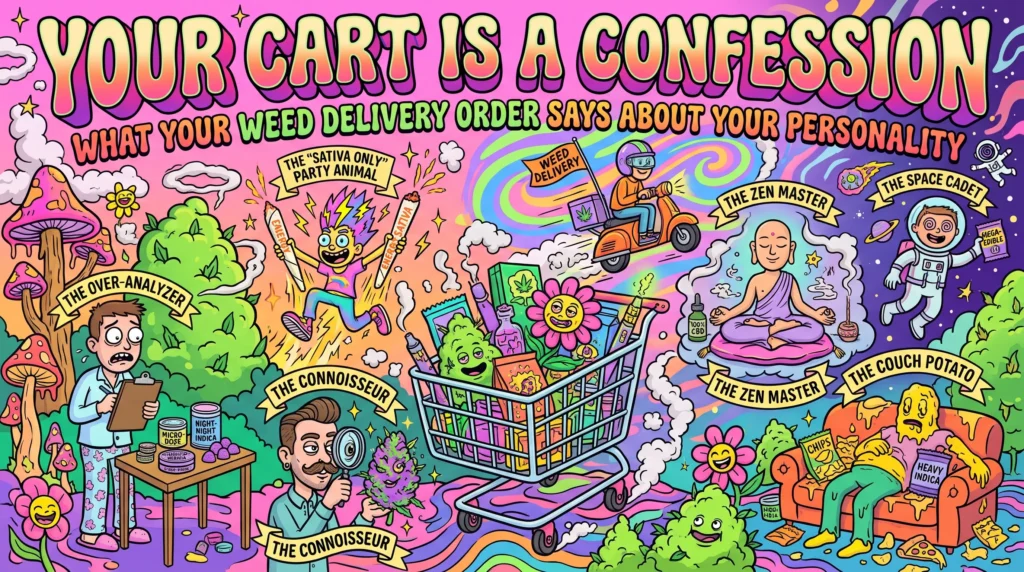
It’s 9:41 p.m. on a Thursday. Maya has three browser tabs open, a forgotten bowl of popcorn, and a delivery cart she has edited four times.
She removes the sativa pre-roll. She adds it back. She removes it again. Then, as she has done for the last eleven orders, she adds two packs of the same 1:1 gummies, from the same brand, with the same 5 mg dose. They are to be delivered to the same side door, with the same note: “Please don’t ring the bell. There’s a dog.”
Twenty minutes away, her friend Dre is doing the opposite. New brand. New terpene profile: He cannot pronounce or research something called Blue Alien Milk. His cart looks like a scavenger hunt.
Same store. Same delivery window. Two completely different nervous systems.
Here’s something nobody tells you: A cannabis delivery order is one of the most honest documents you’ll produce all week. Nobody’s watching. There’s no social performance in front of a checkout screen. You’re just a person alone deciding what kind of evening you want and how much risk you’re willing to take to get it.
By the end of this article, you’ll be able to identify your ordering archetype from six options, understand what your choice of format says about your relationship with time and control, learn why strain names are a poor personality test and terpenes are a better one, and perform a 30-day cart audit that most people find uncomfortable.
🔥REFER A FRIEND
THEY GET 10% OFF THEIR FIRST ORDER🔥
Reality Check: This is pattern-spotting, not psychometrics. There is no peer-reviewed “Weed Cart Personality Inventory,” and anyone selling you one is selling vibes. The Big Five personality model is real science. Reading your gummy order is a funhouse mirror built on top of it — useful for self-reflection, useless for diagnosis. Legal markets only, adults only, and nothing here is medical advice.
Can a Weed Delivery Order Actually Reveal Your Personality?
Partly — your order reflects genuine behavioral patterns, but it is not a validated personality assessment, and treating it like one is where the fun turns into bad science.
Psychologists have a term for the traces we leave behind: behavioral residue. Researcher Sam Gosling’s work on bedrooms and offices found that strangers could estimate an occupant’s personality from their space at better-than-chance accuracy. Not because a messy desk “means” laziness, but because repeated small choices accumulate into a signature.
Your order history is that desk. It’s timestamped, itemized, and unpaid-for-by-anyone-else.
Economists call the same idea revealed preference: what you actually choose under real constraints beats what you say you prefer on a survey. You might describe yourself as adventurous. Your last nine orders say otherwise.
What the research does and doesn’t support
Personality studies have repeatedly found modest group-level associations between cannabis use and higher openness to experience, with some samples showing slightly lower conscientiousness. Note the two words doing all the work: modest and group. Those findings describe averages across populations. They cannot predict you, and correlation isn’t causation — openness might drive curiosity about cannabis, or cannabis-using social circles might reward openness, or a third factor drives both.
So the honest framing is this: your cart doesn’t reveal your personality; it reveals your habits, and habits are personality wearing comfortable shoes.
Expert Insight: The most diagnostic field in your order history isn’t the product. It’s the variance. Behavioral scientists care less about a single choice than about the spread across many. One adventurous order is a mood. Eleven identical orders is a trait.
The Six Cart Archetypes: Which One Are You?
Most delivery customers repeat one of six ordering patterns, and you can usually identify yours in under thirty seconds by scrolling your last five orders.
| Archetype | Signature Order | Trait Signal (Tentative) | Blind Spot |
|---|---|---|---|
| The Creature of Habit | Same SKU, same dose, reordered 8+ times | High routine preference, low novelty-seeking | Confuses “reliable” with “still working” — tolerance creeps |
| The Curator | Three new products, different terpene profiles | High openness, enjoys comparison | Novelty chasing; never learns what actually works |
| The Optimizer | Sorts by mg-per-dollar, screenshots COAs | Analytical, high conscientiousness | Optimizes a number (THC %) that isn’t the experience |
| The Functional Minimalist | CBD-dominant or 1:1, low dose, weekday order | Control-oriented, outcome-focused | Can under-dose into “did I even take anything?” |
| The Social Host | Multipacks, drinks, pre-roll 10-packs, Friday 6 p.m. | High extraversion, plans for others | Buys for a group that shows up as three people |
| The Impulse Sprinter | Whatever’s fastest, 11 minutes before cutoff | Present-focused, low friction tolerance | Repeat “why did I buy this again” mornings |
Notice something? None of these are insults. The Creature of Habit has never had a bad surprise. The Curator can actually describe flavor. The Optimizer knows their cost per milligram, which is more financial literacy than most people apply to their phone plan.
Most people are hybrids: an Optimizer about price and an Impulse Sprinter about timing. That combination — careful with money, careless with the clock — is weirdly common.
What Your Format Choice Says About You
Format choice reveals how you relate to time, control, and other people, because each delivery format imposes a different delay between decision and consequence.
That’s the whole psychological engine here. Inhalation is instant feedback. Edibles are a two-hour trust exercise. Choose your own adventure in delayed gratification.
| Format | Typical Onset | Typical Duration | What the Choice Often Signals |
|---|---|---|---|
| Flower / pre-rolls | Seconds to minutes | ~2–4 hours | Ritual-lover, process-oriented, sensory |
| Vape cart | Seconds to minutes | ~2–4 hours | Efficiency-first, discretion-driven |
| Edibles / gummies | 30 min – 2 hours | ~6–8 hours, sometimes longer | Planner, comfortable with delayed payoff |
| Cannabis drinks | ~10–30 min (varies by product) | Varies widely | Social, replacing a ritual rather than adding one |
| Tinctures (sublingual) | ~15–45 min | ~4–6 hours | Precision-minded, dose-titrating |
| Concentrates | Near-immediate | ~2–4 hours | Intensity-seeking, high tolerance |
Onset and duration ranges are general public-health guidance, not guarantees. Body weight, stomach contents, tolerance and product formulation all shift them.
The flower person: you like the doing, not just the done
Grinding, rolling, the smell on your fingers — you’re buying a process. People who consistently order loose flower over convenience formats tend to enjoy rituals in other domains too: pour-over coffee, vinyl, cast iron pans they refuse to put in the dishwasher.
The gummy person: you signed a contract with the future
You accepted a delay. You planned around it. That’s a genuinely different psychological move than hitting a vape and finding out immediately.
The failure mode is famous, and it deserves blunt language: the second gummy at minute 45 is the most expensive mistake in cannabis. Onset for edibles commonly runs 30 minutes to two hours, and effects can last six to eight hours or more. Redosing because “nothing’s happening” is how a pleasant Friday becomes a story you tell for years.
The 1:1 and CBD person: you’re negotiating, not escaping
Balanced-ratio buyers are usually chasing a function — sleep, a quieter nervous system, a Sunday afternoon that doesn’t feel like static. They read labels. They ask about milligrams. They are, in my experience reading order patterns, the group most likely to keep notes.
The concentrate person: check your tolerance, honestly
High-potency formats aren’t a character flaw. But if a 20% flower product stopped registering months ago, that’s not a personality trait — that’s pharmacology, and it’s worth a deliberate reset conversation with a clinician if you’re using cannabis for a health reason.
Pro Tip: Buy the format that matches your evening, not your identity. If you have somewhere to be in three hours, an edible is a scheduling error dressed up as a preference.
Why Terpenes Tell More Than Strain Names
Strain names are marketing labels; terpenes and cannabinoid ratios are the chemistry that actually shapes your experience — and the indica/sativa personality binary is the least reliable part of your entire order.
Here’s the uncomfortable industry truth. Genetic and chemical testing has repeatedly shown that products sold under the same strain name can differ meaningfully between growers and batches, and that “indica” and “sativa” labels correlate poorly with measured chemistry. Botanically, those terms describe plant lineage and morphology — not a guaranteed effect. Two jars labeled the same can be different experiences.
Chemovar is the more useful concept: the actual cannabinoid-and-terpene fingerprint of what’s in the bag.
The terpene cheat sheet worth screenshotting
- Myrcene — earthy, musky, mango-adjacent. The most common dominant terpene in retail cannabis.
- Limonene — citrus peel. Frequently associated with brighter, more upbeat reports.
- Linalool — lavender, floral. Common in products marketed for evening use.
- β-Caryophyllene — black pepper, spice. Unusual in that it interacts with CB2 receptors.
- α-Pinene — pine needles, sharp and clean.
- Terpinolene — herbal, apple-like, often described as “busy” or heady.
🔥 Stack your savings. Elevate your session. 10% off $100, up to 25% off $450.
🔥 Roll into the menu and start saving. CLICK HERE!
Now the necessary honesty: terpene effects at real-world doses are still debated. The entourage effect — the idea that terpenes meaningfully modulate cannabinoid effects — is a live scientific argument, not settled fact. Ethan Russo’s influential 2011 work in the British Journal of Pharmacology laid out the hypothesis; later reviews have questioned how much terpenes contribute at the concentrations people actually consume.
So don’t build a religion out of myrcene. Use terpenes as a repeatable vocabulary for your own experience, not as a pharmacological promise.
Reality Check: Multiple lab audits have found labeled THC potency running higher than measured potency in retail samples. If your ordering identity is “I only buy 30%+,” you may be optimizing for a number that was rounded in your favor. Ask for the certificate of analysis (COA) and read the batch date.
Which reframes the personality read entirely. The person who orders “the strongest indica you have” isn’t revealing a deep truth about their soul. They’re revealing that they trust a marketing taxonomy built in the 1980s. The person who orders “terpinolene-dominant, 12% THC, 4% CBD” is revealing they’ve stopped trusting it.
The Ordering Habits That Give You Away
Your logistics reveal more than your products do, because logistics are choices you make when you think nobody’s evaluating you.
The timestamp
A Tuesday 10 a.m. order and a Saturday 11:52 p.m. order are different psychological events. Daytime, early-week ordering usually indicates planned integration — cannabis has a slot in the week. Late-night, minutes-before-cutoff ordering indicates reactive relief — the day happened to you, and you’re responding.
Neither is a verdict. But if every single order lives in the last eleven minutes before closing, that’s a pattern worth noticing without judgment.
The cart size
One item is a decision. Six items is a hedge. Large, varied carts often belong to people who genuinely dislike being caught without options — the same instinct that produces three phone chargers in a bag.
The delivery note
This is my favorite field in the whole checkout flow. “Leave at side gate, text don’t knock, dog barks” is a person who has thought about consequences. No note at all, then a missed delivery, then a support ticket? Different relationship with friction.
The tip
Tipping a cannabis delivery driver well when nobody’s watching is one of the cleaner real-world proxies for agreeableness you’ll find in a checkout screen. Drivers in legal markets are checking IDs, handling regulated product, and navigating apartment buildings that were designed by someone who hated visitors.
The reorder button
The reorder button is the most honest feature in the app. It removes decision-making entirely. If you’ve used it eight consecutive times, you’ve told me more about yourself than any strain review ever could.
A 30-Day Cart Audit: The Case Study That Changes How People Order
A 30-day cart audit is the fastest way to see your actual pattern instead of your imagined one — and it takes about four minutes of setup.
Here’s a composite example — assembled from the kind of pattern that shows up again and again when people log their orders, not a single named client.
“R.” described himself as an explorer. New strains, new brands, always curious. Then he exported ninety days of order history. Out of fourteen orders, eleven were the same 20 mg THC vape cart from one brand. The three “adventures” were all pre-rolls bought on Fridays, all sativa-labeled, all followed by a Monday message to a friend along the lines of that one did nothing.
His self-image was Curator. His data said Creature of Habit with a weekend impulse leak.
The fix wasn’t dramatic. He kept the vape (it worked), stopped buying novelty pre-rolls on Fridays, and started one deliberate experiment per month with a logged terpene profile. His spend dropped roughly a fifth. His satisfaction went up. The identity mismatch was the expensive part.
Run your own audit — six steps
- Export or screenshot your last 90 days. Most licensed retailer accounts show full order history. No app? Scroll your email confirmations.
- Log five fields per order: date/time, product, format, THC:CBD ratio, dominant terpene if listed.
- Add one subjective column: rated the experience 1–5 the next day, not the same night. Same-night ratings are unreliable and you know why.
- Calculate your repeat rate. Identical SKUs ÷ total orders. Above 70%? You’re a Habit archetype regardless of what you tell people.
- Find your timestamp cluster. Are your orders planned or reactive? Circle the honest answer.
- Change exactly one variable next order. Format, ratio, or terpene — never all three, or you learn nothing.
Pro Tip: Keep the log in the same app where you keep notes about anything else. Cannabis journals die when they live in a dedicated tool you open twice. A single line in your existing notes app survives.
How to Order Smarter on Your Next Delivery
Ordering smarter means verifying the source, reading the dose correctly, and respecting the delay — in that order.
- Confirm the retailer is licensed. Check your state or provincial regulator’s list. Unlicensed delivery operations have no testing requirements and no accountability.
- Read mg per serving and mg per package. Many U.S. adult-use markets cap edibles at 10 mg THC per serving and 100 mg per package; Canada caps edible packages at 10 mg THC total. A “100 mg” chocolate bar is ten doses, not one.
- Start low if you’re new. 2.5 mg THC or less is a common starting point for edibles, with plenty of patience before considering more.
- Ask for the COA and batch date. Potency, terpene profile, contaminant screening.
- Don’t drive. Canadian lower-risk-use guidance suggests waiting at least six hours after inhaling and eight hours after oral consumption — longer if you still feel any effect.
- Don’t mix with alcohol, especially as a beginner. The combination amplifies impairment unpredictably.
- Store locked, labeled, and out of reach of kids and pets. Gummies look like candy because they are shaped like candy.
- Have ID ready at the door. Age verification isn’t optional, and “leave it on the porch” isn’t a workaround.
- Never cross borders with it. Not state-to-state where prohibited, not internationally, not in the mail.
🔥REFER A FRIEND
THEY GET 10% OFF THEIR FIRST ORDER🔥
Your Cart Is a Mirror, Not a Verdict
Maya’s eleven identical gummy orders don’t make her boring. They make her someone who found a thing that works and stopped auditioning alternatives — which is, depending on the day, either wisdom or a mild rut.
Dre’s Blue Alien Milk doesn’t make him interesting. It makes him someone who’d rather be surprised than satisfied.
Three takeaways worth keeping:
- Variance beats content. How much your orders differ tells more than what’s in them.
- Format is a time contract. Edibles ask for patience; inhalation asks for presence. Choose for the evening you’re actually having.
- Terpenes and ratios beat strain names. One is chemistry you can verify. The other is a name someone chose in a marketing meeting.
Your next step: open your order history right now, count your last five orders, and name your archetype out loud. Then run the 30-day audit and change one variable — just one.
And if you’re the person who tips well, writes a clear delivery note, and still can’t resist one weird new terpene profile a month? You’ve probably already figured out the best version of this: reliable enough to enjoy your evening, curious enough to keep learning something.
For adults 21+ in legal U.S. markets and 19+ in most Canadian provinces (18+ Alberta, 21+ Quebec). Cannabis laws vary by jurisdiction — verify local rules before ordering. This article is for information and entertainment, not medical advice. Talk to a licensed clinician about health-related cannabis use.
The Bottom Line
Your weed delivery order is not a diagnosis. It’s a data point. It tells you something about how you seek pleasure, manage stress, and relate to uncertainty—and it does so with a candor that a personality quiz could only dream of.
The Sativa Seeker wants to move. The Indica Loyalist wants to land. The Hybrid Hedger wants to keep their options open. The Strain Chaser wants to understand. The Edible Strategist wants to control. The Late-Night Orderer wants to soften the edges. The Routine Reorderer wants to trust themselves.
None of these are wrong. All of them are human.
So the next time you open that app and stare at the menu for eleven minutes, ask yourself a different question: What am I actually ordering? The answer might surprise you.
Next step: Pull up your order history. Find your archetype. Then decide which part of it is serving you—and which part is just a habit wearing a disguise.
🔥 Stack your savings. Elevate your session. 10% off $100, up to 25% off $450.
🔥 Roll into the menu and start saving. CLICK HERE!
FAQ Section
Does ordering indica mean I’m a lazy person? No. Indica and sativa are botanical and marketing labels that correlate poorly with measured chemistry or effects. Genetic testing shows inconsistent chemistry under identical strain names. Shop by cannabinoid ratio and terpene profile instead, and ignore personality stereotypes attached to either label.
What does reordering the same product every time say about me? It signals a strong routine preference and low novelty-seeking — not a lack of curiosity. A repeat rate above 70% across your last ten orders suggests you value predictable outcomes. The main risk is tolerance creep, where the same dose gradually delivers less.
Is my weed delivery order history private? Partly. Licensed retailers store your order history under their own privacy policies, and recreational purchases aren’t medical records, so HIPAA generally doesn’t apply. Packaging is typically discreet and ID is checked at the door. Read the retailer’s data policy before assuming anonymity.
Is personality actually linked to cannabis use? Research shows modest group-level associations between cannabis use and higher openness to experience, with some studies finding slightly lower conscientiousness. Effect sizes are small and inconsistent, and correlation isn’t causation. These population averages cannot reliably predict any individual person’s traits.
What’s the safest first order from a licensed cannabis delivery service? Start with a low-dose option — 2.5 mg THC or less, or a CBD-dominant product — from a state- or province-licensed retailer. Verify the COA, read mg per serving, wait at least two hours before considering more, and don’t drive.